How to Start a Canadian Corporation as a US Citizen

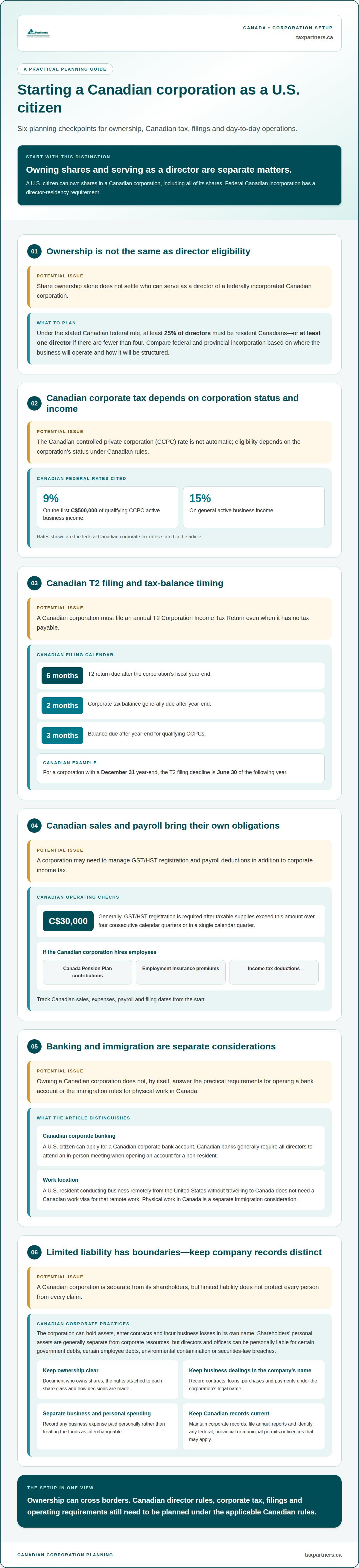
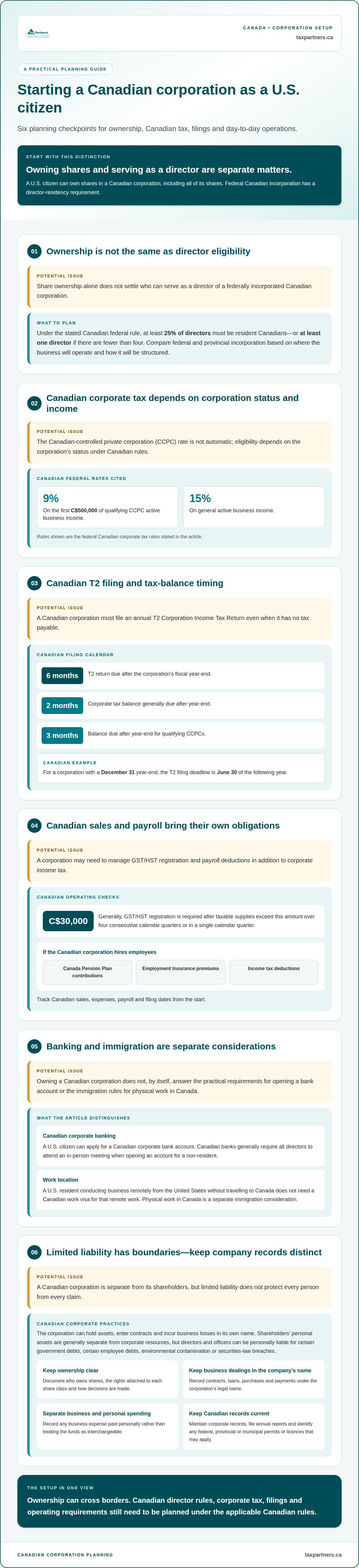
Yes, a US citizen can own a corporation in Canada. Owning shares and serving as a director are separate matters: for a federally incorporated Canadian corporation, at least 25% of directors must be resident Canadians, or at least one director if the corporation has fewer than four, according to Corporations Canada.
A US citizen can own a corporation in Canada, including all of its shares. Incorporation still involves decisions about directors, liability and cross-border tax obligations, so the right structure depends on where the business operates and how it is managed.
This guide explains how a US citizen can start a Canadian business, compare federal and provincial incorporation, and understand the limits of corporate liability. It also covers Canadian tax and compliance considerations to help you plan the setup.
Key Takeaways
- A US citizen can own shares in a Canadian corporation; ownership and eligibility to serve as a director are separate considerations.
- Compare federal and provincial incorporation based on where the business will operate and how you plan to structure it.
- A corporation can help separate business liabilities from shareholders’ personal assets, but it does not remove every potential personal liability.
- Plan for Canadian corporate tax and cross-border reporting obligations when choosing how the Canadian and US businesses will relate.
- According to the Canada Revenue Agency, the federal Canadian corporate tax rate is 9% on the first C$500,000 of qualifying CCPC active business income.
Can a US citizen start a business in Canada?
- Choose a Canadian business structure. A US citizen can start a business in Canada by incorporating a Canadian corporation and holding its shares. Decide how the company will operate, who will manage it, and where it will keep its records. Incorporation creates a Canadian business, but it does not automatically settle immigration status or the corporation’s Canadian tax responsibilities.
- Understand the Canadian corporate tax rates. A Canadian-controlled private corporation (CCPC) is a private corporation that meets Canadian ownership and control conditions. According to the Canada Revenue Agency, the federal Canadian corporate tax rate is 9% on the first C$500,000 of qualifying CCPC active business income. The federal Canadian corporate tax rate on general active business income is 15%, according to the Canada Revenue Agency. A corporation’s eligibility for the CCPC rate depends on its status under Canadian rules.
- Plan for the Canadian T2 filing. Every Canadian corporation must file a T2 Corporation Income Tax Return annually, even if it has no tax payable. The return is due six months after the end of the corporation’s fiscal year. For a Canadian corporation with a December 31 year-end, the filing deadline is June 30 of the following year. The corporate tax balance is generally due two months after year-end, or three months after year-end for qualifying CCPCs.
- Track Canadian sales and payroll obligations. Under Canada Revenue Agency rules, a business generally must register for GST/HST after taxable supplies exceed C$30,000 over four consecutive calendar quarters or in a single calendar quarter. If the corporation hires employees in Canada, it must handle Canada Pension Plan contributions, Employment Insurance premiums, and income tax deductions. Set up bookkeeping to track sales, expenses, payroll, and filing dates from the start.
- Arrange banking and consider immigration separately. A US citizen can apply to open a Canadian corporate bank account; Canadian banks generally require all directors to attend an in-person meeting when opening an account for a non-resident. A US resident conducting the business from the United States without travelling to Canada does not need a Canadian work visa for that remote work. Physical work in Canada involves a separate immigration consideration from owning shares.
- Organize the company’s Canadian operating requirements. Identify the federal, provincial, and municipal permits or licences that may apply to the business’s industry. Canadian corporations must maintain records and file annual reports, while employers must follow Canadian labour requirements. For help organizing Canadian corporate tax and filing responsibilities, explore Canadian tax services.
Corporations and limited liability
- Separate company property from personal property. A Canadian corporation is a legal entity distinct from its shareholders. It can hold assets, enter contracts, and incur business losses in its own name. If the corporation cannot meet a business obligation, the loss generally falls on its resources rather than automatically transferring to a shareholder’s personal assets. Keep business funds, contracts, and records in the corporation’s name to reinforce that separation.
- Define ownership through shares. A corporation can issue shares, giving its owners a structured way to hold interests and set out how ownership is divided. Before issuing shares, document who owns them, what rights attach to each class, and how decisions will be made. For example, a founder and an investor may hold different share classes, but the company’s governing documents should clearly set out their respective rights.
- Distinguish shareholder protection from director duties. Limited liability does not mean every person involved is protected from every claim. Directors and officers can be personally liable for certain government debts, certain employee debts, environmental contamination, or securities-law breaches. Before accepting a director role, understand the responsibilities attached to it and keep corporate decisions, approvals, and supporting records organized.
- Track obligations at the company level. Record each contract, loan, purchase, and payment under the corporation’s legal name. If a shareholder pays a business expense personally, record it accurately rather than treating company and personal spending as interchangeable. Separate bookkeeping also helps identify business deductions for the corporation’s tax reporting; a deduction does not remove personal liability where a director or officer is responsible for a specific obligation.
- Review the structure as the business changes. A corporation’s ownership and management arrangements should reflect how the business actually operates in its province. Revisit share ownership when adding an investor, transferring shares, or changing who manages the company. Keep corporate records current, and document significant decisions so that shareholders and directors can show which actions they took for the corporation.
Corporate protection works best when ownership records, accounting, and decision-making stay aligned. If you’re weighing shareholder and director responsibilities for a Canadian business, you can discuss your corporate structure.
Limited liability is a key consideration when choosing a corporate structure. Generally, a corporation is responsible for its own debts, and shareholders’ personal assets are separate from the corporation’s resources. However, limited liability has exceptions, and it does not make ownership arrangements unimportant: share allocation determines who owns an interest in the corporation.
Consider how much flexibility the business needs in ownership and management as it develops. A Canadian corporation can issue shares and offers flexibility in both areas, so its structure can be considered in light of the people involved and how the business will be managed. Make those choices deliberately, and keep the intended ownership and management arrangement clear. The aim is to use the corporation’s separate identity consistently, while ensuring its share structure and management fit the business. A clear structure helps owners understand their place in the corporation and supports a practical distinction between the corporation’s resources and shareholders’ personal assets.
Canada-U.S. tax considerations
- Map the corporation’s Canadian activities. List where the business earns income, performs services, and carries out projects in Canada. These details help identify which Canadian tax rules may apply to its operations. Keep contracts, invoices, work schedules, and payment records together. For example, a service agreement should show the work location and project scope, while supporting records should show when the work took place.
- Assess whether Canadian activity creates a permanent establishment. Under the Canada-US tax treaty, a Canadian construction or installation project lasting more than 12 months generally creates a permanent establishment. Performing services in Canada for more than 183 days in any 12-month period for the same or connected project generally creates one under Article V(9). Track project dates, related contracts, and service days to assess the Canadian tax implications.
- Review payments for services performed in Canada. Canada generally withholds 15% under Regulation 105 on payments to non-residents performing services in Canada. Identify whether a payment relates to services carried out in Canada, and preserve the contract, invoice, and proof of payment. For a Canadian business engaging a non-resident service provider, this is a Canadian withholding consideration distinct from the corporation’s own income tax filing.
- Separate the corporation’s transactions from shareholder activity. Record payments, loans, and distributions according to their actual purpose, and keep the supporting agreements with the company’s accounting records. A payment for contracted work, a dividend, and interest are different transaction types under Canadian tax analysis. Clear documentation helps show what the corporation paid, who received it, and why, rather than leaving its treatment to assumptions at year-end.
- Build a Canadian review process around each project. Before work begins, note the location, service dates, contract relationship, and payment route. During the project, update those records as the scope or schedule changes. At completion, reconcile invoices and payments against the work performed in Canada. This process helps identify potential Canadian withholding and permanent-establishment issues early, while giving the corporation an organized record for its Canadian tax review.
Add a separate U.S. ownership review to the corporation’s cross-border records. A U.S. person’s ownership of more than 50% of a foreign corporation’s vote or value establishes Controlled Foreign Corporation status. Keep ownership information clear enough to assess voting rights and value, and revisit it when the corporation’s ownership arrangements change.
For U.S. citizens, review foreign financial accounts separately from the company’s Canadian project records. They must file an FBAR if their aggregate foreign financial accounts exceed $10,000 at any point during the year. An organized account inventory helps assess whether this filing threshold is met.
Also classify shareholder payments before applying treaty withholding. Under the Canada-US treaty, dividends paid to corporate shareholders owning at least 10% are subject to 5% withholding. The treaty generally provides a 0% withholding rate on arm's-length interest. Distinguishing dividends from interest in agreements, accounting records, and payment documentation helps support the appropriate treatment of each cross-border payment.
Canadian and US corporate structures
- Choose where to incorporate. Federal incorporation allows a Canadian business to operate across Canada under one business name. Provincial incorporation is tied to a specific province, though a company may operate elsewhere. For a US citizen building a Canadian operation, compare the intended operating footprint, name strategy, and director plans before selecting the jurisdiction. A company does not have to incorporate separately in every province where it conducts business, so map its planned activity before choosing.
- Check director requirements before filing. A federally incorporated Canadian corporation ordinarily must have at least 25% resident Canadian directors, or at least one resident Canadian director if it has fewer than four directors, according to Corporations Canada. Provincial rules can differ: British Columbia does not require Canadian-resident directors for corporations incorporated there. Therefore, a Canadian corporation’s director requirements depend on its place of incorporation, not simply the shareholder’s US citizenship.
- Plan for registration where the company operates. Federal incorporation does not remove provincial registration duties. A federally incorporated business in Canada must register in each province where it operates. A US corporation doing business in Canada may also need extra-provincial registration in each province where it has sufficient presence. Map the company’s locations and activities, then identify where registration applies before beginning operations.
- Arrange a registered office and corporate records. A Canadian corporation must have a registered office in the jurisdiction where it is incorporated. Select an address that can receive official corporate communications, and keep the corporation’s records organized there or in accordance with its recordkeeping arrangements. Federal and provincial incorporation both require attention to the correct jurisdiction. Add annual reports and corporate record maintenance to the company’s compliance calendar.
- Document how the Canadian and US entities relate. If a US parent company will own a Canadian subsidiary, record the ownership chain and the role of each entity. A written agreement can clarify responsibilities, decision-making, and how the entities will handle transactions between them. Keep contracts and accounting records consistent with the actual arrangement. If the Canadian corporation will operate independently, document its ownership and management structure separately from any US business.
- Match the structure to the operating plan. Before filing, list the provinces where the business expects to operate, whether a US company already exists, and who will serve as directors. Then compare federal and provincial incorporation against those facts. This sequence helps identify director and registration considerations early, rather than treating the Canadian corporation and any US parent as interchangeable legal entities.
What are the federal and provincial rules for non-residents incorporating a corporation in Canada?
- Choose the jurisdiction based on your operating plans. Federal incorporation lets a Canadian business operate across Canada under one business name. Provincial incorporation is limited to its province of incorporation, so consider where the company will conduct business before choosing its legal home.
- Plan for federal director requirements. A federally incorporated Canadian corporation ordinarily must have at least 25% resident Canadian directors, or at least one resident Canadian director if it has fewer than four directors, according to Corporations Canada. A US citizen may own shares, but must account for this director rule when selecting the federal structure.
- Compare provincial director rules. Director requirements differ by jurisdiction. British Columbia does not require Canadian-resident directors for corporations incorporated there. If the owner wants to serve as a director, compare the rules in the intended province before filing, rather than assuming federal and provincial requirements are identical.
- Secure a registered office in the incorporation jurisdiction. A Canadian corporation must have a registered office in the jurisdiction where it is incorporated. Select the jurisdiction first, then arrange an office address there for corporate records and official communications. This requirement applies even when the shareholders live outside Canada.
- Identify every province where the company will operate. A corporation doesn’t have to incorporate in every province where it conducts business. However, a federally incorporated business must register in each province where it operates, and a US corporation doing business in Canada may need extra-provincial registration in each province where it has sufficient presence.
- Check local-agent rules for extra-provincial registration. Where an extra-provincial registration requires a local agent, the agent must be at least 18 years old or be a registered corporation in that province. Include the agent requirement in the registration plan, alongside the registered office and any provincial filings.
- Build ongoing filings into the corporate calendar. Incorporation is only the initial filing. Canadian corporations must maintain records and file annual reports, so assign responsibility for tracking these duties and keeping corporate information current. A clear calendar helps owners distinguish incorporation tasks from continuing obligations.
For help coordinating Canadian corporate filings with the company’s structure, discuss your incorporation and filing needs.
Tax Partners: Canadian Accounting & Tax Services
Tax Partners provides Canadian corporate accounting and tax services alongside support for cross-border considerations that come with US ownership. Its Canadian Accounting & Tax Services and US & Cross-Border Accounting & Tax Services can help with incorporation planning, corporate filings and understanding how the Canadian company fits with your US tax obligations.
As the business begins operating, Bookkeeping and Payroll Services can help keep records organized and manage Canadian payroll. This support helps track company transactions and prepare for recurring reporting responsibilities. Wealth Management & Financial Planning can address broader financial planning needs.
For support with your Canadian corporation’s accounting and cross-border tax planning, contact Tax Partners.
Build your Canadian business with a clear plan
Knowing that a US citizen can own a corporation in Canada is only the starting point. Before filing, clarify your ownership plan, operating model and approach to cross-border business records. Clear decisions can make it easier to manage the company as it grows or changes.
In your planning, consider how the Canadian corporation will work alongside any existing US business, who will manage its finances and how you’ll keep its records current. Coordinating accounting, tax, bookkeeping and payroll decisions can help you manage these responsibilities as part of one operating plan.
Tax Partners can help you consider the financial and accounting work involved in that plan. Discuss your cross-border business plans with Tax Partners and take a confident next step.
Frequently Asked Questions
Can a US citizen own 100% of a Canadian corporation?
Yes, a US citizen can own all the shares in a Canadian corporation. Share ownership and director eligibility are separate matters: federal incorporation has Canadian-resident director requirements, while some provincial rules differ. Keep the corporation’s share register and ownership records accurate, especially when shares are issued or transferred. These records document ownership and support the corporation’s administration.
What Canadian tax obligations apply to a corporation owned by a US citizen?
A Canadian corporation must meet tax obligations based on its activities and circumstances. These may include reporting corporate income, registering for GST/HST when required and handling Canadian payroll deductions if it employs staff. For example, a corporation selling taxable goods or services should track sales and filing records to determine when registration and collection responsibilities apply.
How does owning a Canadian corporation affect a US citizen's US tax and reporting obligations?
This article focuses on Canadian requirements, not US personal tax or reporting rules. A shareholder’s US citizenship does not replace the corporation’s Canadian filing and recordkeeping responsibilities. Keep corporate accounts, ownership records and transaction documents organized so Canadian reporting reflects the company’s actual business activity.
What liability, compliance, and cross-border tax risks should US owners consider?
Consider both the corporation’s operating obligations and the responsibilities attached to a director or officer role. Canadian directors and officers may face personal liability for certain government or employee debts, environmental contamination or securities-law breaches. Maintain clear contracts, corporate records and approval documentation, and track where the company performs work. These practices support compliance and help distinguish corporate decisions from personal actions.

Article by
Mahad Mohamed
Mahad Mohamed is an accountant and the CEO of Tax Partners, with over 26+ years of Canadian and international tax and accounting experience. His expertise includes corporate reorganization, cross-border tax structuring (Canada & US), tax disputes, CRA audits, and tax planning for small owner-managed private corporations. Most recently, Mahad is a pioneer in Canadian crypto taxation and founded Block3 Finance.
Previously, Mahad worked for the Canada Revenue Agency (CRA), Big4 accounting firms, and served as a Rulings Officer for the Federal Tax Authority of the UAE before acquiring Tax Partners in 2014.
Tax Partners has 44 full-time accountants and over 18,400+ clients.
Disclaimer
This article provides general information only and is current as of its publication date. It has not been updated and may be out of date. It does not constitute legal advice and should not be relied upon as such. Every tax situation is unique and may differ from the examples discussed in this article. If you have specific questions, you should seek the advice of our accountants for your unique circumstances. Book a FREE Initial Consultation Today!
Frequently Asked Questions
Can a US citizen own 100% of a Canadian corporation?
Yes, a US citizen can own all the shares in a Canadian corporation. Share ownership and director eligibility are separate matters: federal incorporation has Canadian-resident director requirements, while some provincial rules differ. Keep the corporation’s share register and ownership records accurate, especially when shares are issued or transferred. These records document ownership and support the corporation’s administration.
What Canadian tax obligations apply to a corporation owned by a US citizen?
A Canadian corporation must meet tax obligations based on its activities and circumstances. These may include reporting corporate income, registering for GST/HST when required and handling Canadian payroll deductions if it employs staff. For example, a corporation selling taxable goods or services should track sales and filing records to determine when registration and collection responsibilities apply.
How does owning a Canadian corporation affect a US citizen's US tax and reporting obligations?
This article focuses on Canadian requirements, not US personal tax or reporting rules. A shareholder’s US citizenship does not replace the corporation’s Canadian filing and recordkeeping responsibilities. Keep corporate accounts, ownership records and transaction documents organized so Canadian reporting reflects the company’s actual business activity.
What liability, compliance, and cross-border tax risks should US owners consider?
Consider both the corporation’s operating obligations and the responsibilities attached to a director or officer role. Canadian directors and officers may face personal liability for certain government or employee debts, environmental contamination or securities-law breaches. Maintain clear contracts, corporate records and approval documentation, and track where the company performs work. These practices support compliance and help distinguish corporate decisions from personal actions.