Estimated tax payments for self-employed Canadians: how much to set aside

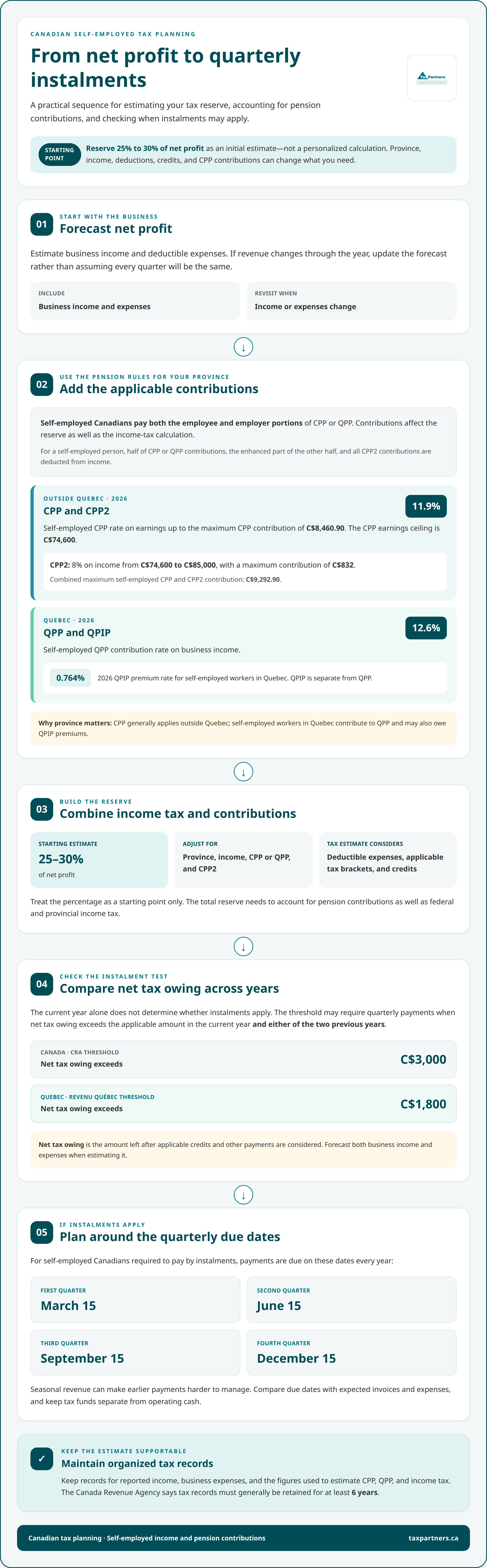
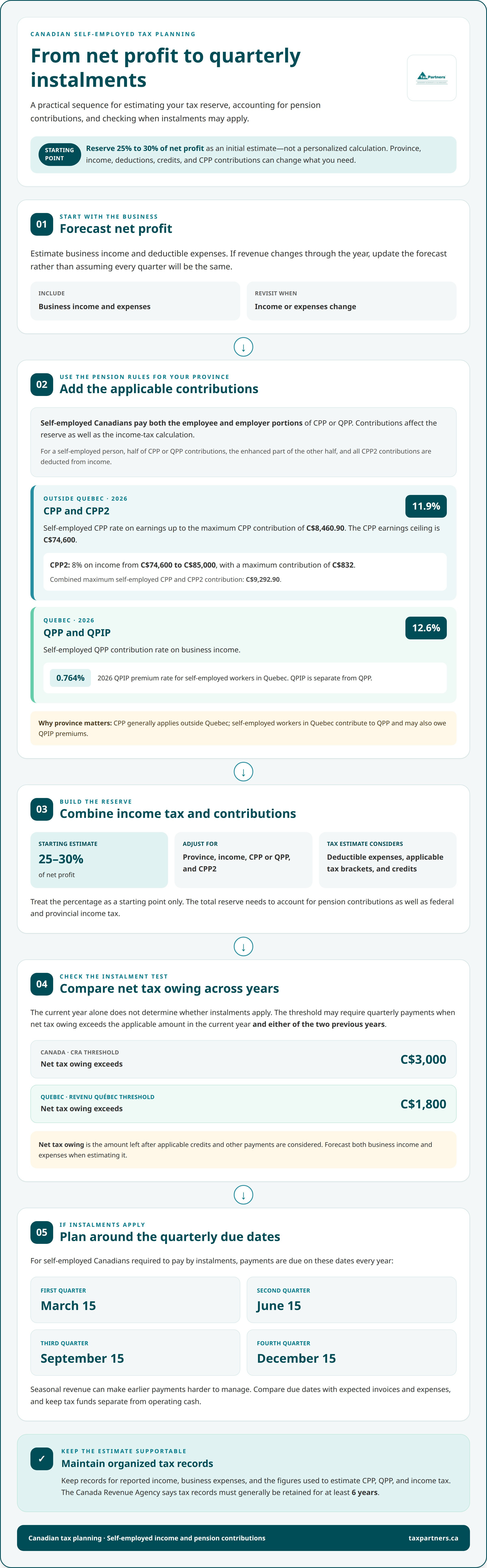
Your tax set-aside needs to cover more than income tax. A useful starting point for estimated tax payments for self-employed Canadians is 25% to 30% of net profit, with room to adjust for your province, income and Canada Pension Plan (CPP) contributions. The second additional CPP contribution (CPP2) can also affect the total, so a simple percentage is a starting point, not a personalized estimate.
If you’re unsure how much to reserve, that’s understandable: self-employed income can change, and tax isn’t usually deducted from client payments. The CRA and Revenu Québec may require quarterly instalments when net tax owing exceeds C$3,000, or C$1,800 in Quebec, in the current year and either of the two previous years.
This guide explains how a tax professional estimates income tax and CPP, how CPP and CPP2 affect your reserve, and when instalments apply. It also covers the Canadian filing and payment deadlines, so you can plan cash flow with a clearer view of what may be due and when.
Key Takeaways
- Build your tax reserve around net business profit, provincial tax, eligible deductions and credits, and CPP contributions rather than relying on one flat estimate.
- Account for both portions of CPP as a self-employed person, and understand how deductible contributions affect your taxable income.
- Include CPP2 in your estimate when your earnings fall within its applicable range, as it can add to your total contributions.
- Assess instalment eligibility using your net tax owing across the current year and the relevant previous years, then plan for the quarterly due dates.
- Keep the payment deadline separate from the filing deadline, and maintain organized records to support your return and future estimates.
Self-employed CPP contributions and both halves
For self-employed Canadians, CPP contributions can form a substantial part of the annual tax reserve. In 2026, the combined rate and CPP2 rules determine how much applies to your earnings.
Both halves of CPP contributions
When you’re self-employed in Canada, you pay both the employee and employer portions of CPP contributions. As a result, your total CPP contributions may be higher than an employee’s payroll deduction.
CPP contributions also affect your income tax calculation. For a self-employed person, half of CPP or QPP contributions, the enhanced part of the other half, and all CPP2 contributions are deducted from income. This treatment matters when estimating taxable income and the reserve needed for both contributions and income tax.
CPP contribution rates and annual maximums
For 2026, the self-employed CPP contribution rate in Canada is 11.9% on earnings up to the maximum CPP contribution of C$8,460.90. The 2026 CPP earnings ceiling is C$74,600.
These figures help show why a single tax set-aside percentage may not fit every business owner. Earnings, the annual ceiling, and CPP2 contributions all affect the total. A tax estimate should account for CPP separately from federal and provincial income tax, rather than treating the full reserve as income tax alone.
CPP and QPP contributions
CPP generally applies outside Quebec, while self-employed workers in Quebec contribute to the Quebec Pension Plan (QPP). For 2026, the self-employed QPP contribution rate in Quebec is 12.6% of business income.
Quebec workers may also owe QPIP premiums, which are separate from QPP contributions. For 2026, the QPIP premium rate for self-employed workers in Quebec is 0.764%. These provincial contributions can change the amount to reserve, so a Quebec estimate should use the QPP and QPIP rules that apply there.
Additional CPP contributions
CPP2 is an additional contribution on earnings above the regular CPP earnings ceiling. In Canada, the 2026 CPP2 rate is 8% on income from C$74,600 to C$85,000, with a maximum contribution of C$832.
For 2026, the maximum self-employed CPP contribution is C$9,292.90 when the CPP and CPP2 maximums are combined. This ceiling is relevant when earnings reach the upper CPP2 range; lower earnings produce a different total. All CPP2 contributions are deducted from income when calculating tax.
Use the applicable year’s figures when estimating contributions, since ceilings and rates can change. For example, the 2026 CPP ceiling and CPP2 range affect a different tax year than the 2025 figures. A Canadian tax estimate can account for your business income and applicable pension contributions together.
Keep supporting records with your tax calculations. The Canada Revenue Agency says tax records must generally be retained for at least 6 years. Organized records help support reported income, business expenses, and the figures used to estimate CPP, QPP, and income tax.
Quarterly tax instalment eligibility and dates
Quarterly instalments spread personal income tax payments across the year instead of leaving the full balance until you file. Whether you need to pay instalments depends on your net tax owing, while the amount depends on projected business income and tax credits.
Instalment eligibility and thresholds
Canada’s instalment threshold determines when individuals may need to pay income tax before filing. According to the Canada Revenue Agency and Revenu Québec, a self-employed person may have to pay quarterly instalments when net tax owing exceeds C$3,000, or C$1,800 in Quebec, in the current year and either of the two previous years.
Net tax owing is the amount left after applicable credits and other payments are considered. If you’re a sole proprietor with fluctuating revenue, include both business income and expenses when forecasting that balance. The current year alone does not determine whether instalments apply; the previous two years also matter.
Quarterly instalment due dates
For self-employed Canadians required to pay by instalments, payments are due March 15, June 15, September 15, and December 15 every year. Each date falls within a different quarter, creating a recurring schedule for allocating cash toward tax.
Seasonal revenue can make quarterly payments harder to manage. If your business earns most of its income later in the year, plan ahead for earlier due dates. Mark each payment date against expected invoices and expenses, and set aside tax funds separately from operating cash.
How a Tax Professional Estimates Your Quarterly Tax Instalment Amounts
A tax professional can estimate instalments by projecting annual business income, deductible expenses, applicable tax brackets, and credits. This forecast helps estimate your tax balance and divide the required payments across the year.
For a sole proprietor, the estimate can reflect changing revenue rather than assuming every quarter will be the same. A professional can update the projection as income or expenses change, helping keep instalments aligned with the year’s results.
How a Tax Professional Can Help You Pay CRA Tax Instalments
A tax professional can calculate your instalments, organize the payment schedule, and explain how to submit payments to the CRA through online banking or a financial institution. Keep clear payment records so each transfer can be matched to the correct tax period.
If you miss or underpay an instalment, the outstanding amount may incur instalment interest. The CRA calculates interest based on the shortfall and how long it remains unpaid, so the total depends on both the amount and the timing.
For support aligning projected cash flow with tax payments, discuss instalment planning with a tax professional.
Self-employed tax filing and payment deadlines
For self-employed Canadians, the tax return filing deadline and the tax payment deadline are different. Plan for both so you can separate preparing your return from paying any balance owing.
Tax filing deadlines
For Canada, a self-employed person generally has until June 15 to file a personal income tax return if they or their spouse or common-law partner is self-employed. This later filing date gives more time to report business activity, but it doesn’t extend the deadline for paying tax owed.
Self-employed Canadians report business income on Form T2125 as part of their personal tax return. The form records business revenue and expenses used to calculate profit, which flows into the return and affects the income tax estimate. A Canadian resident should organize those records before filing, especially when income sources or expenses changed during the year.
A tax professional can prepare your return by reviewing business records and calculating income alongside applicable federal and provincial tax. A calculator can illustrate a projected amount, but the result depends on the information entered and your circumstances. Keep the filing deadline on your calendar even if you have paid instalments.
Tax payment deadlines
For self-employed Canadians, personal income tax owed is generally due April 30, even when the return can be filed by June 15. Paying by April 30 helps avoid interest on an unpaid balance, which starts accruing May 1.
Treat filing and payment as separate tasks. A sole proprietor who submits a return in June may still have had a balance due in April. Instalments paid during the year can reduce the balance, but the final amount depends on the tax calculation and payments already credited.
For a practical calendar, note the dates and what you need to do for each:
- April 30: Pay any personal income tax owing for the year.
- June 15: File the return when the self-employment filing extension applies.
These Canadian deadlines serve different purposes. A tax professional can coordinate your return, business profit calculation, and payment records so the filing reflects the year’s activity. If your income changes, an updated estimate can help you anticipate the balance rather than treating last year’s result as a fixed guide.
Keep payment confirmations with the records used to prepare your return. This makes it easier to reconcile payments with the final tax calculation and identify any remaining balance. An organized filing process also gives you a clearer starting point for planning the next Canadian tax year.
Self-employed CPP and CPP2 rates
For self-employed Canadians, CPP and CPP2 contributions can materially change the amount to reserve. The key distinction is between the regular CPP ceiling and the higher earnings range subject to CPP2.
In 2026, the self-employed CPP contribution rate in Canada is 11.9% on earnings within the applicable range. The regular CPP earnings ceiling is C$74,600, and the maximum regular contribution is C$8,460.90. These contributions are separate from federal and provincial income tax, so a tax estimate should account for them distinctly.
CPP2 applies to the portion of 2026 income above C$74,600 and up to C$85,000. Its contribution rate is 8%, with a maximum of C$832. When both CPP portions reach their maximums, the maximum self-employed CPP contribution is C$9,292.90 for 2026.
The combined rate reflects both the employee and employer portions that a self-employed person pays. For comparison, the 2026 CPP contribution rate for regular workers in Canada is 5.95%. That payroll rate is not the self-employed rate, so using it to estimate personal contributions can understate the amount required.
The example shows how CPP2 can add to regular CPP contributions once earnings pass the first ceiling. Actual contribution amounts depend on the applicable contribution range and the income used in the calculation.
Business expenses matter because your estimate should use business income after allowable expenses, not gross revenue alone. A tax calculator can help project income tax and CPP, but the calculator described for this purpose excludes business expenses, other credits, EI, and GST/HST. These items can affect how much cash a self-employed person should reserve.
Quebec residents use QPP rather than CPP for their provincial pension contributions. In 2026, the self-employed QPP rate in Quebec is 12.6%, and QPIP premiums are 0.764% of business income. Those rates make the province of residence an important input when estimating contributions for a tax return.
For a more reliable projection, the calculation should distinguish regular CPP, CPP2, and income tax instead of applying one rate to all earnings. It should also reflect the tax year: the 2026 ceilings and rates apply to 2026, not automatically to another year. Individuals can use this breakdown to understand why two people with similar revenue may need different reserves.
What are the CRA tax instalment payment thresholds for individuals?
For individuals, CRA instalment thresholds help determine whether income tax should be paid before filing a return. They are not an income limit or a fixed instalment amount, so business revenue alone does not determine whether you need to pay.
The assessment focuses on net tax owing, meaning the balance after applicable payments and credits are considered. This distinction matters if you have more than one income source, such as self-employment income alongside employment or investment income.
A tax professional estimating tax payments for self-employed Canadians can review your tax account history alongside your current income. This broader view helps distinguish a temporary increase in revenue from a change that is likely to affect your year-end tax balance.
Your records can explain why the current estimate differs from a previous tax return. For example, changes in business expenses, income sources, or credits may shift projected net tax owing, even if business revenue appears similar.
The threshold assessment and the amount of each instalment answer different questions. The first determines whether instalments may apply; the payment calculation considers your projected tax position and amounts already paid. Keeping these decisions separate makes the estimate easier to understand.
You can also use your CRA account information and prior tax records to support a professional review. Organized records make it easier to reconcile assessed balances, payments, and income changes without relying on a single headline revenue figure.
For a self-employed person, the practical benefit is a clearer view of how personal tax obligations connect to business results. A professional can explain the assessment in plain language and show which records support the estimate, making instalment planning more deliberate.
Tax Partners
Tax Partners helps self-employed Canadians bring income tax, CPP contributions, instalment planning, and filing obligations together through its Canadian Accounting & Tax Services. This can be useful when business income changes during the year, you’re unsure whether instalments apply, or you need an estimate based on your records.
With details of your revenue, expenses, previous tax balances, and payments, a tax professional can assess your projected tax position and explain how the figures affect your reserve. Bookkeeping and Payroll Services can also help keep financial records organized, giving your tax planning a stronger foundation.
For an informed review of your Canadian tax instalments, contact Tax Partners.
Build a tax plan that can adapt
Business income can shift as projects begin, costs change, or client payments arrive later than expected. Make tax planning part of your regular financial review so your reserve reflects the business you’re running now, not just last year’s results.
A tailored estimate of estimated tax payments for self-employed Canadians can connect your cash-flow forecast with your tax obligations. It can also clarify when to revisit your plan as circumstances change. The goal is a steady approach that supports business decisions without treating tax planning as a once-a-year task.
Tax Partners can help you assess your Canadian tax position and plan around your business records. Contact Tax Partners to discuss your tax planning and take a considered next step with your finances.
With a practical plan in place, you can focus on running and growing your business with greater clarity.
Frequently Asked Questions
How Can a Tax Professional Estimate How Much You Should Set Aside for Taxes?
A tax professional can build an estimate using organized income records, expense documentation, prior assessments, and details of tax already paid. Help the review along by providing current bookkeeping reports and noting unusual transactions, such as a large one-time contract or a period without client work. These details help distinguish recurring earnings from changes that may not continue throughout the year.
Does this include GST/HST?
No. A personal tax estimate doesn’t include GST/HST. Keep records of GST/HST charged, collected, and remitted separate from the figures used to assess personal income tax. This makes it easier to reconcile business records and identify which funds are available for operating costs. The person preparing your estimate can then focus on personal tax without treating collected sales tax as business earnings.
Who in Canada has to make tax instalment payments?
Self-employed individuals are among the Canadians who may need to pay income tax instalments. A professional can review your tax account history, the income reported on your return, and the payments already made. This is especially useful if you also have employment or investment income, since multiple income sources can affect your overall tax position.
When are Canadian tax instalment payments due for self-employed taxpayers?
Canadian instalments follow four quarterly due dates, shown earlier in this article. Set calendar reminders and keep a payment record with the amount, date, and confirmation details for each transfer. If business receipts fluctuate, regular cash-flow reviews can help you plan for upcoming payments while keeping funds available for business commitments.
Can a Tax Professional Help You Choose the Current-Year, Prior-Year, or Second-Prior-Year Method?
Yes. A tax professional can compare available calculation approaches using your recent tax records and the reliability of your current income forecast. A current-year projection may need closer monitoring if revenue changes often, while historical figures can provide a documented reference point. The review can also account for payments already made, helping you understand the assumptions behind the selected approach.
Do provincial and territorial taxes affect self-employed tax instalments in Canada?
Yes. Your province or territory can affect the overall income tax estimate, so a professional should use the jurisdiction relevant to your Canadian tax situation. Provide your current residence information and disclose any changes during the tax year. This helps the reviewer apply the appropriate provincial or territorial calculation alongside federal tax, rather than relying on an estimate prepared for another jurisdiction.
How do GST/HST payments differ from personal income tax instalments?
GST/HST records track tax charged on taxable supplies and related remittances, while personal tax planning concerns your individual tax position. Keep separate bookkeeping categories and retain supporting invoices for each. This makes it easier to reconcile business activity, prepare the relevant filings, and avoid confusing amounts collected for GST/HST with revenue available for personal use.
What Tax Deductions and Credits Can a Tax Professional Account for When Estimating Your Instalments?
A tax professional can review documented business expenses and assess which deductions or credits may apply to your circumstances. Provide receipts, bookkeeping records, and information about changes affecting your personal tax situation. The professional can then consider how eligible amounts affect taxable income or tax payable, instead of relying on a rough reserve based only on gross business receipts.

Article by
Mahad Mohamed
Mahad Mohamed is an accountant and the CEO of Tax Partners, with over 26+ years of Canadian and international tax and accounting experience. His expertise includes corporate reorganization, cross-border tax structuring (Canada & US), tax disputes, CRA audits, and tax planning for small owner-managed private corporations. Most recently, Mahad is a pioneer in Canadian crypto taxation and founded Block3 Finance.
Previously, Mahad worked for the Canada Revenue Agency (CRA), Big4 accounting firms, and served as a Rulings Officer for the Federal Tax Authority of the UAE before acquiring Tax Partners in 2014.
Tax Partners has 44 full-time accountants and over 18,400+ clients.
Disclaimer
This article provides general information only and is current as of its publication date. It has not been updated and may be out of date. It does not constitute legal advice and should not be relied upon as such. Every tax situation is unique and may differ from the examples discussed in this article. If you have specific questions, you should seek the advice of our accountants for your unique circumstances. Book a FREE Initial Consultation Today!
Frequently Asked Questions
How Can a Tax Professional Estimate How Much You Should Set Aside for Taxes?
A tax professional can build an estimate using organized income records, expense documentation, prior assessments, and details of tax already paid. Help the review along by providing current bookkeeping reports and noting unusual transactions, such as a large one-time contract or a period without client work. These details help distinguish recurring earnings from changes that may not continue throughout the year.
Does this include GST/HST?
No. A personal tax estimate doesn’t include GST/HST. Keep records of GST/HST charged, collected, and remitted separate from the figures used to assess personal income tax. This makes it easier to reconcile business records and identify which funds are available for operating costs. The person preparing your estimate can then focus on personal tax without treating collected sales tax as business earnings.
Who in Canada has to make tax instalment payments?
Self-employed individuals are among the Canadians who may need to pay income tax instalments. A professional can review your tax account history, the income reported on your return, and the payments already made. This is especially useful if you also have employment or investment income, since multiple income sources can affect your overall tax position.
When are Canadian tax instalment payments due for self-employed taxpayers?
Canadian instalments follow four quarterly due dates, shown earlier in this article. Set calendar reminders and keep a payment record with the amount, date, and confirmation details for each transfer. If business receipts fluctuate, regular cash-flow reviews can help you plan for upcoming payments while keeping funds available for business commitments.
Can a Tax Professional Help You Choose the Current-Year, Prior-Year, or Second-Prior-Year Method?
Yes. A tax professional can compare available calculation approaches using your recent tax records and the reliability of your current income forecast. A current-year projection may need closer monitoring if revenue changes often, while historical figures can provide a documented reference point. The review can also account for payments already made, helping you understand the assumptions behind the selected approach.
Do provincial and territorial taxes affect self-employed tax instalments in Canada?
Yes. Your province or territory can affect the overall income tax estimate, so a professional should use the jurisdiction relevant to your Canadian tax situation. Provide your current residence information and disclose any changes during the tax year. This helps the reviewer apply the appropriate provincial or territorial calculation alongside federal tax, rather than relying on an estimate prepared for another jurisdiction.
How do GST/HST payments differ from personal income tax instalments?
GST/HST records track tax charged on taxable supplies and related remittances, while personal tax planning concerns your individual tax position. Keep separate bookkeeping categories and retain supporting invoices for each. This makes it easier to reconcile business activity, prepare the relevant filings, and avoid confusing amounts collected for GST/HST with revenue available for personal use.
What Tax Deductions and Credits Can a Tax Professional Account for When Estimating Your Instalments?
A tax professional can review documented business expenses and assess which deductions or credits may apply to your circumstances. Provide receipts, bookkeeping records, and information about changes affecting your personal tax situation. The professional can then consider how eligible amounts affect taxable income or tax payable, instead of relying on a rough reserve based only on gross business receipts.