Documents Needed for Corporate Tax Filing and What to Keep

A corporate tax return is only as well supported as the records behind it. In Canada, corporations generally must keep tax records for at least six years from the end of the tax year. The documents needed for corporate tax filing typically include financial statements, bookkeeping records, business receipts, bank and credit card statements, and relevant tax slips.
Gathering those records can feel like a paperwork exercise, especially when everyday expenses, digital documents and year-end figures all need to fit together. The key is to keep clear support for income and expenses: corporations generally don’t send every receipt with a T2 return, but the CRA may request supporting documents later.
This article explains which records to prepare, how receipts and financial statements support a return, whether digital records can be used, and how long to retain your files. It also covers filing deadlines, helping you understand how records, reporting, and timing fit together before preparing your corporation’s return.
Key Takeaways
- Keep corporate tax records for at least six years from the end of the tax year, and organize them so they can support the return if requested.
- Bring together bookkeeping records, financial statements, bank and credit card statements, receipts, and relevant tax slips for preparing a T2 corporate income tax return.
- Use clear, consistent digital records and reconciliations to connect transactions in the books with the corporation’s statements.
- According to the Canada Revenue Agency, corporations generally must file a T2 return within six months after their fiscal year-end; keep filing and payment dates distinct.
- Match expense records to their business purpose, and retain supporting documents even when they aren’t filed with the return.
How long must corporations keep tax documentation in Canada?
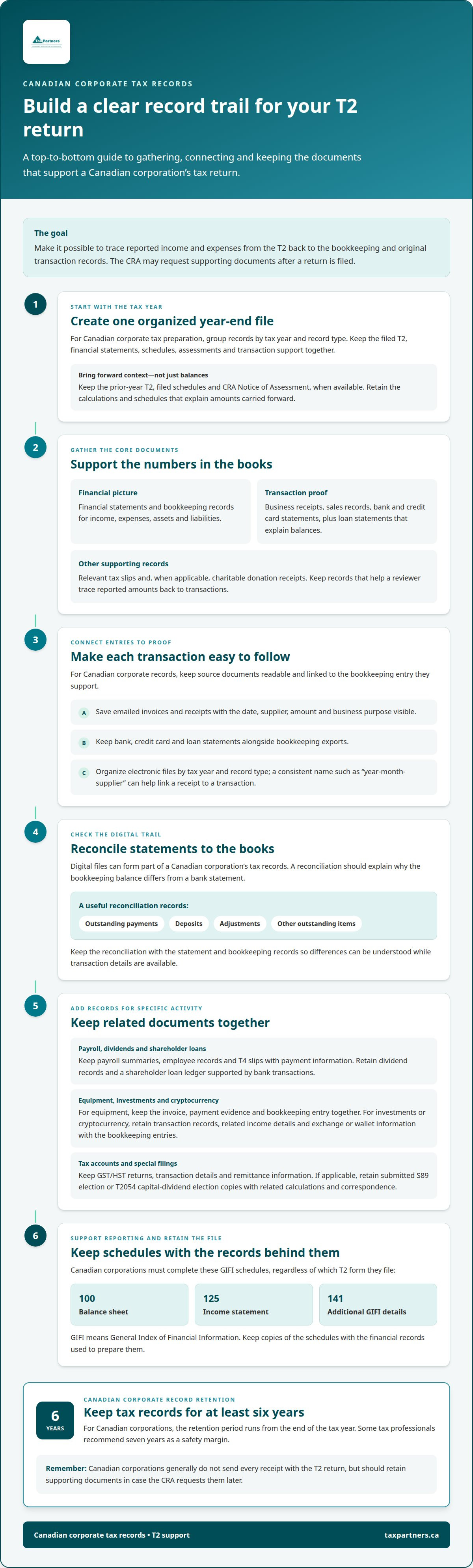
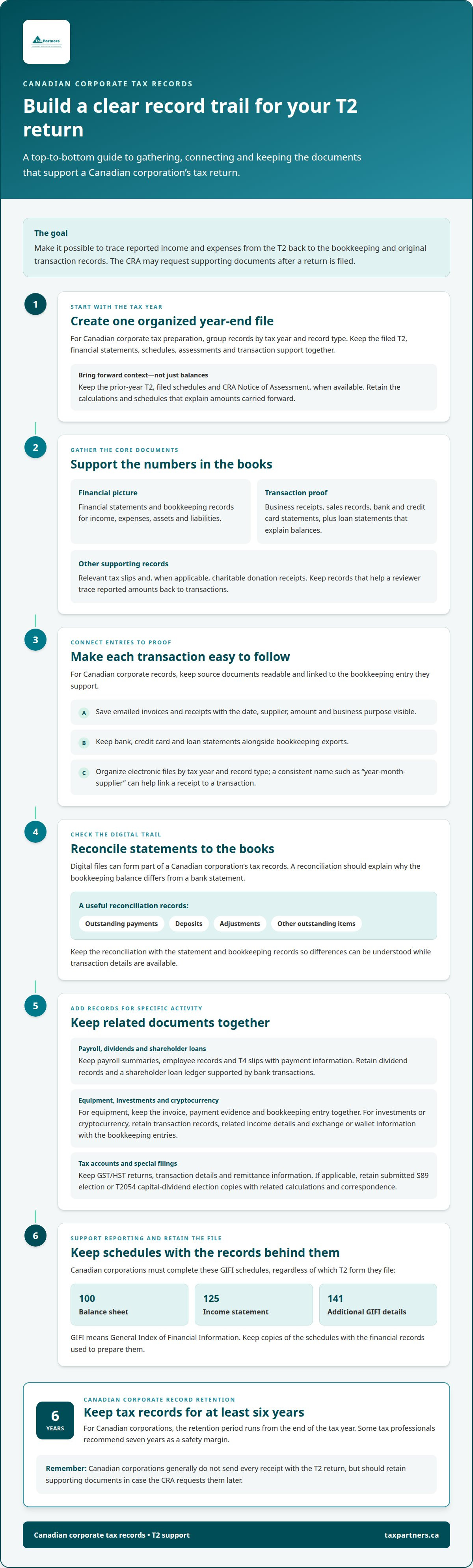
Canadian corporations must keep tax documents for at least six years from the end of the tax year. Some tax professionals recommend seven years as a safety margin. Retain records supporting the T2 Corporation Income Tax Return, Canada’s corporate income tax return, not only the filed return itself.
The documents needed for corporate tax filing should let a reviewer trace reported income and expenses back to transactions. Keep financial statements, bookkeeping records, business receipts, bank and credit card statements, relevant tax slips, and charitable donation receipts when applicable.
Use a tax-year checklist to keep the file complete:
- Financial statements and bookkeeping records supporting income, expenses, assets, and liabilities.
- Receipts, sales records, bank statements, and credit card statements supporting transactions.
- Loan statements and other records explaining balances entered in the books.
- The prior-year T2 return, filed schedules, and Canada Revenue Agency (CRA) Notice of Assessment, when available.
Keep the previous T2 return beside the current year’s working papers. It helps the preparer trace balances carried forward and compare them with current records. Retain calculations and schedules supporting those amounts, rather than carrying figures forward without context.
Canadian corporations must complete Schedules 100, 125, and 141, regardless of which T2 form they file. Schedule 100 reports balance-sheet information, Schedule 125 reports income-statement information, and Schedule 141 provides additional GIFI (General Index of Financial Information) details. Keep copies with the financial records used to prepare them.
Keep special filings with the tax year they concern. An S89 election is a corporate tax election associated with section 89 of Canada’s Income Tax Act; T2054 is the form used to elect to pay a capital dividend from a corporation’s capital dividend account. Retain submitted copies and supporting records with related calculations and correspondence.
Goods and Services Tax/Harmonized Sales Tax (GST/HST) records should include related returns, transaction details, and remittance information. Provincial tax files may include separate returns, such as Alberta’s AT1, the Alberta corporate income tax return, which is separate from the federal T2. For international transactions, retain records supporting the amounts entered in the books; companies managing cross-border activity or overseas entities often coordinate with international firms such as CTC Tax & Accounting to ensure bookkeeping and documentation standards align across jurisdictions.
Organize the documents needed for corporate tax filing by tax year and record type. Store the filed return, statements, schedules, assessments, and transaction support together. This makes it easier to respond to CRA questions and understand prior-year balances when preparing another return.
Are email and digital records acceptable as tax documentation?
Email and digital files can form part of a Canadian corporation’s tax records. Keep invoices, receipts, statements, and messages readable and organized so they support bookkeeping entries and corporate income tax preparation.
A digital bookkeeping file is useful when its transactions connect to source documents. For example, a monthly bank reconciliation should explain differences between the bookkeeping balance and the bank statement, such as outstanding payments or deposits.
Keep a clear record trail:
- Save emailed invoices and receipts with dates, suppliers, amounts, and business purposes visible.
- Retain bank, credit card, and loan statements alongside bookkeeping exports.
- Record how each statement balance reconciles to the books, including adjustments and outstanding items.
- Keep payroll summaries and supporting employee records with the related payment information.
The Canada Revenue Agency may request supporting records after a return is filed. Organize electronic files by tax year and record type, and keep them accessible throughout the retention period. A consistent naming system, such as “year-month-supplier,” helps link each receipt to a transaction.
For payroll, retain employee pay records, payroll summaries, and issued T4 slips. To report payroll, dividends, and shareholder loans on a Canadian corporate tax return, keep payroll registers and T4 slips, dividend records, and a shareholder loan ledger supported by bank transactions. These records help distinguish salary, dividends, and amounts owed between the corporation and its shareholder.
Equipment records should identify the purchase, payment, and asset details. Keep the invoice, payment evidence, and bookkeeping entry together so the purchase can be assessed during tax preparation.
Investment records should show transactions and related income, including interest, supported by statements. For cryptocurrency, retain transaction records and keep exchange or wallet information with the related bookkeeping entries. This helps connect the activity to the corporation’s reported income and expenses.
Well-organized digital records also make monthly reconciliations more useful: differences can be investigated while the transaction details are available. Discuss bookkeeping and payroll record support when records span multiple accounts, employees, or transaction types.
Corporate tax filing and payment deadlines
A corporation’s fiscal year-end sets the starting point for its Canadian filing deadlines. According to the Canada Revenue Agency, corporations in Canada generally must file their T2 Corporation Income Tax Return within 6 months after the end of their fiscal year. Filing and paying are separate obligations, so plan for each date.
For example, a corporation with a December 31 year-end generally has a June 30 filing deadline the following year. A corporation’s filing deadline depends on its fiscal year-end. These examples show why a corporation’s tax year, rather than the calendar year, drives the filing schedule.
Most resident corporations in Canada must file a T2 for every tax year, even when they have no tax payable. A nil balance doesn’t remove the filing requirement, so the bookkeeping and financial information still need to support a complete return.
Keep these timing points distinct:
- T2 filing: count 6 months from the corporation’s fiscal year-end.
- Tax balance: corporations with tax payable generally must pay within 2 months after year-end.
- Qualifying CCPC: a Canadian-controlled private corporation may have up to 3 months to pay.
- Instalments: corporate tax instalments are generally paid quarterly during the tax year.
For a December 31, 2026 year-end, the federal T2 return is generally due June 30, 2027. The federal tax balance is generally due February 28, 2027, or March 31, 2027, if the corporation qualifies for the 3-month rule. The separate dates make cash-flow planning important.
Instalment dates usually fall in March, June, September, and December, though they can vary. A corporation’s circumstances determine whether it must pay by instalment and whether payments are monthly or quarterly. Track each payment in the bookkeeping records and reconcile it against the tax account.
Prepare early by organizing receipts, sales records, expense support, and year-end statements before the filing date. This gives the preparer time to review deductions, resolve bookkeeping differences, and estimate any balance owing. Keep payment confirmations with the records for the relevant tax year.
A late T2 filing can trigger a penalty based on unpaid tax. The stated penalty starts at 5% of unpaid taxes, plus 1% for each full month late, up to 12 months. Filing on time matters even when the corporation expects no balance.
Year-end financial statements and GIFI reporting
A Canadian T2 return reports financial statement information using the CRA’s General Index of Financial Information (GIFI). GIFI organizes statement amounts into standardized categories, helping connect the corporation’s accounting results with its tax reporting.
Start with the year-end income statement and balance sheet. The income statement summarizes revenue and expenses for the reporting period, while the balance sheet shows assets, liabilities, and equity at year-end. Together, they provide a framework for reporting the corporation’s financial position and results.
The bookkeeping file should support each important statement balance. For example, the general ledger shows the transactions posted to individual accounts, while the trial balance gathers those account balances for review. Differences or unusual balances should be investigated before the figures are used for T2 reporting.
Useful records to keep with the statements include:
- The general ledger and trial balance for the fiscal year.
- Bank and credit card reconciliations that support cash balances.
- Accounts receivable and payable details that explain outstanding balances.
- Loan, inventory, and fixed-asset records that support the applicable statement accounts.
- Year-end adjusting entries and explanations for material changes.
Each amount should have a traceable path. For example, revenue on the income statement should reconcile with the sales accounts in the ledger and supporting sales records. A loan balance should agree with the books and the related lender statements.
GIFI reporting is not simply a matter of copying each bookkeeping account into the closest-looking field. The preparer maps account balances to suitable GIFI categories, reviews their presentation, and considers whether tax adjustments apply. Book income and taxable income can differ, so preserve both the original accounting amount and any adjustment made for the corporate tax return.
A clear handoff includes the final financial statements and the bookkeeping file used to prepare them. If a statement changes after review, retain the revised version and supporting entry instead of leaving multiple unexplained totals in circulation.
Before submission, reconcile the figures in the financial statements with the T2 reporting schedules. Confirm that assets equal liabilities plus equity, that the income statement agrees with the ledger, and that each adjustment has supporting records. These checks help identify inconsistent amounts before the Canadian return is filed.
Clear statements and organized ledger records give the preparer a reliable basis for GIFI reporting. They also make later questions easier to address, because each reported figure can be traced to a transaction, account, or year-end adjustment.
Business expenses and supporting documents
For a Canadian corporate income tax return, expense records should explain what the corporation paid, why it paid it, and how the amount was recorded. An invoice alone may not show the business purpose, so connect each expense to its accounting entry and payment record.
Build the supporting file around each transaction. A supplier invoice, credit card statement, and bookkeeping entry can show the amount, payment, and account used. Add a short explanation when the expense’s purpose isn’t clear from those records.
Organize expenses into useful groups, then retain evidence suited to each type:
- Employee costs: retain payroll summaries and records supporting salaries and benefits.
- Premises and services: keep rent, facilities, utilities, and service invoices with payment evidence.
- Marketing and professional fees: file advertising invoices and professional service statements with the related accounting entries.
- Travel and vehicle use: keep travel expense records and automobile logbooks that support business use.
- Income-related costs: retain records of business income and expenses, including rental income and expense receipts when applicable.
Separate business spending from personal transactions. If a payment serves both purposes, preserve the calculation or explanation used to allocate the business portion. For example, records for a mixed-use expense should show how the accounting entry reflects the corporation’s business use.
Small purchases still need a clear explanation. For a Canadian corporate expense under C$15, a written explanation of its business purpose may suffice when the original receipt is unavailable. Keep that note with the bookkeeping entry, including the transaction date and account category.
Review expense entries against statements before finalizing year-end records. Match credit card charges to invoices, identify duplicate entries, and explain refunds or credits in the accounting file. This helps keep reported expenses accurate and prevents a credit from being recorded as a separate purchase.
Don’t treat every payment as an expense. An equipment purchase, for example, may need to be recorded as an asset rather than a routine operating cost. Preserve the invoice and payment evidence so the preparer can assess its accounting and income tax treatment.
A well-organized expense file gives the tax preparer context, not just totals. Get support organizing corporate expense records when transactions span employees, suppliers, travel, or mixed business use.
Tax Partners
Tax Partners helps Canadian corporations bring financial records, bookkeeping, and tax reporting together for a T2 filing. Its corporate income tax services can support businesses that need help preparing a return, organizing supporting documents, or addressing a more involved reporting situation.
Consider professional support when records involve multiple accounts, payroll, or shareholder activity. Tax Partners provides Bookkeeping and Payroll Services to help align transaction records and payroll information with year-end reporting.
Share the corporation’s tax-year records and describe the areas that need attention. Contact Tax Partners to discuss support for your corporate tax filing.
Prepare the next filing with a clear plan
Use the next tax cycle to make record preparation part of the corporation’s regular financial routine. Consistently capturing transactions, organizing supporting files, and resolving questions during the year can make the eventual review more focused. This process also helps decision-makers understand how current business activity flows into future reporting.
Organizing the documents needed for corporate tax filing is a practical starting point, but the records must also tell a coherent story. A professional can help connect bookkeeping details with the corporation’s reporting needs and identify the Canadian tax considerations relevant to its operations.
Tax Partners provides Canadian Accounting & Tax Services and Bookkeeping and Payroll Services. The right support depends on the corporation’s operations and where its records need attention.
Contact Tax Partners for filing help and take the next step with a more organized approach to your corporation’s tax work.
Frequently Asked Questions
Can a corporation claim expenses without original receipts?
Sometimes, but the available evidence should still support the expense and its business purpose. For a Canadian corporate expense under C$15, a written explanation of its business purpose may suffice when the original receipt is unavailable. For other amounts, preserve whatever supporting records exist, such as a supplier invoice, payment statement, or transaction detail, and provide the context to the tax preparer rather than treating a missing receipt as proof of eligibility.
How does a professional use your records to prepare your T2 return?
A tax professional uses the corporation’s records to organize financial information, prepare reporting schedules, and identify items needing tax review. For example, the professional can compare a ledger expense with its invoice and payment record, then determine how it fits the return. Clear records also help distinguish bookkeeping balances from tax adjustments, so amounts are not carried into the return without supporting context.
What should your tax preparer check before filing?
Before filing, the preparer should check that the return’s figures agree with the corporation’s financial information and supporting records. This includes looking for unexplained differences, missing transaction support, inconsistent balances, and schedules relevant to the corporation’s circumstances. The preparer should also confirm that prior-year amounts carried into the current return remain supported, and address filing and payment dates separately.
Which documents does a professional need to file a Canadian corporate income tax return (T2)?
A professional generally needs the corporation’s financial statements, bookkeeping file, business receipts, bank and credit card statements, loan records, relevant tax slips, and prior-year T2 return. New corporate tax clients may also need to provide their Articles of Incorporation, signed RC59 Authorization Form, and the new-client T2 checklist. The exact working file depends on the corporation’s activities, ownership, and transactions during the tax year.
What financial statements and accounting records should you provide for a Canadian T2 return?
Provide the year-end financial statements and the accounting records used to prepare them. A useful package includes the general ledger, trial balance, bookkeeping file, and bank, credit card, and loan statements. If a balance changed because of a year-end adjustment, include its supporting calculation or explanation. This helps the preparer trace reported totals to the corporation’s records instead of relying on unexplained summary figures.
What tax slips and information returns should you provide to your tax preparer?
Provide tax slips received by the corporation and copies of information returns it issued, where applicable. Include employee T4 slips and payroll summaries when the corporation paid employees, plus slips and records connected to other income or transactions. Charitable donation receipts can support reported donations. Organize these documents by tax year and identify the related account or transaction, so the preparer can match each amount to the corporation’s books.
What supporting documents should you provide for corporate tax deductions, expenses, and tax credits in Canada?
Provide invoices, receipts, payment records, and a short explanation of the business purpose when it isn’t clear. Include travel or automobile logbooks when relevant, along with records supporting business income and expenses. For a claimed credit, provide records supporting the underlying activity or expenditure. The preparer can then assess how each item should be reported instead of treating every payment in the bookkeeping as deductible.
What supporting documents should you provide for capital assets, depreciation, and CCA claims in Canada?
For capital assets, provide purchase invoices, payment evidence, asset descriptions, and records showing when an item became available for use. Include disposal documents for assets sold or otherwise disposed of. These details help the preparer review capital cost allowance (CCA), the tax deduction for eligible depreciable property, and related reporting. If the corporation disposed of capital property, purchase and sale records can support the applicable Schedule 6 reporting.

Article by
Mahad Mohamed
Mahad Mohamed is an accountant and the CEO of Tax Partners, with over 26+ years of Canadian and international tax and accounting experience. His expertise includes corporate reorganization, cross-border tax structuring (Canada & US), tax disputes, CRA audits, and tax planning for small owner-managed private corporations. Most recently, Mahad is a pioneer in Canadian crypto taxation and founded Block3 Finance.
Previously, Mahad worked for the Canada Revenue Agency (CRA), Big4 accounting firms, and served as a Rulings Officer for the Federal Tax Authority of the UAE before acquiring Tax Partners in 2014.
Tax Partners has 44 full-time accountants and over 18,400+ clients.
Disclaimer
This article provides general information only and is current as of its publication date. It has not been updated and may be out of date. It does not constitute legal advice and should not be relied upon as such. Every tax situation is unique and may differ from the examples discussed in this article. If you have specific questions, you should seek the advice of our accountants for your unique circumstances. Book a FREE Initial Consultation Today!
Frequently Asked Questions
Can a corporation claim expenses without original receipts?
Sometimes, but the available evidence should still support the expense and its business purpose. For a Canadian corporate expense under C$15, a written explanation of its business purpose may suffice when the original receipt is unavailable. For other amounts, preserve whatever supporting records exist, such as a supplier invoice, payment statement, or transaction detail, and provide the context to the tax preparer rather than treating a missing receipt as proof of eligibility.
How does a professional use your records to prepare your T2 return?
A tax professional uses the corporation’s records to organize financial information, prepare reporting schedules, and identify items needing tax review. For example, the professional can compare a ledger expense with its invoice and payment record, then determine how it fits the return. Clear records also help distinguish bookkeeping balances from tax adjustments, so amounts are not carried into the return without supporting context.
What should your tax preparer check before filing?
Before filing, the preparer should check that the return’s figures agree with the corporation’s financial information and supporting records. This includes looking for unexplained differences, missing transaction support, inconsistent balances, and schedules relevant to the corporation’s circumstances. The preparer should also confirm that prior-year amounts carried into the current return remain supported, and address filing and payment dates separately.
Which documents does a professional need to file a Canadian corporate income tax return (T2)?
A professional generally needs the corporation’s financial statements, bookkeeping file, business receipts, bank and credit card statements, loan records, relevant tax slips, and prior-year T2 return. New corporate tax clients may also need to provide their Articles of Incorporation, signed RC59 Authorization Form, and the new-client T2 checklist. The exact working file depends on the corporation’s activities, ownership, and transactions during the tax year.
What financial statements and accounting records should you provide for a Canadian T2 return?
Provide the year-end financial statements and the accounting records used to prepare them. A useful package includes the general ledger, trial balance, bookkeeping file, and bank, credit card, and loan statements. If a balance changed because of a year-end adjustment, include its supporting calculation or explanation. This helps the preparer trace reported totals to the corporation’s records instead of relying on unexplained summary figures.
What tax slips and information returns should you provide to your tax preparer?
Provide tax slips received by the corporation and copies of information returns it issued, where applicable. Include employee T4 slips and payroll summaries when the corporation paid employees, plus slips and records connected to other income or transactions. Charitable donation receipts can support reported donations. Organize these documents by tax year and identify the related account or transaction, so the preparer can match each amount to the corporation’s books.
What supporting documents should you provide for corporate tax deductions, expenses, and tax credits in Canada?
Provide invoices, receipts, payment records, and a short explanation of the business purpose when it isn’t clear. Include travel or automobile logbooks when relevant, along with records supporting business income and expenses. For a claimed credit, provide records supporting the underlying activity or expenditure. The preparer can then assess how each item should be reported instead of treating every payment in the bookkeeping as deductible.
What supporting documents should you provide for capital assets, depreciation, and CCA claims in Canada?
For capital assets, provide purchase invoices, payment evidence, asset descriptions, and records showing when an item became available for use. Include disposal documents for assets sold or otherwise disposed of. These details help the preparer review capital cost allowance (CCA), the tax deduction for eligible depreciable property, and related reporting. If the corporation disposed of capital property, purchase and sale records can support the applicable Schedule 6 reporting.