Departure Tax for Canadians Moving to the US: Which Assets May Be Taxed

Moving to the US can create a Canadian tax consequence before you sell an asset. The departure tax for Canadians moving to the US may apply when you cease to be a Canadian tax resident: Canada can treat certain assets as if you sold them at fair market value on the day before you left, and tax accrued gains.
Not every asset is treated the same way. Canadian real property and registered accounts are generally excluded from the deemed disposition, while non-registered investments and foreign real estate may be included.
This guide explains how Canadian tax residency affects departure tax, which assets may be subject to it, and what filing obligations can follow. It also covers how planning before departure can help you understand the tax treatment of your assets and prepare required Canadian filings, giving you a clearer picture of what to expect.
Key Takeaways
- Canadian tax residency depends on your residential ties and move circumstances, not simply your citizenship or immigration status.
- When Canadian residency ends, certain assets may be treated as sold at fair market value, even if you keep them.
- Non-registered investments and some foreign property may be affected, while registered accounts and Canadian real property generally receive different treatment.
- Pre-departure planning can help clarify the tax impact of your assets and whether a deferral may be available under Canadian rules.
- Your move may involve Canadian departure-year filings, so the timing and scope of those filings matter.
When do you become a non-resident of Canada?
Canadian tax residency depends on your residential ties and circumstances, not your citizenship. Your status helps determine whether Canadian tax applies to your worldwide income or only to certain Canadian-source income.
Canadian Tax Residency on Moving
Tax residency is your status under Canadian income tax rules, based on your ties and circumstances. A Canadian who settles in the United States usually becomes a non-resident for Canadian income tax purposes. The date matters because it can determine when reporting worldwide income ends and departure tax may apply.
When you leave Canada to settle elsewhere, the residency change usually takes effect on the latest of three dates: your departure date, the date your spouse or dependants leave, and the date you become resident in the new country. These dates can differ, so crossing the border alone does not establish your Canadian tax departure date.
Residential ties help determine whether Canada remains your home for tax purposes. A home in Canada is a significant tie and may indicate continued residency, even after you begin living in the United States. Other facts about your move and personal circumstances also matter when determining whether you have severed your Canadian ties.
Residential Ties and Departure Tax Eligibility
Departure tax eligibility depends on whether you cease to be a Canadian tax resident, not whether you give up Canadian citizenship. A temporary move may leave you resident if significant ties remain; a returning Canadian may become a non-resident when the move and ties support that status. Canadian citizens can remain citizens while becoming non-residents for tax purposes.
If you maintain Canadian tax residency while abroad, departure tax does not apply. Instead, Canadian residents generally report income from sources inside and outside Canada. This distinction matters for temporary stays in the United States and for moves that become permanent after a period abroad.
For the part of the year you remain a Canadian resident, report worldwide income in Canadian dollars, including income earned in the United States. After non-residency begins, Canadian tax generally applies to Canadian-earned income. The change in reporting scope follows your tax status, not simply your physical location.
For departure tax for Canadians moving to the US, the key question is when Canadian residency ends. If you keep a Canadian home or other significant ties, you may remain a resident and continue reporting worldwide income. If you sever residential ties and settle in the United States, the departure date and deemed-disposition rules become relevant.
What is Canada’s Departure Tax?
Canadian departure tax can apply when you cease to be a Canadian tax resident, even if you retain ownership of affected assets. It is generally calculated through a deemed disposition, which treats certain property as if you sold it.
Deemed Dispositions at Departure
A deemed disposition treats qualifying assets as sold for Canadian tax purposes, even though no actual sale occurred. This rule can bring accrued gains into your Canadian income for the year you leave. The difference between an asset’s tax cost and its deemed sale value determines whether there is a gain to report.
For example, moving to the United States may trigger this calculation for eligible investments that remain in your portfolio. The resulting Canadian tax position depends on which assets are covered and their value on the relevant date.
Assets Valued at Fair Market Value
For many assets subject to Canadian departure tax, the deemed sale occurs at fair market value on the day before you leave Canada. Fair market value is the price an asset would reasonably fetch in an open market. It establishes the deemed proceeds used to calculate the gain.
This valuation date can matter even if you sell the asset later, after its value has changed. A departure assessment focuses on its Canadian tax value at that point, not simply the amount eventually received from a buyer.
Departure Tax Calculation and Capital Gains Rates
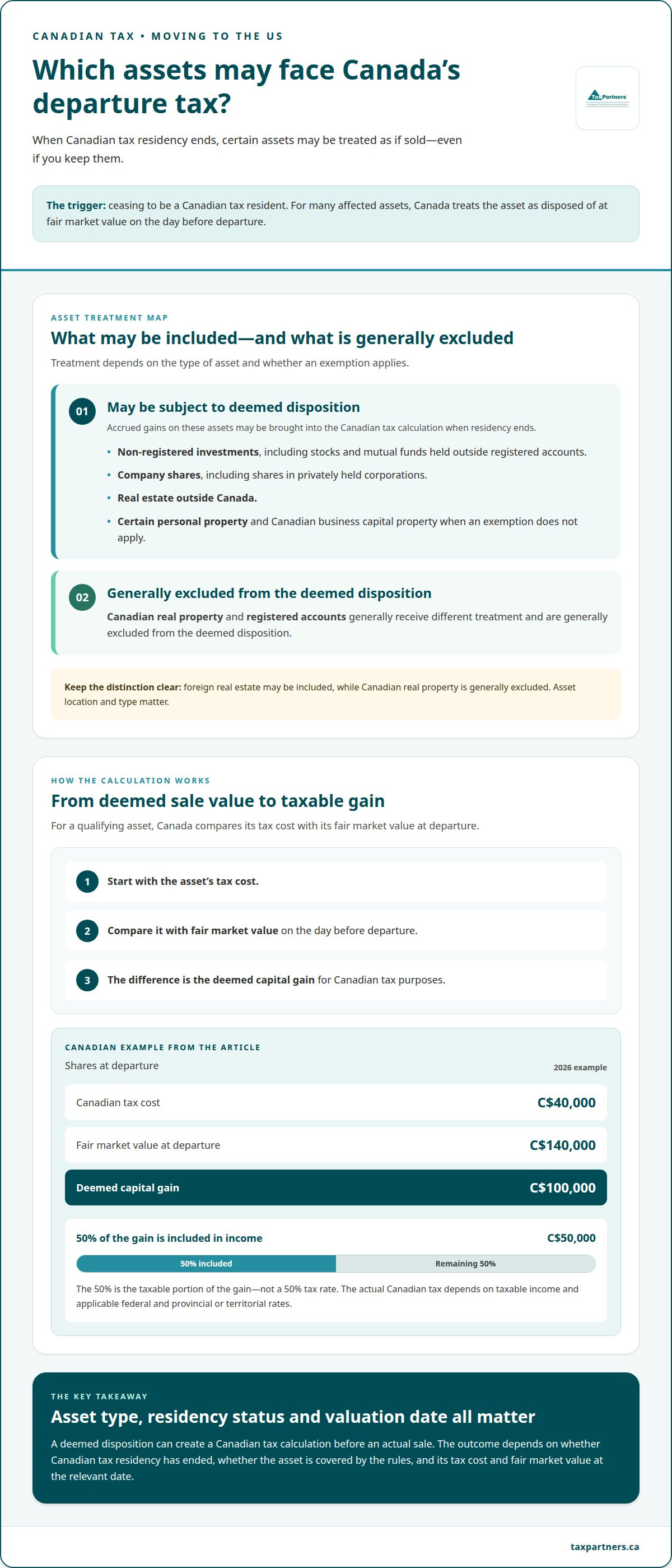
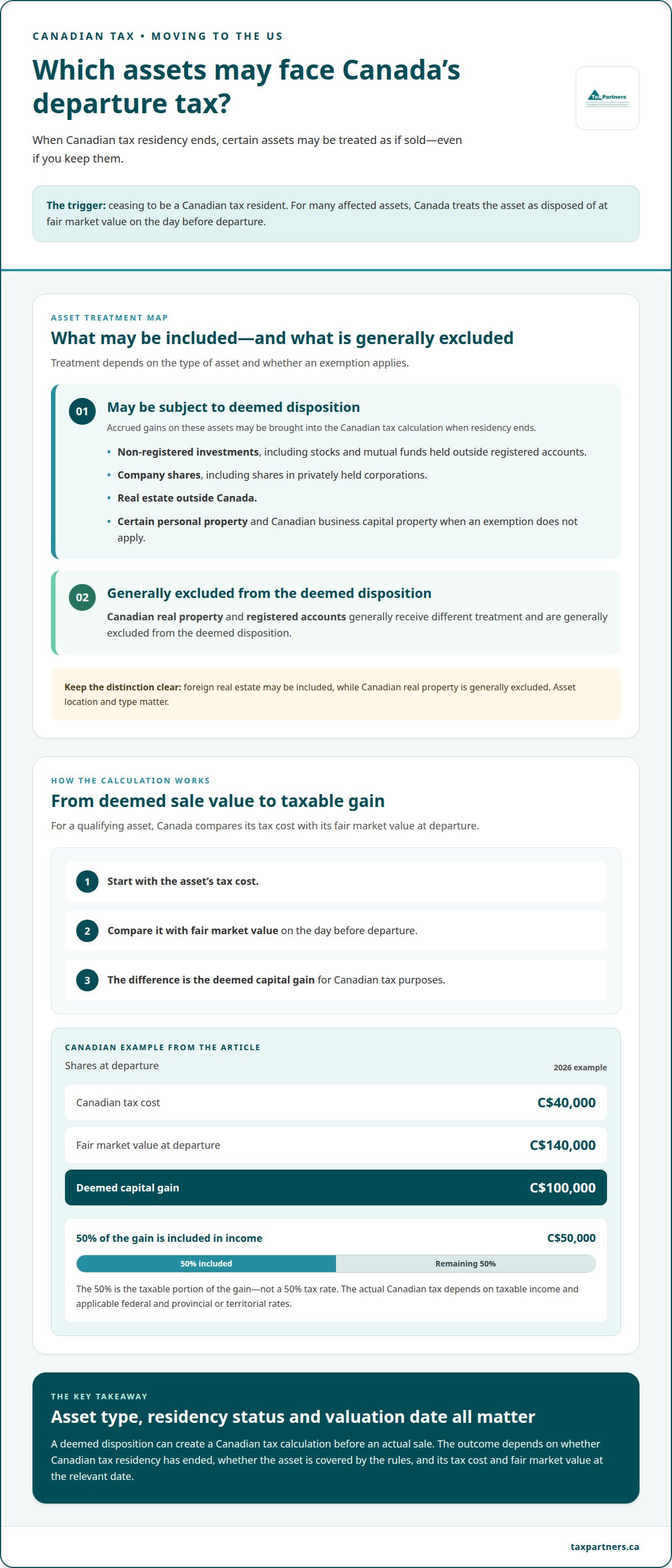
Canada calculates the deemed capital gain by subtracting the asset’s tax cost from its fair market value. For a qualifying asset, 50% of the gain is added to income for the year of departure. That percentage is the taxable portion, not a 50% tax rate.
The taxable capital gain is taxed under Canadian income tax rules at the applicable marginal rates. The actual tax depends on your taxable income and applicable federal and provincial or territorial rates. There is no single departure-tax rate that applies to every emigrant.
Consider shares with a Canadian tax cost of C$40,000 and a fair market value of C$140,000 at departure. The deemed capital gain is C$100,000; using the 50% inclusion rate, the taxable capital gain is C$50,000 in the 2026 example. The final tax depends on the applicable Canadian rates and your income.
Accurate asset values and tax-cost records help establish the calculation. A review of your Canadian departure tax position can clarify which gains enter the Canadian return and how the calculation applies to your assets.
Which Assets Are Subject to Departure Tax?
Canadian departure tax generally applies to accrued gains on certain property when you cease to be a Canadian tax resident. The key distinction is whether an asset falls under Canada’s deemed-disposition rules or an exception.
Assets that may be subject to Canadian departure tax include:
- Non-registered investments, such as stocks and mutual funds held outside registered accounts.
- Shares in privately held corporations and other company shares.
- Real estate located outside Canada.
- Certain personal property and Canadian business capital property in circumstances where an exemption does not apply.
For these assets, the tax calculation can create a taxable capital gain without an actual sale. The fact that foreign property is located in another country does not, by itself, remove it from Canadian departure-tax rules.
Canadian real property is generally excluded from the departure-tax deemed disposition. If you keep a home or other Canadian real estate after leaving, Canadian tax may instead arise when you sell it. The timing differs from a deemed disposition at departure.
Registered and pension-type holdings are generally excluded from the deemed disposition. Examples include RRSPs, RRIFs, RESPs, RDSPs, TFSAs, pension plans and annuities. Other listed exclusions include Canadian trusts, employee benefit programs, life insurance and certain Canadian business property. Exclusion from departure tax does not mean future withdrawals, distributions or sales are always tax-free.
A separate exception can apply to property you owned when you last became a Canadian resident, or inherited afterward. The exclusion applies if you lived in Canada for 60 months or less during the 10 years before departure. This rule can change which assets enter the departure-tax calculation, so ownership history and dates matter.
Canadian reporting forms have separate purposes. Form T1161 reports property owned at departure; it is not a list of only taxable assets. For Canadian emigrants, the form is required when the total fair market value of all property owned at departure exceeds C$25,000. Cash and bank deposits are excluded from its property list, as are personal items worth less than C$10,000 each.
Foreign-asset reporting is another distinct requirement. For 2026, Canadian Form T1135 is required if the total cost of specified foreign property exceeds C$100,000. That threshold concerns foreign-property reporting, not whether an asset is subject to departure tax. Reviewing both lists helps distinguish taxable property from property that still needs to be reported.
Pre-departure tax planning
Planning before leaving Canada helps organize residency information, asset records and upcoming CRA filings. A tax professional can bring these details together so your departure-year tax position reflects your move and relevant Canadian requirements.
Departure Preparation and CRA Steps
A tax professional can review your residential ties and departure circumstances, then assess whether submitting CRA Form NR73 is appropriate. This analysis can include your planned departure date, when your spouse or dependants are leaving, and when you expect to establish residency elsewhere.
As departure approaches, a professional can help coordinate the date you provide to your financial advisor, financial institutions and pension administrators. Consistent records help these organizations update your accounts and keep Canadian tax reporting aligned with your circumstances.
Preparation also includes organizing asset ownership records, tax-cost information and valuation support for the departure-year return. If Form T1161 applies, it must be filed by the Canadian filing due date, even when you aren’t required to file an income tax return. A late Canadian T1161 filing can result in a C$25-per-day penalty, with a minimum of C$100 and a maximum of C$2,500.
Canadian Tax Planning
Canadian planning can consider which income and deductions belong to the resident and non-resident portions of the departure year. For example, an emigrant may claim the eligible educator school supply tax credit for qualifying expenses in the non-resident portion if Canadian-source income reported for that period is at least 90% of net world income for that period.
Moving expenses also need careful treatment. A person moving out of Canada generally cannot deduct these expenses, subject to an exception for eligible full-time post-secondary students with specified taxable Canadian education funding.
For the 2025 Canadian tax return, an emigrant must enter their spouse’s or common-law partner’s 2025 net world income on page 1. A tax professional can organize the relevant income and expense information for the applicable tax year, and identify which Canadian claims relate to each part of the year.
Planning can also cover whether to request a Canadian departure-tax deferral and what security the CRA may require. A professional can assess filing requirements and coordinate supporting information before the applicable deadline.
Canadian and U.S. tax filing requirements
For Canadian tax purposes, your departure-year return records the end of your Canadian residency and the tax items connected with leaving. The required Canadian filings depend on whether you owe tax, are claiming a refund or must submit departure-related information forms.
A Canadian tax professional can prepare the departure-year T1 return and include the departure date and applicable forms. The Canadian return is generally filed in April following the year of departure, using the income tax package for the province or territory where you lived on your departure date.
Canadian Form T1243 reports deemed dispositions for departure-tax purposes. A tax professional uses the relevant property and valuation records to complete the form and report the resulting amounts with the Canadian departure-year return.
Form T1161 is a separate Canadian information filing. If required, it must be sent by the Canadian filing due date, even when you aren’t required to file a Canadian income tax return. It reports property owned at departure and does not replace the T1 return or Form T1243.
Canadian non-residents receiving certain types of Canadian-source income may be able to elect under section 217 of the Canadian Income Tax Act to report that income on a Canadian return. This election can change how eligible income is taxed in Canada, so the income type and the taxpayer’s circumstances need to be considered.
Coordinating your Canadian departure date, return and information forms helps keep your filing position consistent. A professional can organize your records and prepare the applicable Canadian forms for departure-year reporting.
For help with Canadian departure filings and tax reporting, contact a tax professional.
U.S. tax residence may depend on the Substantial Presence Test, which includes a 183-day rule. The test requires at least 31 days of physical presence in the current year and 183 weighted days across the current year and the two preceding years. The Canada-US Tax Treaty mitigates most risks of double taxation for people who may be tax residents of both jurisdictions.
Cross-border tax treatment of RRSP growth can depend on your circumstances, so consider getting professional advice.
Tax Partners: Canadian Accounting & Tax Services
Tax Partners helps individuals plan and manage Canadian tax obligations when they leave Canada and their residency status changes. Its Canadian Accounting & Tax Services support departure-year reporting, including reviewing assets subject to deemed disposition and preparing related Canadian filings.
Consider professional support before leaving Canada if your move date, residential ties, investments or registered accounts raise questions about your tax position. Coordinating your departure-year return with your circumstances can clarify which information and filings apply.
Contact Tax Partners to discuss Canadian departure tax planning and Canadian tax filings.
Make your next move with a clear plan
Leaving Canada can affect financial decisions well beyond your departure year. Keeping tax records, account details and future plans organized can make it easier to explain your position as circumstances change. Build that continuity before a transaction, withdrawal or change in your financial arrangements raises another reporting question.
Tax Partners offers Canadian Accounting & Tax Services and Bookkeeping and Payroll Services. If you are planning to leave Canada or managing tax matters after departure, professional support can connect your Canadian tax work with your broader financial records.
Take the next step with a conversation about Canadian departure tax and your Canadian tax needs. Contact Tax Partners to discuss your situation and move forward with greater clarity.
Frequently Asked Questions
Can you defer the departure tax?
Yes. Canada may allow an emigrant to defer departure-tax payment until the affected assets are sold. For a 2026 departure, the Canadian deferral request is made using Form T1244 by April 30 of the following year.
The CRA may require security for the tax owing. Deferral changes the payment timing; it doesn’t remove the Canadian tax arising from the deemed disposition.
Do I pay tax twice on the same income?
Not automatically. For Canadian tax purposes, the result depends on the income’s character, timing and your residency status.
A deemed gain at departure and a later sale are separate events, so records of acquisition cost, departure value and sale proceeds help distinguish them. This is particularly relevant when an asset’s value changes between the Canadian deemed-disposition date and its eventual sale.
Does the CRA know when you leave Canada?
Your Canadian departure-year return reports your departure date to the CRA. Form T1161 may also apply and has its own filing requirement, even when you don’t need to file an income tax return.
These filings provide the CRA with information about your departure and property. Keep the departure date consistent across your Canadian return and related forms.
What is Canada's departure tax when a Canadian moves to the US?
For Canadian tax purposes, departure tax can apply when you cease to be a Canadian tax resident. Canada treats many qualifying assets as though they were disposed of at fair market value, which can create a taxable capital gain without a sale.
The Canadian tax calculation depends on the asset’s tax cost and deemed proceeds, as well as the taxable income reported for the departure year.
Which assets are subject to Canadian departure tax when becoming a non-resident?
Canadian departure tax may apply to non-registered investments, shares in privately held corporations, certain personal property and real estate outside Canada. Whether an asset is covered depends on its classification under Canadian tax rules.
Keep records of ownership, acquisition cost and value at departure, as these details help establish whether a taxable capital gain arises and support your Canadian reporting.
Which assets are exempt from Canadian departure tax, such as Canadian real estate and registered accounts?
Canadian real property and registered or pension-type holdings are generally excluded from the departure-tax deemed disposition. Examples include RRSPs, RRIFs, TFSAs, RESPs, RDSPs and pension plans.
This exclusion applies specifically to departure tax. Canadian tax may still apply later when property is sold or account funds are withdrawn, depending on the asset and transaction.
What is the deemed disposition date and fair market value used to calculate departure tax?
For many assets covered by Canadian departure tax, the deemed disposition takes place on the day before you leave Canada. Canada uses the asset’s fair market value on that date to calculate deemed proceeds.
This is a valuation for tax purposes, not proof that you sold the asset. Records supporting ownership and value on the relevant date help substantiate the Canadian calculation.
Can I defer payment of Canadian departure tax, and what collateral or interest is required?
Canada may permit a deferral until the affected assets are sold, with a Canadian Form T1244 filing by April 30 of the year after departure. The CRA may require security for the tax owing.
The deferral request should address the required security and any applicable conditions, including interest; postponing payment doesn’t itself cancel the tax or its associated obligations.

Article by
Mahad Mohamed
Mahad Mohamed is an accountant and the CEO of Tax Partners, with over 26+ years of Canadian and international tax and accounting experience. His expertise includes corporate reorganization, cross-border tax structuring (Canada & US), tax disputes, CRA audits, and tax planning for small owner-managed private corporations. Most recently, Mahad is a pioneer in Canadian crypto taxation and founded Block3 Finance.
Previously, Mahad worked for the Canada Revenue Agency (CRA), Big4 accounting firms, and served as a Rulings Officer for the Federal Tax Authority of the UAE before acquiring Tax Partners in 2014.
Tax Partners has 44 full-time accountants and over 18,400+ clients.
Disclaimer
This article provides general information only and is current as of its publication date. It has not been updated and may be out of date. It does not constitute legal advice and should not be relied upon as such. Every tax situation is unique and may differ from the examples discussed in this article. If you have specific questions, you should seek the advice of our accountants for your unique circumstances. Book a FREE Initial Consultation Today!
Frequently Asked Questions
Can you defer the departure tax?
Yes. Canada may allow an emigrant to defer departure-tax payment until the affected assets are sold. For a 2026 departure, the Canadian deferral request is made using Form T1244 by April 30 of the following year. The CRA may require security for the tax owing. Deferral changes the payment timing; it doesn’t remove the Canadian tax arising from the deemed disposition.
Do I pay tax twice on the same income?
Not automatically. For Canadian tax purposes, the result depends on the income’s character, timing and your residency status. A deemed gain at departure and a later sale are separate events, so records of acquisition cost, departure value and sale proceeds help distinguish them. This is particularly relevant when an asset’s value changes between the Canadian deemed-disposition date and its eventual sale.
Does the CRA know when you leave Canada?
Your Canadian departure-year return reports your departure date to the CRA. Form T1161 may also apply and has its own filing requirement, even when you don’t need to file an income tax return. These filings provide the CRA with information about your departure and property. Keep the departure date consistent across your Canadian return and related forms.
What is Canada's departure tax when a Canadian moves to the US?
For Canadian tax purposes, departure tax can apply when you cease to be a Canadian tax resident. Canada treats many qualifying assets as though they were disposed of at fair market value, which can create a taxable capital gain without a sale. The Canadian tax calculation depends on the asset’s tax cost and deemed proceeds, as well as the taxable income reported for the departure year.
Which assets are subject to Canadian departure tax when becoming a non-resident?
Canadian departure tax may apply to non-registered investments, shares in privately held corporations, certain personal property and real estate outside Canada. Whether an asset is covered depends on its classification under Canadian tax rules. Keep records of ownership, acquisition cost and value at departure, as these details help establish whether a taxable capital gain arises and support your Canadian reporting.
Which assets are exempt from Canadian departure tax, such as Canadian real estate and registered accounts?
Canadian real property and registered or pension-type holdings are generally excluded from the departure-tax deemed disposition. Examples include RRSPs, RRIFs, TFSAs, RESPs, RDSPs and pension plans. This exclusion applies specifically to departure tax. Canadian tax may still apply later when property is sold or account funds are withdrawn, depending on the asset and transaction.
What is the deemed disposition date and fair market value used to calculate departure tax?
For many assets covered by Canadian departure tax, the deemed disposition takes place on the day before you leave Canada. Canada uses the asset’s fair market value on that date to calculate deemed proceeds. This is a valuation for tax purposes, not proof that you sold the asset. Records supporting ownership and value on the relevant date help substantiate the Canadian calculation.
Can I defer payment of Canadian departure tax, and what collateral or interest is required?
Canada may permit a deferral until the affected assets are sold, with a Canadian Form T1244 filing by April 30 of the year after departure. The CRA may require security for the tax owing. The deferral request should address the required security and any applicable conditions, including interest; postponing payment doesn’t itself cancel the tax or its associated obligations.