Deferred profit sharing plan Canada: Withdrawals and transfers

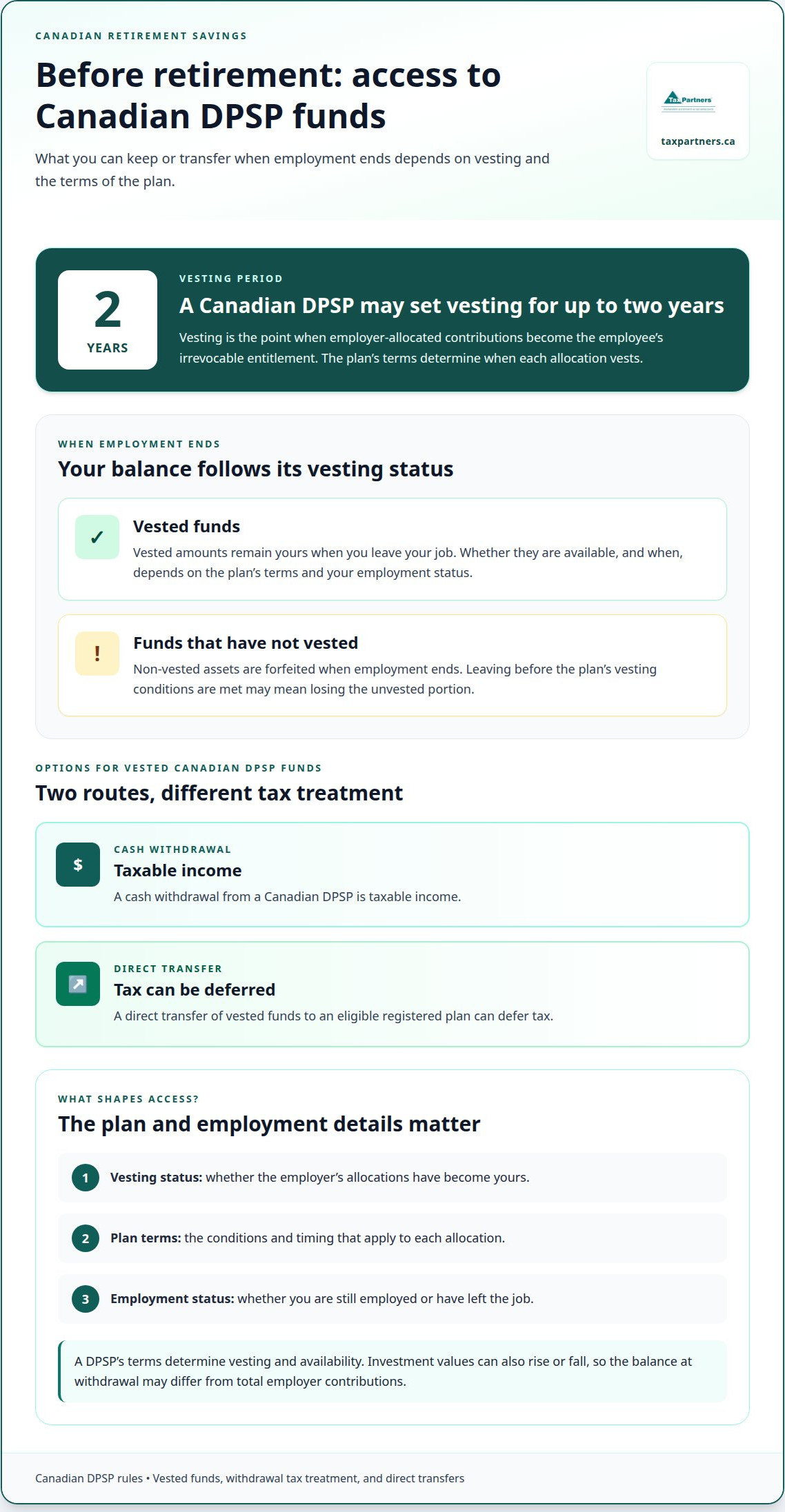
Can you access a deferred profit sharing plan in Canada before retirement? Generally, you can withdraw vested funds. “Vested” means you have earned the right to keep the funds, even if you leave your job. A cash withdrawal is taxable income, while a direct transfer to an eligible registered plan can defer tax. Whether funds are vested and available depends on the plan’s terms and your employment status.
It’s reasonable to expect money set aside for you to remain yours, but a DPSP has specific rules for employer contributions, vesting and withdrawals. Understanding those rules can help you make an informed decision while you’re working or when you leave a job.
This article explains how a DPSP works, how it differs from a general profit-sharing arrangement, and what may happen to your funds before retirement. It also covers how withdrawals and transfers affect Canadian income tax, so you can understand your options.
Key Takeaways
- Understand what makes a DPSP different from a general profit sharing arrangement and how employer contributions are governed.
- Learn why vesting matters when you leave a job and what may happen to amounts that haven’t vested.
- See how a cash withdrawal can affect your taxable income, and how a direct transfer may change the tax treatment.
- Explore the factors that shape access to plan funds before retirement and how financial planning can help you weigh your options.
What is a deferred profit sharing plan (DPSP)?
A DPSP is an employer-sponsored plan that allocates employer contributions to eligible employees. In Canada, its contribution limits and tax treatment distinguish it from an informal profit-sharing arrangement.
DPSP contributions and contribution limits
Employers contribute to beneficiaries’ accounts under the plan’s terms, rather than deducting contributions from employees’ payroll. According to Department of Justice Canada, a DPSP may receive only employer contributions made under its terms for beneficiary employees, or an amount transferred under subsection 147(19).
For each calendar year, the contribution limit is the lesser of 18% of the beneficiary’s compensation from the employer or half that year’s money purchase limit, the annual contribution ceiling for a defined contribution pension plan. For 2026, half the money purchase limit is C$17,695. Employers generally make contributions within 120 days after their fiscal year ends, and contributions are deductible to the employer.
DPSPs as an alternative pension plan
A DPSP can provide a workplace retirement benefit without being a defined contribution pension plan. In a defined contribution pension plan, contributions fund a pension benefit. A DPSP instead allocates employer contributions to beneficiaries according to the plan’s terms.
This distinction matters when comparing workplace savings plans. A DPSP contribution depends on the employer’s plan and eligible compensation, while investment results affect the eventual account value. Employers may offer a DPSP alongside a group registered retirement savings plan (RRSP) or another savings arrangement.
Pension adjustments and RRSP contribution room
A pension adjustment (PA) reflects retirement benefits accrued through a workplace plan and reduces an employee’s RRSP contribution room in a subsequent year. For a DPSP, the employer contribution creates the PA, which is reported in Box 52 of the employee’s T4.
That adjustment matters when planning personal RRSP contributions: the available room is not determined by employment income alone. Reviewing the T4’s Box 52 alongside the employee’s RRSP deduction limit helps show how workplace savings affect the amount available for personal contributions.
DPSP fees, investment options, and risks
Fees, investment choices and risk depend on the specific plan and its options. Consider how administration or investment charges affect the balance, which investments beneficiaries can select, and whether those choices suit their time horizon and risk tolerance.
Investment values can rise or fall, so the balance at withdrawal may differ from the total employer contributions. For Canadian employers, payroll records and plan contributions also need consistent treatment; Canadian tax requirements are part of managing that reporting accurately.
DPSP compared with a general profit sharing plan
In Canada, a deferred profit sharing plan is an employer-sponsored plan registered with the Canada Revenue Agency (CRA). A general profit-sharing arrangement may describe how an employer shares profits, but the label alone doesn’t make it a registered plan or give it DPSP tax treatment. Registration and the plan’s terms determine whether it qualifies as a DPSP.
A registered DPSP must meet conditions under Canada’s Income Tax Act. The CRA won’t register a profit-sharing plan as a DPSP unless it meets those requirements. A cash bonus paid through payroll differs from an amount contributed to a registered plan: the plan’s legal status and payment method affect how the benefit is treated.
Eligibility also has specific limits. A DPSP may cover all employees or a designated group, but a person with more than a 10% stake in the company can’t participate. The ownership restriction separates an employee benefit plan from a way for a significant owner to defer income through their own company’s plan.
Consider two employees at the same employer: an eligible employee may receive allocations under the DPSP’s terms, while an owner with a 12% stake is excluded. The plan must define who qualifies and how amounts are allocated. This makes eligibility and ownership details important when an employer establishes the plan or reviews its participant records.
Beneficiary rules also distinguish a DPSP from a general arrangement. DPSP funds can’t be split with an employee’s spouse. If a member dies, a surviving spouse or common-law partner may transfer the vested balance to their own registered retirement plan and retain tax-deferred status. Other heirs receive the funds in cash and pay tax on them.
“Profit sharing” is an incomplete description. A general arrangement may share profits as compensation, while a DPSP is a registered plan with defined eligibility, contribution and beneficiary terms. For Canadian businesses, understanding the distinction helps clarify whether a payment belongs in payroll or a registered plan, and how employee records should reflect it.
Where a plan’s status or participant treatment affects Canadian reporting, discuss the Canadian tax considerations with a professional.
DPSP withdrawals and transfers when leaving employment
When employment ends, what you can keep depends on vesting, and a cash withdrawal is generally taxable. You may be able to transfer a vested balance directly to an eligible registered plan instead.
Vesting and forfeiture on leaving
Vesting means an employer’s allocated contributions become the employee’s irrevocable entitlement. A Canadian DPSP may set a vesting period of up to two years, so leaving earlier can affect how much of the savings the employee keeps.
Non-vested assets are forfeited when employment ends. For example, an employee who leaves before meeting the plan’s vesting conditions may lose the unvested portion, while vested amounts remain theirs. The plan’s terms determine when each allocation vests, so length of service can matter.
Tax treatment for employers and employees
For Canadian employers, DPSP contributions are generally deductible business expenses. For employees, contributions and investment earnings accumulate tax-free inside the plan, but a cash withdrawal is included in taxable income for the year it’s received.
A direct transfer under subsection 147(19) is treated differently: the transferred amount isn’t included in the person’s income, and they can’t claim a deduction for it. This distinction matters when choosing between receiving cash and preserving tax-deferred savings through an eligible transfer.
DPSP funds after leaving, retiring, or dying
After leaving an employer, an employee can transfer vested DPSP funds to an RRSP, registered retirement income fund (RRIF), or annuity. A direct transfer to an eligible registered plan avoids including the amount in income at the time of transfer. Taking the balance in cash makes it taxable in the withdrawal year.
At retirement, payment or transfer options depend on the plan’s terms and the member’s vested balance. If a member dies, a surviving spouse or common-law partner can transfer the vested amount to their own registered retirement plan and retain tax-deferred status. Other heirs receive the funds in cash and pay tax on them.
Vesting and employee retention
A vesting schedule sets when employer allocations become the employee’s property. A maximum two-year vesting period can encourage employees to stay until contributions vest, but leaving before then may reduce the benefit they keep.
For employees, the schedule helps explain why the account balance and the amount they can retain may differ. For employers, clear plan terms make the consequences of leaving easier to understand. Pension adjustments are reported in Box 52 of a Canadian T4 and reduce RRSP contribution room in subsequent years.
When considering leaving a job, separate the vested balance, any amount forfeited, and the tax consequences of taking cash versus transferring funds. These are distinct parts of the decision. A direct registered-plan transfer rather than a cash payment can change the employee’s taxable income for that year.
Can I withdraw from a DPSP before retirement?
In Canada, an employer may allow a participant to withdraw or transfer vested funds before leaving. After employment ends, vested amounts can generally be withdrawn or transferred, with different tax results.
Withdrawal or transfer after leaving a job
After leaving an employer, a participant can take vested DPSP funds in cash or transfer them directly to an eligible registered plan. A cash withdrawal is included in taxable income for that year, while a qualifying direct transfer preserves tax-deferred treatment.
Vesting is the deciding factor: non-vested assets are forfeited when employment ends. A departing employee with both vested and unvested amounts can retain the vested portion, but not the forfeited balance. The plan’s terms determine when employer allocations vest.
Transfers at termination or retirement
At termination or retirement, a participant may transfer a vested balance to an RRSP, RRIF, or annuity. A direct transfer under subsection 147(19) isn’t included in the recipient’s income, and the recipient can’t deduct the transferred amount.
Taking the same funds in cash makes them taxable income in the year of withdrawal. This distinction helps participants compare immediate access with keeping savings in a registered arrangement. The plan’s terms and the transfer destination determine the available option.
Transfers to an RRSP or another DPSP
A vested DPSP balance can be transferred directly to an RRSP without being included in income at transfer. A participant can transfer a DPSP to an RRSP only if they’re 71 or younger; the transfer doesn’t create an RRSP deduction.
A transfer to another DPSP must qualify under subsection 147(19), and the receiving plan must permit it. Don’t assume that changing employers makes a transfer automatic. The distinction between an eligible direct transfer and a cash payment affects whether the amount is taxable immediately.
Transfers to other registered plans
When leaving employment, a participant may transfer vested funds to a RRIF or annuity, as well as an RRSP. If completed directly under the eligible transfer rules, these options can keep the amount outside taxable income at the time of transfer.
DPSP funds aren’t locked in for retirement, so vested amounts may also be withdrawn partly or in full. A cash withdrawal is taxable income, and withholding tax may apply. Before retirement or at termination, compare the amount you need now with the tax-deferred value of a transfer.
How a deferred profit sharing plan works
A Canadian DPSP follows a sequence: the employer sets the plan terms, makes eligible contributions, and allocates amounts to member accounts. Contributions may reflect company profits, but the employer may contribute nothing in a year without profits.
The plan’s formula determines how an employer contribution is calculated. For example, a plan might base an allocation on a stated share of profits, such as 5%. The member receives an account benefit, rather than a cash bonus through payroll, and the plan’s terms govern how allocations are handled.
An employer may also pay an employee bonus into a DPSP. That does not make the account an employee-contribution plan: permitted contributions are employer contributions under the plan, or eligible transfers under subsection 147(19). The distinction affects how the plan receives money and how the member accesses it later.
- Plan terms: The employer defines the contribution formula and which employees can participate.
- Contribution: The employer contributes under those terms, subject to Canadian annual limits.
- Account: The contribution is allocated to a beneficiary’s account and invested within the plan.
- Access: Vesting and plan rules affect when a member can take or transfer the funds.
During employment, a plan may restrict a member from withdrawing funds. That restriction differs from retirement lock-in: DPSP assets aren’t locked in for retirement, although plan terms and vesting can still affect access. The available balance may therefore differ from the total contributions shown in the account.
Investment earnings remain in the plan until payment or withdrawal. If a member takes cash, the amount is generally included in taxable income for that year. A qualifying direct transfer can preserve tax-deferred treatment. Choosing a transfer instead of cash changes when the member reports income, not the amount originally contributed.
When an amount becomes payable, a DPSP may provide equal annual or more frequent instalments over no more than 10 years. That option can spread payments over time instead of providing the entire benefit at once. The plan’s payment terms determine whether instalments are available to the member.
The key point is that a DPSP is an employer-funded arrangement governed by its written terms, not a guaranteed annual bonus. The employer’s profit formula, contribution decisions, vesting provisions and payment options all influence the member’s eventual benefit.
For help understanding how plan contributions and payroll records fit together, discuss your DPSP reporting needs.
Tax Partners: Wealth Management & Financial Planning
Tax Partners helps individuals connect DPSP decisions with their broader financial plans through Wealth Management & Financial Planning. If you’re weighing a taxable withdrawal against a registered-plan transfer, or considering how a pension adjustment affects your savings, coordinated planning can help clarify the trade-offs.
Tax Partners also provides Canadian Accounting & Tax Services for questions about reporting a DPSP payment as income. For employers, Bookkeeping and Payroll Services can support accurate records for contributions and payroll reporting.
To discuss how your DPSP choices fit your financial and tax planning, contact Tax Partners.
Make your next decision with a clear plan
Your next step is to consider your DPSP decision alongside your other financial choices. Before changing jobs, retiring or using the funds, think about how the timing and form of a payment fit your broader savings and tax picture. A deferred profit sharing plan in Canada is one part of that picture, not a decision to make in isolation.
Tax Partners offers Wealth Management & Financial Planning, Canadian Accounting & Tax Services, and Bookkeeping and Payroll Services. These services help individuals consider their planning and tax needs, while employers address the accounting and payroll side of plan contributions.
If you’d like to discuss how your situation fits together, contact Tax Partners. A thoughtful next step can help you move forward with greater clarity.
Frequently Asked Questions
How does a DPSP work?
A DPSP lets an employer allocate contributions to eligible employees’ plan accounts under written terms. The employer decides whether to contribute and applies the plan’s allocation formula. Employees don’t contribute their own earnings.
For example, an employer might allocate a share of profits among eligible members. Investment choices and results affect account value, while the plan’s vesting terms determine when members own the allocated amounts.
What are the DPSP contribution limits?
For a Canadian DPSP, the annual limit is the lesser of 18% of the beneficiary’s compensation from the employer or half the money purchase limit for that year. For 2026, half the money purchase limit is C$17,695.
The limit applies to employer contributions for each beneficiary, so both compensation and the applicable annual limit affect the maximum permitted contribution.
Can business owners participate?
A business owner with more than a 10% stake in the company can’t participate in that company’s Canadian DPSP. The restriction applies even if the owner also works as an employee.
For example, an employee-owner holding 12% is excluded, while an eligible employee without that level of ownership may participate under the plan’s terms. The ownership percentage is therefore central to determining eligibility.
Does the employer have to contribute every year?
No. A Canadian employer isn’t required to contribute every year. A DPSP may receive no employer contribution in a year when the employer records no profits.
The plan’s formula and terms determine how contributions relate to profits. Participation doesn’t guarantee a deposit every year, so members should distinguish the account’s existing balance from future employer contributions.
Is a DPSP the same as a pension?
No. A DPSP is a registered, employer-funded savings arrangement, not a defined contribution pension plan. The employer allocates contributions to member accounts, and investment performance affects their eventual value.
A DPSP may be offered alongside a group RRSP or another workplace savings plan. Each arrangement has its own terms for contributions, access and retirement planning.
What is a deferred profit sharing plan (DPSP) in Canada?
A DPSP in Canada is an employer-sponsored plan registered with the Canada Revenue Agency (CRA), designed to allocate employer contributions to eligible employees. It can receive contributions made by an employer under the plan’s terms, or eligible transfers under subsection 147(19) of the Income Tax Act.
A DPSP isn’t simply any bonus or profit-sharing payment. Its status depends on registration conditions and plan rules.
Who is eligible to participate in a Canadian DPSP?
A Canadian DPSP may cover all employees or a defined group of employees, according to its plan terms. However, a person with more than a 10% stake in the employer’s company is excluded.
Eligibility can depend on the group covered by the plan and the employee’s ownership interest. An employee’s job title alone, for example, doesn’t establish eligibility if the plan defines participation differently.
What are the CRA rules and contribution limits for DPSPs?
For a Canadian DPSP, CRA registration depends on meeting the conditions in the Income Tax Act. The plan must restrict contributions to employer contributions made under its terms for beneficiary employees, or eligible transfers under subsection 147(19).
Annual employer contributions are limited to the lesser of 18% of compensation or half the money purchase limit. The limit changes with the applicable year’s money purchase limit.

Article by
Mahad Mohamed
Mahad Mohamed is an accountant and the CEO of Tax Partners, with over 26+ years of Canadian and international tax and accounting experience. His expertise includes corporate reorganization, cross-border tax structuring (Canada & US), tax disputes, CRA audits, and tax planning for small owner-managed private corporations. Most recently, Mahad is a pioneer in Canadian crypto taxation and founded Block3 Finance.
Previously, Mahad worked for the Canada Revenue Agency (CRA), Big4 accounting firms, and served as a Rulings Officer for the Federal Tax Authority of the UAE before acquiring Tax Partners in 2014.
Tax Partners has 44 full-time accountants and over 18,400+ clients.
Disclaimer
This article provides general information only and is current as of its publication date. It has not been updated and may be out of date. It does not constitute legal advice and should not be relied upon as such. Every tax situation is unique and may differ from the examples discussed in this article. If you have specific questions, you should seek the advice of our accountants for your unique circumstances. Book a FREE Initial Consultation Today!
Frequently Asked Questions
How does a DPSP work?
A DPSP lets an employer allocate contributions to eligible employees’ plan accounts under written terms. The employer decides whether to contribute and applies the plan’s allocation formula. Employees don’t contribute their own earnings. For example, an employer might allocate a share of profits among eligible members. Investment choices and results affect account value, while the plan’s vesting terms determine when members own the allocated amounts.
What are the DPSP contribution limits?
For a Canadian DPSP, the annual limit is the lesser of 18% of the beneficiary’s compensation from the employer or half the money purchase limit for that year. For 2026, half the money purchase limit is C$17,695. The limit applies to employer contributions for each beneficiary, so both compensation and the applicable annual limit affect the maximum permitted contribution.
Can business owners participate?
A business owner with more than a 10% stake in the company can’t participate in that company’s Canadian DPSP. The restriction applies even if the owner also works as an employee. For example, an employee-owner holding 12% is excluded, while an eligible employee without that level of ownership may participate under the plan’s terms. The ownership percentage is therefore central to determining eligibility.
Does the employer have to contribute every year?
No. A Canadian employer isn’t required to contribute every year. A DPSP may receive no employer contribution in a year when the employer records no profits. The plan’s formula and terms determine how contributions relate to profits. Participation doesn’t guarantee a deposit every year, so members should distinguish the account’s existing balance from future employer contributions.
Is a DPSP the same as a pension?
No. A DPSP is a registered, employer-funded savings arrangement, not a defined contribution pension plan. The employer allocates contributions to member accounts, and investment performance affects their eventual value. A DPSP may be offered alongside a group RRSP or another workplace savings plan. Each arrangement has its own terms for contributions, access and retirement planning.
What is a deferred profit sharing plan (DPSP) in Canada?
A DPSP in Canada is an employer-sponsored plan registered with the Canada Revenue Agency (CRA), designed to allocate employer contributions to eligible employees. It can receive contributions made by an employer under the plan’s terms, or eligible transfers under subsection 147(19) of the Income Tax Act. A DPSP isn’t simply any bonus or profit-sharing payment. Its status depends on registration conditions and plan rules.
Who is eligible to participate in a Canadian DPSP?
A Canadian DPSP may cover all employees or a defined group of employees, according to its plan terms. However, a person with more than a 10% stake in the employer’s company is excluded. Eligibility can depend on the group covered by the plan and the employee’s ownership interest. An employee’s job title alone, for example, doesn’t establish eligibility if the plan defines participation differently.
What are the CRA rules and contribution limits for DPSPs?
For a Canadian DPSP, CRA registration depends on meeting the conditions in the Income Tax Act. The plan must restrict contributions to employer contributions made under its terms for beneficiary employees, or eligible transfers under subsection 147(19). Annual employer contributions are limited to the lesser of 18% of compensation or half the money purchase limit. The limit changes with the applicable year’s money purchase limit.