Currency Conversion for Canadian Tax Reporting: Rate Rules

For Canadian tax reporting, foreign-currency amounts are generally converted to Canadian dollars using the relevant spot rate for the date the amount arose, unless an exception applies. The appropriate currency conversion for tax reporting in Canada depends on the type and timing of the income, payment or transaction.
It’s understandable to look for one exchange rate to use across a return. But a transaction-date spot rate and an annual average rate apply in different situations. When reporting recurring foreign income, choose the method that fits and apply it consistently.
This guide explains when each rate may apply, how the rules differ for common income and capital transactions, and which exchange-rate records can support your reporting if the CRA asks questions. You’ll also learn how to make your method clear and consistent, so your Canadian return has a traceable basis.
Key Takeaways
- Use the relevant transaction-date spot rate for one-off foreign-currency amounts, unless a tax rule allows another method.
- For recurring income, a consistent annual average rate may be appropriate; the right approach depends on the type and timing of the amounts.
- Convert foreign dividends and interest when received, but calculate capital gains using the rates for the proceeds, adjusted cost base and expenses at their respective dates.
- Keep records of the exchange-rate source and method you used so the conversions can be explained if the CRA asks.
- According to the Canada Revenue Agency, a functional-currency election must be filed within the first 61 days of the tax year to which it applies.
What is Spot Rate in Foreign Exchange?
A spot rate is the exchange rate used to value a foreign-currency amount on a particular date. For Canadian income tax reporting, the relevant date generally depends on when the income or transaction arose.
Daily Rates for One-Off Transactions
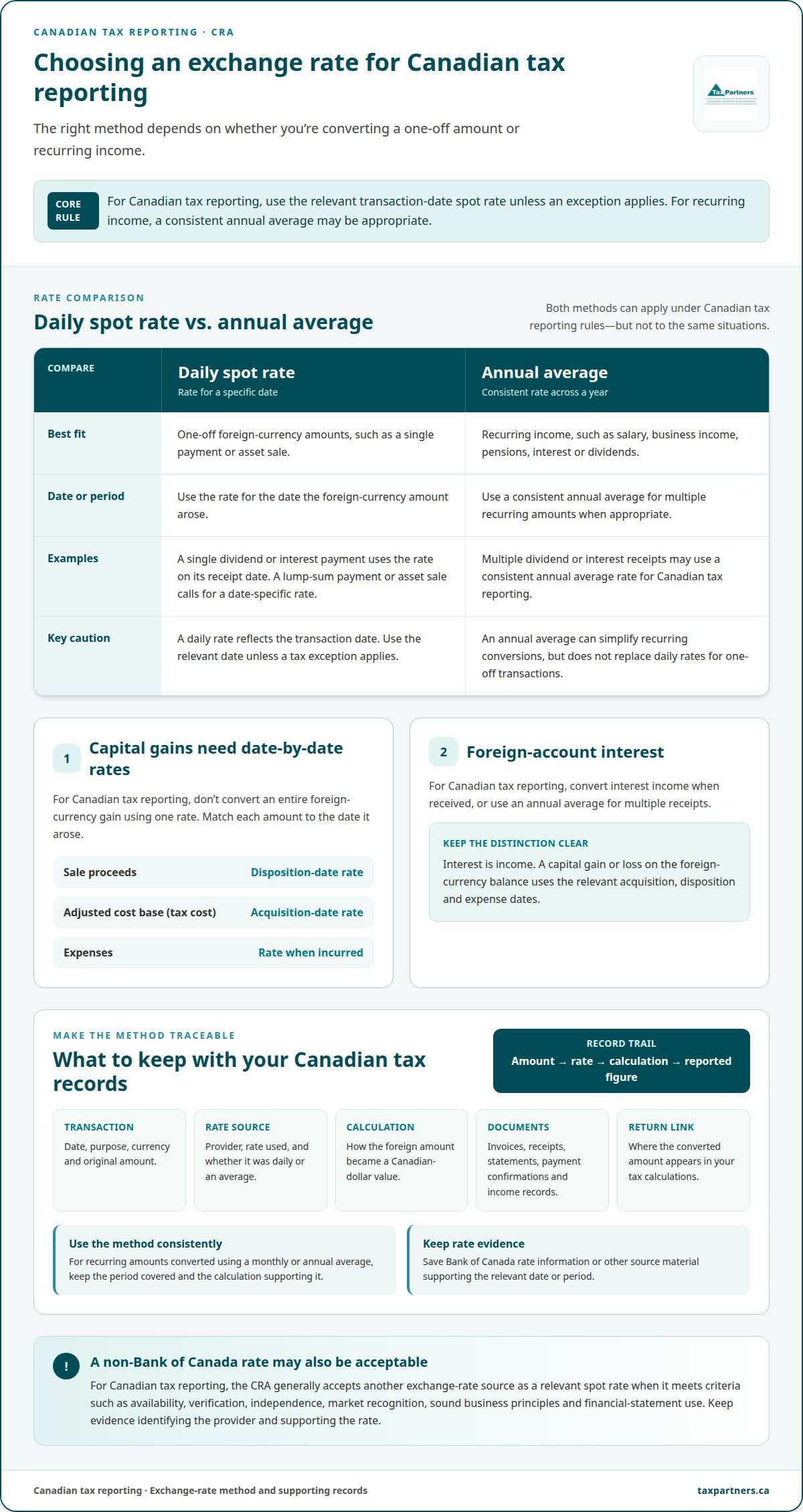
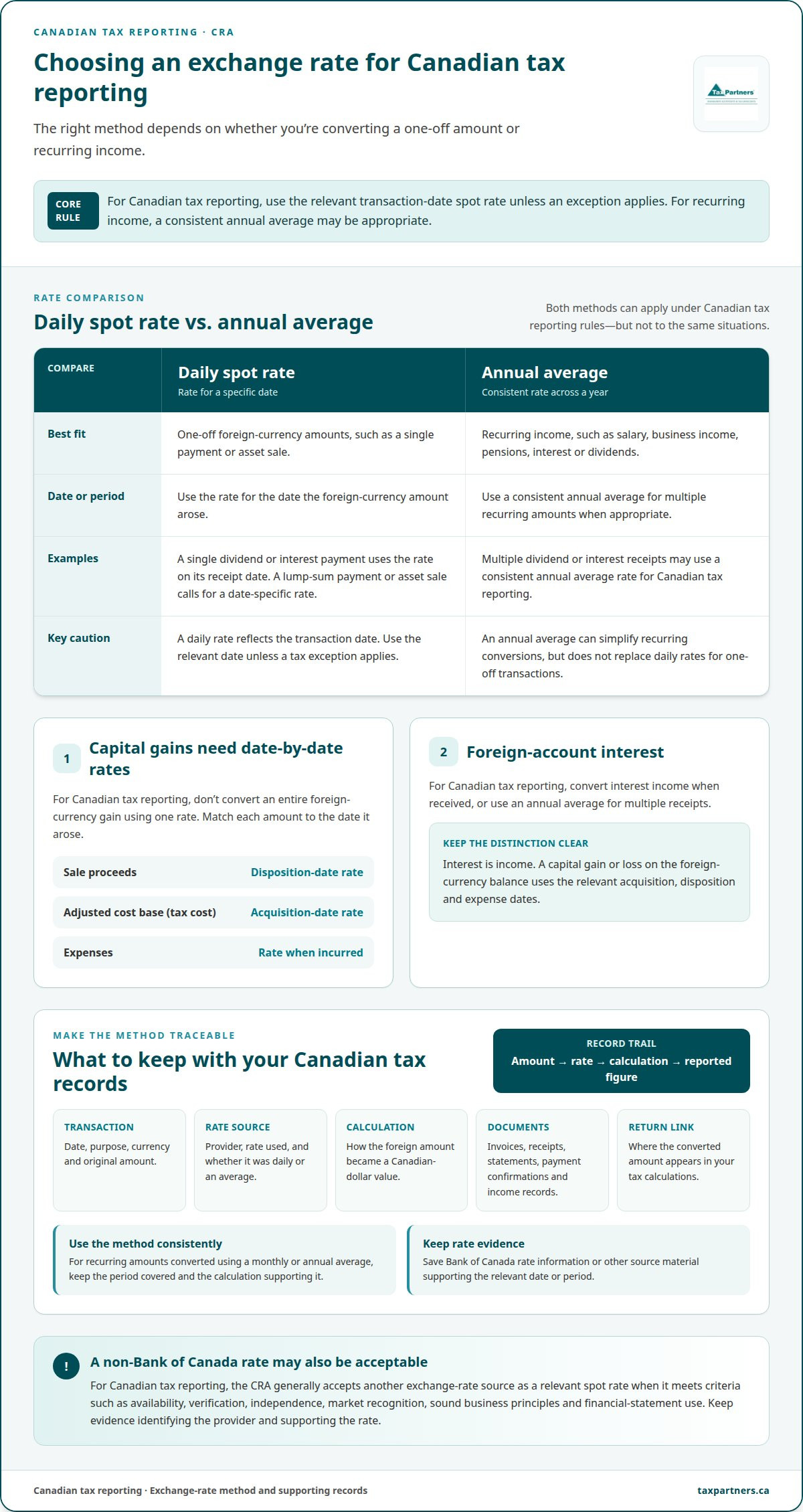
A daily rate is the exchange rate for a specific transaction date. For a one-time payment or asset sale, convert the foreign-currency amount using the relevant spot rate for the date it arose, unless a statutory exception applies.
Section 261(1) of Canada’s Income Tax Act generally requires foreign-currency amounts to be converted into Canadian dollars. That means the exchange rate can affect the reported amount even when the foreign amount stays unchanged.
For foreign-currency capital gains, use the disposition-date rate for the proceeds, the acquisition-date rate for the adjusted cost base, and the rate on the date expenses were incurred. This ties each part of the calculation to its own event, rather than applying one rate to the entire gain.
Cryptocurrency transactions in foreign currencies follow the same conversion principle: convert the relevant amount to Canadian dollars using the spot rate for the date it arose, unless an exception applies. For Canadian tax reporting, the transaction date and the nature of the amount determine which rate is relevant.
For a foreign bank account, distinguish interest income from currency movements. Convert interest when received, or use an annual average for multiple receipts. If a foreign-currency balance gives rise to a capital gain or loss calculation, convert amounts using the acquisition and disposition dates, and convert expenses when incurred.
Bank of Canada Rates for Income Tax
A Bank of Canada rate is an exchange rate published by the Bank of Canada for converting currencies. For Canadian income tax, the rate in effect when a foreign-currency amount arises is generally accepted as the spot rate.
For a single dividend or interest payment, use the rate on the receipt date. For multiple receipts during the year, you may use a consistent annual average rate. Keep the distinction clear in your accounting records: dividends and interest are income, while capital gains require date-specific conversions for proceeds, adjusted cost base and expenses.
Recurring income, such as salary, business income, pensions, interest or dividends, may be converted using a consistent annual average exchange rate. This can simplify repeated conversions for Canadian reporting, but it does not replace daily rates for one-off transactions, such as an asset sale or lump-sum payment.
The Canadian dollar’s exchange rate against the U.S. dollar changes over time, so the same foreign income can convert to different Canadian-dollar amounts on different dates. A daily rate reflects the transaction date; an annual average reflects exchange-rate movements across the year for recurring income. Choose the method that fits the amount and apply it consistently.
Documenting currency conversions for CRA questions
A conversion record shows how a foreign-currency amount was converted to Canadian dollars for tax reporting. For each transaction, connect the original amount, exchange rate, date, calculation and reported figure.
A clear record trail helps explain a return entry if the Canada Revenue Agency asks how you calculated it. Keep records together by tax year and income or expense category, rather than relying on a single annual total.
A transaction-level record lists converted amounts line by line for reporting. Include enough detail for someone to retrace each calculation:
- Transaction details: Record the transaction date, its purpose, the foreign currency, and the original amount.
- Rate evidence: Identify the exchange-rate source, the rate used, and whether it was a daily rate or period average.
- Calculation: Show how the foreign amount was converted and the resulting Canadian-dollar value.
- Supporting documents: Keep relevant invoices, receipts, account statements, payment confirmations, and income records.
- Reporting link: Note where the converted amount appears in your income, expense, or other tax calculations.
A rate-source record identifies where the exchange rate came from. Save the Bank of Canada rate information or other source material that supports the rate for the relevant date or period.
For example, an invoice paid in foreign currency should be linked to the invoice, payment record, selected rate and Canadian-dollar accounting entry. If it covers business expenses, preserve the itemized details showing what the payment covered.
Consistency means applying the chosen conversion method in the same way to comparable transactions. If you use an annual or monthly average for recurring amounts, keep the period covered and the calculation supporting that average.
The CRA generally accepts a non-Bank of Canada exchange rate as a relevant spot rate when it meets criteria for availability, verification, independence, market recognition, sound business principles and financial-statement use. Keep evidence identifying the provider and showing how the selected rate meets those criteria.
GST/HST records need their own method trail. Canadian GST/HST registrants must document and consistently use their chosen foreign-currency conversion method, generally for a year. Keep the source and calculation for the relevant GST/HST amounts separate from income tax working papers.
Before responding to a CRA question, organize records so each reported figure can be traced back to its transaction and source. For help with organizing Canadian tax records, bring together the supporting documents and conversion calculations.
Exchange-rate recordkeeping and documentation
Exchange-rate recordkeeping is the organized evidence behind each currency conversion in Canadian tax records. It connects the foreign amount and exchange rate to the transaction and Canadian-dollar entry.
A reference rate is the published or otherwise documented rate used for a conversion. Keep a copy or record of the source, the date or period it covers, and the currency pair, such as U.S. dollars to Canadian dollars.
Organize files by tax year, then group records by income, interest, capital transactions and expenses. This makes it easier to trace accounting entries from source documents to tax calculations without combining unrelated transactions in one total.
A useful transaction record includes the following details:
- Source document: Retain the statement, receipt, invoice, or payment confirmation showing the foreign-currency amount.
- Conversion details: Record the date, exchange rate, rate source, and Canadian-dollar result.
- Tax category: Identify whether the entry relates to income, interest, capital proceeds, an acquisition cost, or an expense.
- Calculation link: Connect the converted figure to the accounting ledger or tax working paper where it appears.
- Method note: Describe whether the calculation uses a daily rate or a period average, and apply the method consistently to comparable items.
For interest credited to a foreign account, retain the account statement and note the receipt date or averaging period used. For a capital transaction, keep purchase and sale documents distinct because their relevant exchange dates may differ.
Canadian GST/HST registrants must document their chosen foreign-currency conversion method and use it consistently, generally for a year. Keep records showing the source and method applied to GST/HST amounts, separate from income tax calculations where the accounting treatment differs.
Consistency does not mean using one rate for every transaction. A daily exchange rate may suit a one-off capital event, while a documented period average may suit recurring income. Explain why each method fits the transaction and preserve the underlying source material.
During a year-end review, reconcile converted totals with source statements and accounting records. Before using the figures for Canadian reporting, investigate differences such as a missing receipt, a rate entered for the wrong date or an amount recorded in the wrong currency.
Keep records in a form that lets you trace each reported amount back to its source and calculation. A clear reference trail helps explain how foreign income, interest, capital amounts and expenses were converted, without relying on memory.
Annual average and convenience-rate risks
An annual average exchange rate is a period-based rate for converting recurring foreign income into Canadian dollars. The CRA may accept a consistent annual or monthly average exchange rate when there are multiple payments during the period.
A convenience rate simplifies conversions rather than matching each transaction date. Convenience alone does not make a rate appropriate: the income pattern, rate period and consistent application all matter.
For recurring salary, business revenue, pension payments, interest or dividends, an annual average can simplify repeated conversions. Match the income category and period to the rate, and use the same method consistently for comparable receipts.
A one-time payment calls for a different consideration. A transaction-date rate reflects when that amount arose, while a monthly or annual average blends exchange-rate movements over a longer period. The choice can change the Canadian-dollar figure reported.
For illustration only, a hypothetical comparison uses a foreign receipt converted at a transaction-date rate of 1.3612 and a month-end average rate of 1.3480. The hypothetical resulting reported amounts are C$115,702 and C$114,580, respectively, a difference of over C$1,100.
This is why a convenient month-end rate shouldn’t automatically replace a transaction-date spot rate for an isolated amount. The less a transaction resembles recurring income, the more important it is to consider its specific date and nature.
The exchange-rate method should match the item being converted:
- Recurring payments: Consider a consistent annual average for multiple income receipts during the year.
- Single payments: Use the rate relevant to the date the amount arose, unless an exception applies.
- Capital transactions: Keep date-specific rates for proceeds, acquisition costs, and expenses in the calculation.
- Mixed income: Separate recurring revenue from one-off receipts instead of applying one average indiscriminately.
For illustration only, a hypothetical annual average exchange rate of 1.47 is used to convert euros to Canadian dollars for 2024; this is not a confirmed CRA rate. Other years and currencies require their own applicable rate, which readers should confirm with the CRA.
For Canadian income tax reporting, the CRA may accept a consistent annual or monthly average for multiple payments during a period. Keep the period, rate source and calculation with your records so you can explain the selected method alongside the reported income.
Convenience should not blur the distinction between recurring income and an isolated transaction. Matching the exchange-rate period to the payment pattern helps keep Canadian-dollar revenue and other reported amounts consistent.
Canadian-currency reporting rules
Canadian income tax generally requires foreign-currency amounts to be reported in Canadian dollars. Currency conversion for tax reporting in Canada depends on when an amount arose, its purpose and whether a statutory exception applies.
Reporting in Canadian Currency
Canadian-currency reporting means expressing amounts used to calculate Canadian income tax in Canadian dollars. Under section 261(1) of Canada’s Income Tax Act, one foreign-currency transaction in a tax year can trigger the conversion requirement.
For most amounts, identify when the foreign-currency amount arose and use the relevant spot rate. The Bank of Canada rate for that date is generally accepted for Canadian income tax reporting, unless a statutory exception applies.
Some qualifying Canadian corporations may elect under subsection 261(3) to calculate their Canadian tax results in a functional currency. This is the currency used for that tax calculation instead of Canadian dollars; it does not change the currency used to pay Canadian tax.
According to the Canada Revenue Agency, the functional-currency election must be filed within the first 61 days of the tax year to which it applies. Canadian tax amounts payable under the Act must still be paid in Canadian dollars, even when a corporation reports using an elected functional currency.
When neither currency in a transaction is Canadian, derive the relevant spot rate using Bank of Canada rates to exchange Canadian currency for each currency. This cross-rate method establishes the relationship through Canadian dollars rather than relying on a direct rate between the two foreign currencies.
Rates for Foreign Expenses, Deductions, and Tax Payments
A foreign-expense conversion expresses a cost incurred in another currency as a Canadian-dollar amount. For expenses, currency conversion for tax reporting in Canada generally uses the relevant rate when the amount arose, unless a statutory exception applies.
For a capital gain calculation, convert each expense using the rate in effect when it was incurred. Keep its date distinct from the acquisition and disposition dates, because those amounts may arise at different times and use different rates.
For a Canadian foreign tax credit, convert foreign income and related foreign taxes using the Bank of Canada rate in effect when each amount arose. Foreign tax paid on interest or dividend income may qualify for the credit and should not be netted against the income.
For certain taxes outside Parts I, VI, VI.1, and XIII.1 of Canada’s Income Tax Act, a functional-currency taxpayer uses the relevant spot rate on the day the amount is due. This rule applies to those specified taxes, not every income tax conversion.
Amounts payable under Canada’s Act must still be paid in Canadian dollars. For help applying Canadian-currency rules to a return, discuss your Canadian tax reporting.
Tax Partners
Tax Partners helps individuals and businesses apply Canadian currency-conversion rules to foreign income, expenses, investments and accounting records. Its Canadian Accounting & Tax Services can help when multiple currencies, recurring receipts, capital transactions or exchange-rate documentation make a return more complex.
Bring relevant transaction records and rate calculations to your discussion with Tax Partners. The firm can help organize how amounts were converted and reported, including when foreign income or cross-border activity adds complexity.
Contact Tax Partners to discuss your Canadian tax reporting needs.
Build a reliable process for the next reporting cycle
A reliable approach to currency conversion for Canadian tax reporting starts before year-end. Set a consistent process for capturing transaction details and choosing the right rate method, then carry it through your bookkeeping and tax preparation. This makes foreign-currency activity easier to manage as your business or investments evolve.
Tax Partners helps individuals and businesses organize tax calculations and supporting records. Its Bookkeeping and Payroll Services can support well-organized financial records, while its US & Cross-Border Accounting & Tax Services can help when foreign income or cross-border activity adds complexity to Canadian reporting.
Review your process when you add foreign accounts, receive income in another currency or make more international transactions. Doing so promptly can help identify recordkeeping gaps before they complicate your next filing.
Contact Tax Partners about your tax reporting to discuss a practical next step. With a clear process in place, you can approach your Canadian reporting with greater confidence.
Frequently Asked Questions
How are foreign exchange rates determined for reporting purposes in Canada?
For Canadian income tax, the relevant rate is generally the spot rate when the foreign-currency amount arises. The transaction’s nature and timing help identify that date. The Bank of Canada rate is generally accepted, and the CRA may accept another rate source if it meets its criteria and is used consistently. For transactions between two non-Canadian currencies, derive the rate using Bank of Canada rates against Canadian currency.
What exchange rate should Canadian taxpayers use to convert foreign income to Canadian dollars?
Use a rate that fits the income and its timing. A single payment generally calls for the spot rate when it arose, while multiple payments during a period may be converted using a consistent annual or monthly average. For example, distinguish a one-time bonus from recurring salary rather than automatically applying the same method to both. Use the selected method consistently for comparable amounts and retain its supporting calculation.
Can CRA’s annual average exchange rates be used for tax reporting in Canada?
Yes, a consistent annual average may be used for multiple foreign-currency payments during the period. It can be practical for recurring income, such as regular pension or investment receipts. The average should match the relevant period and income pattern; it is not automatically appropriate for every foreign amount. For a single payment or asset sale, consider whether the transaction-date rate better reflects when the amount arose.
When must taxpayers use the transaction-date exchange rate instead of an annual average rate?
A transaction-date rate is generally used for a one-off amount, unless a statutory exception applies. This is especially relevant when one event determines the amount, such as an asset sale or lump-sum payment. An annual average can smooth exchange-rate movements across recurring receipts, but may not reflect the rate on a specific transaction date. Link the transaction date to the conversion calculation.
How do you convert foreign employment income, dividends, interest, and rental income for a Canadian tax return?
Convert each income amount to Canadian dollars using the rate relevant to when it arose. For recurring employment income, dividends, interest or rental payments, a consistent annual average may be appropriate when there are multiple receipts during the period. A single payment generally uses its receipt-date rate. Keep income categories separate because payment frequency and timing can affect which approach fits.
How do Canadian taxpayers report foreign capital gains and losses in Canadian dollars?
Calculate the Canadian-dollar amount for each part of the transaction rather than converting only the final foreign-currency gain or loss. Use the disposition-date rate for proceeds, the acquisition-date rate for adjusted cost base, and the rate in effect when expenses were incurred. This may produce a different result from converting the net foreign amount at the sale-date rate. Retain the purchase and sale records.
How are foreign taxes converted to Canadian dollars when claiming a foreign tax credit in Canada?
Convert foreign income and foreign taxes using the Bank of Canada rate in effect when each amount arose. Keep evidence of the tax payment separate from the income statement, since they may relate to different dates. Foreign tax paid on interest or dividend income may qualify for a Canadian foreign tax credit; don’t subtract it from the income amount. Treaty-exempt income and related taxes are excluded from the credit calculation.
Where can taxpayers find official Bank of Canada and CRA exchange rates for tax reporting?
The Bank of Canada publishes exchange-rate information, including daily rates and annual averages. The CRA’s income tax guidance explains Canadian reporting methods and when other exchange-rate sources may be accepted. Match the rate table to the currency pair and reporting period you need. Save the rate information used with your tax working papers so you can trace the conversion to its published source later.

Article by
Mahad Mohamed
Mahad Mohamed is an accountant and the CEO of Tax Partners, with over 26+ years of Canadian and international tax and accounting experience. His expertise includes corporate reorganization, cross-border tax structuring (Canada & US), tax disputes, CRA audits, and tax planning for small owner-managed private corporations. Most recently, Mahad is a pioneer in Canadian crypto taxation and founded Block3 Finance.
Previously, Mahad worked for the Canada Revenue Agency (CRA), Big4 accounting firms, and served as a Rulings Officer for the Federal Tax Authority of the UAE before acquiring Tax Partners in 2014.
Tax Partners has 44 full-time accountants and over 18,400+ clients.
Disclaimer
This article provides general information only and is current as of its publication date. It has not been updated and may be out of date. It does not constitute legal advice and should not be relied upon as such. Every tax situation is unique and may differ from the examples discussed in this article. If you have specific questions, you should seek the advice of our accountants for your unique circumstances. Book a FREE Initial Consultation Today!
Frequently Asked Questions
How are foreign exchange rates determined for reporting purposes in Canada?
For Canadian income tax, the relevant rate is generally the spot rate when the foreign-currency amount arises. The transaction’s nature and timing help identify that date. The Bank of Canada rate is generally accepted, and the CRA may accept another rate source if it meets its criteria and is used consistently. For transactions between two non-Canadian currencies, derive the rate using Bank of Canada rates against Canadian currency.
What exchange rate should Canadian taxpayers use to convert foreign income to Canadian dollars?
Use a rate that fits the income and its timing. A single payment generally calls for the spot rate when it arose, while multiple payments during a period may be converted using a consistent annual or monthly average. For example, distinguish a one-time bonus from recurring salary rather than automatically applying the same method to both. Use the selected method consistently for comparable amounts and retain its supporting calculation.
Can CRA’s annual average exchange rates be used for tax reporting in Canada?
Yes, a consistent annual average may be used for multiple foreign-currency payments during the period. It can be practical for recurring income, such as regular pension or investment receipts. The average should match the relevant period and income pattern; it is not automatically appropriate for every foreign amount. For a single payment or asset sale, consider whether the transaction-date rate better reflects when the amount arose.
When must taxpayers use the transaction-date exchange rate instead of an annual average rate?
A transaction-date rate is generally used for a one-off amount, unless a statutory exception applies. This is especially relevant when one event determines the amount, such as an asset sale or lump-sum payment. An annual average can smooth exchange-rate movements across recurring receipts, but may not reflect the rate on a specific transaction date. Link the transaction date to the conversion calculation.
How do you convert foreign employment income, dividends, interest, and rental income for a Canadian tax return?
Convert each income amount to Canadian dollars using the rate relevant to when it arose. For recurring employment income, dividends, interest or rental payments, a consistent annual average may be appropriate when there are multiple receipts during the period. A single payment generally uses its receipt-date rate. Keep income categories separate because payment frequency and timing can affect which approach fits.
How do Canadian taxpayers report foreign capital gains and losses in Canadian dollars?
Calculate the Canadian-dollar amount for each part of the transaction rather than converting only the final foreign-currency gain or loss. Use the disposition-date rate for proceeds, the acquisition-date rate for adjusted cost base, and the rate in effect when expenses were incurred. This may produce a different result from converting the net foreign amount at the sale-date rate. Retain the purchase and sale records.
How are foreign taxes converted to Canadian dollars when claiming a foreign tax credit in Canada?
Convert foreign income and foreign taxes using the Bank of Canada rate in effect when each amount arose. Keep evidence of the tax payment separate from the income statement, since they may relate to different dates. Foreign tax paid on interest or dividend income may qualify for a Canadian foreign tax credit; don’t subtract it from the income amount. Treaty-exempt income and related taxes are excluded from the credit calculation.
Where can taxpayers find official Bank of Canada and CRA exchange rates for tax reporting?
The Bank of Canada publishes exchange-rate information, including daily rates and annual averages. The CRA’s income tax guidance explains Canadian reporting methods and when other exchange-rate sources may be accepted. Match the rate table to the currency pair and reporting period you need. Save the rate information used with your tax working papers so you can trace the conversion to its published source later.