Cross border tax issues for remote workers: employee status and payroll

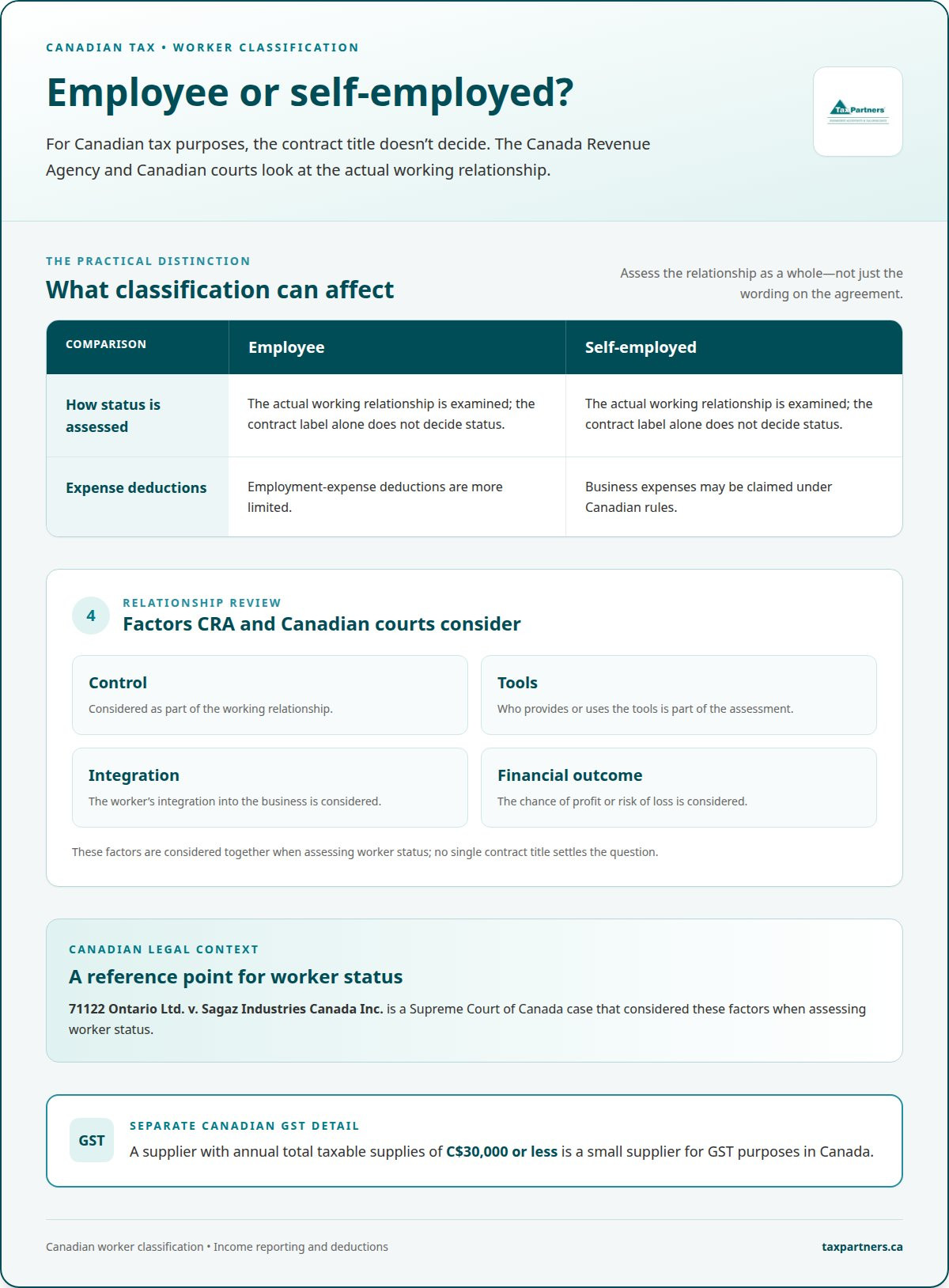
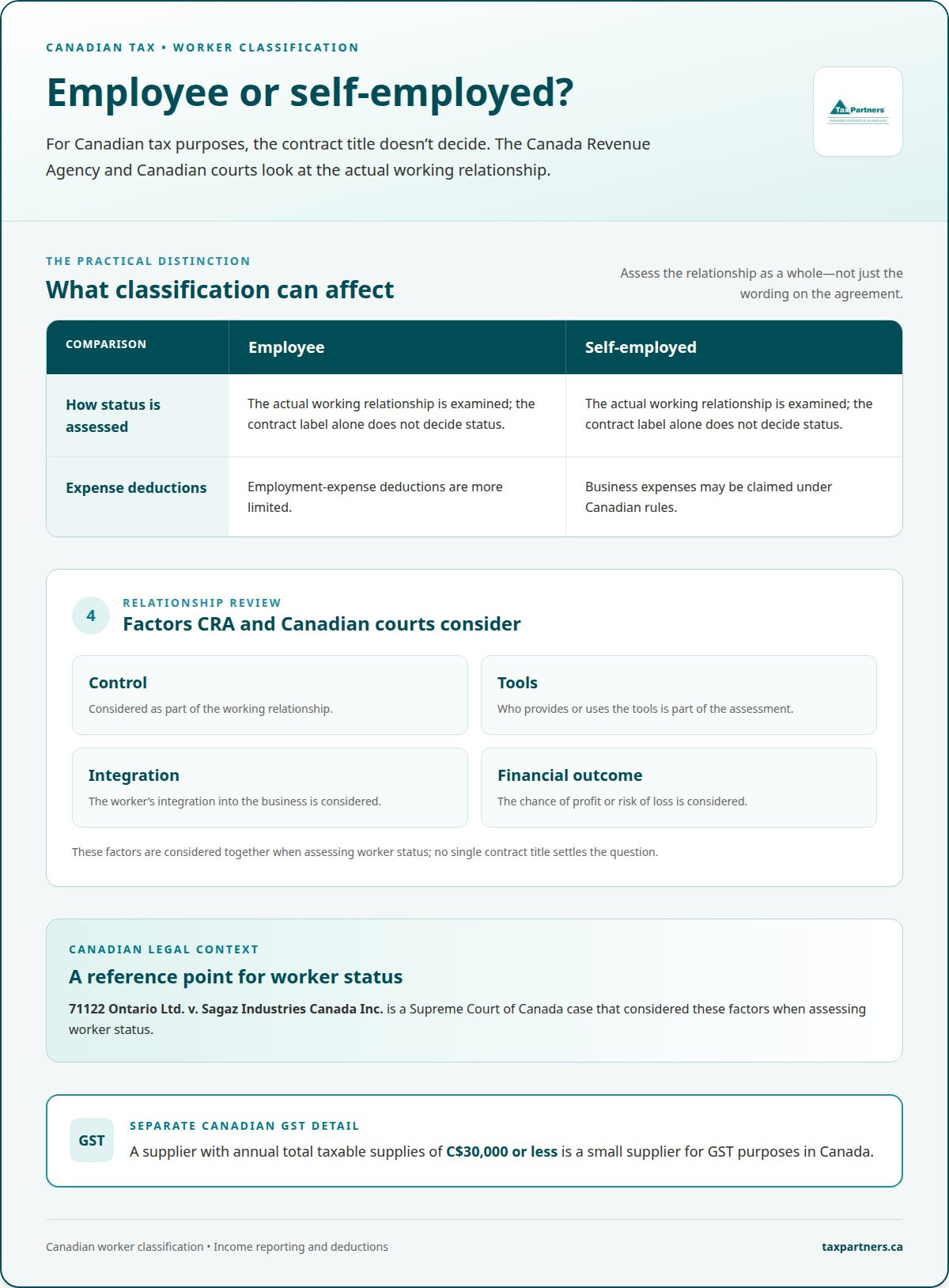
A worker’s contract title doesn’t decide whether they’re an employee or self-employed for Canadian tax purposes. The Canada Revenue Agency looks at the actual working relationship, and that classification shapes Canadian income reporting and payroll responsibilities.
It’s easy to assume a remote arrangement changes only where the work gets done. For Canadian tax purposes, a worker’s classification, residency and work location can each affect how income is treated and what the employer must report.
This article explains how to assess worker classification, understand Canadian payroll and withholding responsibilities, and identify when an employee’s activities may raise a permanent establishment concern for a business. It offers a practical framework for reviewing a remote-work arrangement under Canadian tax rules.
Key Takeaways
- Assess employee or contractor status from the working relationship, including control, tools, integration and financial risk, not just the contract title.
- Map where the work is physically performed to understand how Canadian tax rules apply and where payroll withholding may be required.
- Separate income tax from social contributions: CPP coverage involves distinct considerations.
- For a Canadian working remotely, consider CRA rules alongside any Canadian filing obligations.
- Review what an employee does from a home office, including their authority to make decisions for the business.
1. Employee or Independent Contractor?
A contract’s label doesn’t decide whether someone is an employee or independent contractor for Canadian tax purposes. The Canada Revenue Agency and Canadian courts examine the actual working relationship, including control, tools, integration, and the chance of profit or risk of loss. In 71122 Ontario Ltd. v. Sagaz Industries Canada Inc., the Supreme Court of Canada considered these factors when assessing worker status.
Classification affects how income is reported and which expenses may be deducted under Canadian rules. Self-employed people may claim business expenses, while employees have more limited employment-expense deductions. According to the Canada Revenue Agency, a supplier with annual total taxable supplies of C$30,000 or less is a small supplier for GST purposes in Canada.
Canadian tax residency depends on residential ties and other circumstances, not only a worker’s job title or payroll location. Under ITA 250, sufficient residential ties can make someone a Canadian tax resident, and Canada taxes residents on worldwide income. Spending more than 183 days in Canada can also be relevant, but the day count alone doesn’t settle residency.
A Canadian working remotely abroad should distinguish tax residency from the source of employment income. Income is generally sourced to where the employee physically performs the services. A Canadian resident working abroad may therefore earn income connected to work outside Canada while remaining subject to Canadian tax on worldwide income.
A non-resident of Canada can still earn Canadian-source employment income. For example, someone living abroad who physically performs work in Canada may earn income connected to services performed here, even if the employer and payroll are outside Canada. Work-location records help show where those services were performed.
Keep residency and work records together: travel dates, homes maintained, employment agreements, payroll statements, and work locations. A calendar can show time spent in Canada, while work logs can identify where services were performed. These records help explain Canadian tax residency and income reporting if circumstances change.
For cross border tax issues for remote workers, Canadian residency, worker classification and the location of services are separate questions. Reviewing them together clarifies which Canadian reporting and payroll considerations may apply. Revisit the analysis when the employee’s duties, work location or residential ties change, rather than relying only on the original agreement.
Canadian tax rules don’t determine permission to work in another country. A Canadian working remotely abroad must follow the destination country’s visa and work-permit requirements, which are separate from Canadian tax residency. For cross border tax issues for remote workers, keep immigration status distinct from the Canadian tax analysis: one decision does not answer the other.
2. How does payroll work across the border?
For Canadian tax purposes, the payroll provider’s location doesn’t determine how employment income is treated. Income is generally sourced to where the employee performs the services, so workdays in Canada and abroad may need separate records. If payroll groups all workdays together, it may be harder to explain the Canadian reporting position.
Canadian residents report worldwide income. Income from services performed outside Canada may therefore still need to be included on a Canadian tax return. Keep gross employment income, payroll statements and work-location records together so you can reconcile the amount reported with the employment arrangement.
Double taxation is a concern when the same income is taxed in more than one jurisdiction. From the Canadian side, ITA 126(1) provides a foreign tax credit for tax paid on the same income. A credit is not an exclusion from income: the income remains part of Canadian reporting, and the credit is considered in calculating Canadian tax payable.
To support a Canadian foreign tax credit, link the tax paid to the income it relates to. Keep the relevant payroll statement, payment evidence and income calculation together. If a payroll deduction combines different taxes or contributions, identify each amount separately rather than treating the full deduction as income tax.
Withholding and the final Canadian tax calculation serve different purposes. Payroll withholding is collected during the year; the Canadian tax return reports income and calculates the taxpayer’s final position. Any difference between tax withheld and the amount payable must be reconciled, so retain payroll records even when deductions appeared regular.
A practical Canadian reconciliation compares payroll statements with work-location records and reported income. For example, if an employee performed services both in Canada and abroad, keep the dates and related pay information clear. Match foreign tax payments to the income concerned before considering a Canadian foreign tax credit.
This helps identify missing income or credits before filing.
Employers can keep the Canadian payroll file aligned with the employee’s work arrangement by recording the role, where services are performed, income paid and Canadian deductions remitted. Update the records when the arrangement changes instead of relying on the original payroll setup to describe a new work pattern.
For assistance organizing Canadian reporting and payroll records, discuss your cross-border payroll situation.
3. International payroll withholding and social contributions
A cross-border employee can trigger Canadian payroll duties even when the employer operates abroad. Canadian Regulation 102 requires withholding and remittance on remuneration paid to a non-resident employee for employment services performed in Canada.
Canadian Regulation 105 addresses payments to non-residents for services rendered in Canada, except payments for an office or employment. Employers must distinguish employee remuneration from other service payments before applying the relevant Canadian withholding rules.
A non-resident employer with an employee continuing to work remotely from Canada as of January 1, 2021, must withhold and remit under Canadian law or obtain a Canada Revenue Agency waiver of the withholding requirement. The employer’s payroll process must account for Canadian deductions and remittances, rather than relying only on payroll arrangements in the employee’s home country.
Employer registration and withholding are connected but distinct. The employer needs a process to meet applicable Canadian payroll obligations, including remitting withheld amounts; an applicable waiver can affect the withholding requirement. A treaty may reduce or eliminate domestic withholding tax on certain payments to non-residents, but it does not automatically resolve every payroll or employment obligation.
Social contributions require a separate review. A US employer with an employee working in Canada may need to withhold Canadian income tax and remit Canada Pension Plan (CPP) and Employment Insurance (EI) contributions. The employee’s work location and employment arrangement help determine which Canadian obligations apply.
Foreign payroll deductions also need careful treatment on the Canadian tax return. A Canadian-resident individual who made valid US Federal Insurance Contributions Act (FICA) contributions in 2020 may claim a Canadian foreign tax credit for those contributions. That historical treatment does not establish how other US social contributions should be handled.
Keep FICA contributions separate from US retirement plan contributions. A payroll record showing a retirement contribution does not, by itself, establish a deduction on a Canadian tax return. Canadian treatment depends on the plan and applicable rules, so payroll records should identify the contribution type and the country that received it.
Organize each employee’s payroll data by work country, income, Canadian withholding, CPP and EI, US FICA, and retirement contributions. Reconcile these records with the employee’s tax residency and return reporting to help distinguish income tax credits from social contribution questions.
When a cross-border arrangement makes payroll treatment difficult to determine, get help reviewing cross-border payroll obligations.
4. What happens when a Canadian works remotely from the US?
For Canadian tax purposes, where the employee performs the work matters. Employment income is generally taxed in the country where services are physically performed, not where the employer is located or the paycheque originates. A Canadian working from a US home office therefore needs to consider US tax on that work alongside any Canadian obligations tied to tax residency.
The Canada-US tax treaty can provide relief for some short stays. Under Article XV(2) of the treaty, employment income for work in the other country may be exempt from source-country tax if the pay for that work is US$10,000 or less for the year. This is a treaty exemption, not a blanket rule for every Canadian employee working in the United States.
A Canadian may need to file a US Form 1040-NR to claim a treaty exemption, even when the exemption means the income isn’t taxed in the United States. Filing and tax payable are separate questions: an exemption can affect the final US tax result without removing a reporting requirement.
Review Canadian and US personal tax obligations together, not as separate compliance silos. A Canadian tax resident may have Canadian reporting obligations while the United States also taxes work performed there. Coordinate the income reported, work location and any treaty position across the relevant returns to reduce mismatches.
Social Security and Canada Pension Plan coverage is a separate question from income tax. The employee’s work location, employer and payroll deductions help identify which social contribution system is being applied. Track US Social Security deductions and CPP contributions separately; a deduction from one payroll does not, by itself, establish how the other country treats the employee’s coverage.
For a Canadian employee, review payroll records to identify the country named on each deduction and the period it covers. Keep employer statements and contribution records with the Canadian and US tax documents. This creates a clear record for distinguishing income tax withholding from social contributions when preparing each country’s reporting.
Moving abroad permanently can change the Canadian tax analysis. A person who becomes a non-resident of Canada may face departure tax in the year they leave, based on capital gains from the deemed disposition of certain property at fair market value on the departure date. Departure tax is distinct from tax on salary earned while working in the United States.
Keep the move date, work location, payroll records and property information together. These details help clarify Canadian residency, possible departure tax and US-source employment income. Coordinate Canadian personal tax reporting with the cross-border facts of the move instead of treating it as an isolated corporate payroll question.
5. Permanent establishment risks for remote work
A foreign employer with a remote employee in Canada must consider two separate questions: Canadian payroll obligations and corporate income tax presence. A permanent establishment is a taxable business presence in another country. Under the Canada-US tax treaty, an employee’s home office can contribute to this risk in specific circumstances.
Article V(5) of the Canada-US tax treaty identifies a key concern: an employee habitually exercises authority to conclude contracts for the employer. For example, a Canadian-based employee who regularly commits a US company to customer contracts presents a different risk profile from someone who only performs internal support work.
The employee’s activities matter more than the home office label. Review what decisions the employee makes, whether they negotiate or conclude contracts, and how those activities affect the employer’s business. A home office alone does not establish the treaty condition described in Article V(5), but the employee’s actual authority and repeated conduct are central to assessing the risk.
Article V(6) of the Canada-US tax treaty identifies activities that may be preparatory or auxiliary, including advertising, supplying information and scientific research. These examples help frame the analysis, but the nature of the work and its role in the employer’s business remain important. Providing information as a supporting activity differs from routinely securing or finalizing business contracts.
For a foreign employer hiring someone who lives and works in Canada, the analysis extends beyond permanent establishment. Canadian rules can require withholding and remittance on employment remuneration for services performed in Canada. The employer may also need to consider Canadian income tax and social contribution responsibilities. A treaty analysis for corporate taxation does not replace a separate review of payroll obligations.
Using a professional employment organization to administer an overseas employee does not necessarily prevent that employee from creating an international tax presence for the company. Payroll administration and the employer’s exposure to Canadian taxation are separate questions. The employee’s contract authority and day-to-day activities still need consideration.
Document the employee’s role, work location, contract responsibilities and business activities. For example, records showing whether the employee can approve terms or bind the company help distinguish support tasks from contract authority. Review these details as the role changes, especially if responsibilities expand to include customer negotiations.
For a structured review of Canadian payroll and permanent establishment exposure, discuss your cross-border tax position.
Tax Partners: Canadian Accounting & Tax Services
Tax Partners helps individuals and businesses address Canadian tax and payroll work for remote arrangements. Its Canadian Accounting & Tax Services address Canadian filing needs and payroll administration.
For employers, Tax Partners’ Bookkeeping and Payroll Services support payroll administration when employees work remotely. Consider professional support when worker classification, withholding obligations or home-office activities raise questions about Canadian requirements.
Bringing the employment arrangement, payroll records and tax reporting together can help clarify the issues to address. Contact Tax Partners to discuss your Canadian tax and payroll needs.
Plan for the next change
A remote-work arrangement can shift as an employee’s location, responsibilities or work pattern change. Treat each change as a new planning point, not simply an update to an existing payroll record. This helps employers and workers identify Canadian tax and reporting questions before year-end.
A practical next step is to document the arrangement’s current facts: where the work takes place, who directs it and what authority the employee holds. Revisit those details when the role or location changes. A clear record supports Canadian tax reporting and helps keep decisions consistent across the employment relationship.
Thoughtful planning makes Canadian tax issues for remote workers easier to manage as circumstances evolve. Tax Partners can help clarify the accounting, tax and payroll considerations relevant to your situation.
Start a conversation with Tax Partners about your next remote-work arrangement. A clear plan can make the next decision easier.
Frequently Asked Questions
Employee or Independent Contractor?
Assess how the work operates in practice, not only the title in the agreement. For example, a designer who sets their own schedule, uses personal equipment and serves several clients may have a different relationship from someone whose manager directs daily tasks and methods. In Canada, control, tools, integration and financial risk help determine worker status. Classification affects payroll treatment and which expense deductions may be available.
How does payroll work across the border?
Payroll must account for the employee’s work location, not just the employer’s address or payroll platform. For example, a Canadian resident paid through a US payroll system may still have Canadian reporting and withholding considerations. Keep payroll records aligned with income reported on each relevant tax return. If two countries tax the same income, review whether a foreign tax credit or treaty relief applies.
What about state and provincial taxes?
Canadian provincial tax and US state tax follow separate jurisdictional rules. For Canadian provincial income tax, the province where a remote worker resides on December 31 determines the applicable provincial tax. US state residency tests differ by state; New York, for example, may deem someone a resident after 184 days or more there. Track work and residence locations separately, since a state’s rules don’t replace Canadian provincial requirements.
What are the practical compliance steps?
Create one cross-border file for the employment agreement, payroll summaries, work-location calendar and tax correspondence. Each pay period, record where the employee performed services and which country withheld tax. At tax-return time, reconcile income and withholding by jurisdiction, then document any foreign tax credit claimed. Employers should review the worker’s duties and contract authority when the role or work location changes.
What happens when a Canadian works remotely from the US?
Work performed in the United States can create US tax and reporting obligations, while Canadian tax residency can preserve Canadian reporting responsibilities. Under Article XV(2) of the Canada-US tax treaty, employment income for work in the other country may be exempt from source-country tax if the pay for that work is US$10,000 or less for the year. A Canadian may still need Form 1040-NR to claim that treaty exemption.
What is cross-border taxation?
Cross-border taxation involves the interaction of tax rules when income, work, residence or business activities connect to more than one country. A Canadian resident working for a US employer is one example: work location may affect source-country tax, while Canadian residency can affect Canadian reporting. The Canada-US tax treaty may coordinate certain income tax outcomes, but it does not automatically resolve payroll, social contributions or local employment-law matters.
What should I do next?
Start by identifying the worker’s status, tax residency, work locations and payroll deductions. Then align Canadian and US records before preparing returns or changing payroll procedures. For arrangements involving more than one jurisdiction, Tax Partners offers Canadian Accounting & Tax Services, US & Cross-Border Accounting & Tax Services, and Bookkeeping and Payroll Services. Contact Tax Partners for a free initial consultation about the tax and payroll questions relevant to your situation.
What’s the permanent establishment risk?
A permanent establishment is a potential taxable business presence in another country. Under Article V(5) of the Canada-US tax treaty, risk may arise when an employee habitually exercises authority to conclude contracts for the employer. For example, regularly committing a company to customer agreements is different from providing internal support. Review the employee’s actual authority, contract activities and role in the business, rather than relying only on their job title.

Article by
Mahad Mohamed
Mahad Mohamed is an accountant and the CEO of Tax Partners, with over 26+ years of Canadian and international tax and accounting experience. His expertise includes corporate reorganization, cross-border tax structuring (Canada & US), tax disputes, CRA audits, and tax planning for small owner-managed private corporations. Most recently, Mahad is a pioneer in Canadian crypto taxation and founded Block3 Finance.
Previously, Mahad worked for the Canada Revenue Agency (CRA), Big4 accounting firms, and served as a Rulings Officer for the Federal Tax Authority of the UAE before acquiring Tax Partners in 2014.
Tax Partners has 44 full-time accountants and over 18,400+ clients.
Disclaimer
This article provides general information only and is current as of its publication date. It has not been updated and may be out of date. It does not constitute legal advice and should not be relied upon as such. Every tax situation is unique and may differ from the examples discussed in this article. If you have specific questions, you should seek the advice of our accountants for your unique circumstances. Book a FREE Initial Consultation Today!
Frequently Asked Questions
Employee or Independent Contractor?
Assess how the work operates in practice, not only the title in the agreement. For example, a designer who sets their own schedule, uses personal equipment and serves several clients may have a different relationship from someone whose manager directs daily tasks and methods. In Canada, control, tools, integration and financial risk help determine worker status. Classification affects payroll treatment and which expense deductions may be available.
How does payroll work across the border?
Payroll must account for the employee’s work location, not just the employer’s address or payroll platform. For example, a Canadian resident paid through a US payroll system may still have Canadian reporting and withholding considerations. Keep payroll records aligned with income reported on each relevant tax return. If two countries tax the same income, review whether a foreign tax credit or treaty relief applies.
What about state and provincial taxes?
Canadian provincial tax and US state tax follow separate jurisdictional rules. For Canadian provincial income tax, the province where a remote worker resides on December 31 determines the applicable provincial tax. US state residency tests differ by state; New York, for example, may deem someone a resident after 184 days or more there. Track work and residence locations separately, since a state’s rules don’t replace Canadian provincial requirements.
What are the practical compliance steps?
Create one cross-border file for the employment agreement, payroll summaries, work-location calendar and tax correspondence. Each pay period, record where the employee performed services and which country withheld tax. At tax-return time, reconcile income and withholding by jurisdiction, then document any foreign tax credit claimed. Employers should review the worker’s duties and contract authority when the role or work location changes.
What happens when a Canadian works remotely from the US?
Work performed in the United States can create US tax and reporting obligations, while Canadian tax residency can preserve Canadian reporting responsibilities. Under Article XV(2) of the Canada-US tax treaty, employment income for work in the other country may be exempt from source-country tax if the pay for that work is US$10,000 or less for the year. A Canadian may still need Form 1040-NR to claim that treaty exemption.
What is cross-border taxation?
Cross-border taxation involves the interaction of tax rules when income, work, residence or business activities connect to more than one country. A Canadian resident working for a US employer is one example: work location may affect source-country tax, while Canadian residency can affect Canadian reporting. The Canada-US tax treaty may coordinate certain income tax outcomes, but it does not automatically resolve payroll, social contributions or local employment-law matters.
What should I do next?
Start by identifying the worker’s status, tax residency, work locations and payroll deductions. Then align Canadian and US records before preparing returns or changing payroll procedures. For arrangements involving more than one jurisdiction, Tax Partners offers Canadian Accounting & Tax Services, US & Cross-Border Accounting & Tax Services, and Bookkeeping and Payroll Services. Contact Tax Partners for a free initial consultation about the tax and payroll questions relevant to your situation.
What’s the permanent establishment risk?
A permanent establishment is a potential taxable business presence in another country. Under Article V(5) of the Canada-US tax treaty, risk may arise when an employee habitually exercises authority to conclude contracts for the employer. For example, regularly committing a company to customer agreements is different from providing internal support. Review the employee’s actual authority, contract activities and role in the business, rather than relying only on their job title.