Cross border financial planning for retirement and estate needs

A child with Canadian and U.S. citizenship can make family wealth planning a two-country exercise. A cross border financial planner helps coordinate retirement accounts, estate plans, and family wealth decisions across Canada and the U.S., considering how choices in one country may affect the other. Planning may include a child’s future inheritance and how assets are held and transferred.
It’s understandable to expect one financial plan to cover the whole family. But different tax rules, account structures, and estate arrangements can complicate planning when family members or assets have ties to both countries. A coordinated approach brings those moving parts into view while keeping your family’s priorities at the centre.
Here, you’ll learn how cross-border planning can connect retirement, estate, and investment decisions, especially when children hold dual citizenship. We’ll consider coordination among financial and tax professionals, estate-planning details families should review, and how to turn a broad picture of your needs into a practical plan.
Key Takeaways
- Coordinate financial, tax and legal advice so retirement, investment and estate decisions across Canada and the U.S. work together.
- Align wills, trusts and beneficiary arrangements with family ties and assets in both countries.
- Assess an advisory firm’s experience with the relevant jurisdictions and complex cross-border planning needs.
- Plan retirement income with attention to account types, withdrawal timing, government benefits and currency exposure.
- For children with dual citizenship, consider how future inheritance and family wealth decisions may affect their cross-border financial picture.
Coordination with accountants, lawyers, and portfolio managers
Canadian financial planning works best when tax, legal, and investment decisions reflect the same household priorities. Coordinating accountants, lawyers, and portfolio managers can connect account ownership, retirement timing, and the income needed to support your lifestyle.
Investment Planning and Account Structures
Investment planning considers which accounts hold your assets, who owns them, and how each supports your goals. For example, a Canadian household may hold an RRSP, or registered retirement savings plan, alongside a TFSA, or tax-free savings account. Each has a different planning role, so decisions should reflect the owner’s intended use, time horizon, and financial needs.
Canadian tax treatment depends on factors such as residency and the type of account or transaction. Canada taxes individuals based on residency rather than citizenship. An accountant can assess how those factors apply, while a portfolio manager considers how investments support planned income and risk preferences. A lawyer can advise on ownership arrangements and their relationship to estate documents.
Retirement planning also needs to connect account choices with future withdrawals. Someone nearing retirement may need a different investment approach from someone saving for a longer-term goal. Before recommending changes, the professionals involved can coordinate expected withdrawal timing, the accounts intended to provide income, and the household’s other financial commitments.
For Canadian investments, consider the account structure alongside the asset itself. A TFSA, RRSP, and non-registered investment account may each serve a different purpose in a household plan. Reviewing the owner, intended beneficiary, investment strategy, and expected use together clarifies each account’s role instead of treating every holding as interchangeable.
Relocating Assets and Investments
When assets move between financial institutions or ownership arrangements change, review the account’s purpose and associated records. A transfer can affect how assets fit into the broader plan, especially if the account supports retirement income or a family goal. A Canadian accountant and portfolio manager can coordinate tax and investment considerations before the household changes its structure.
Keep the review practical: map the accounts, identify each owner, record the intended use, and note upcoming withdrawals or major purchases. Then share those details with the professionals responsible for tax, legal, and investment advice. This gives them a common view of the facts and helps keep recommendations aligned.
A cross-border financial planner may not be necessary for a plan focused solely on Canadian accounts. A Canadian financial plan can bring the relevant domestic advice together: an accountant can assess Canadian tax considerations, a lawyer can address ownership documents, and a portfolio manager can align investments with household goals.
Estate planning across Canada and the U.S.
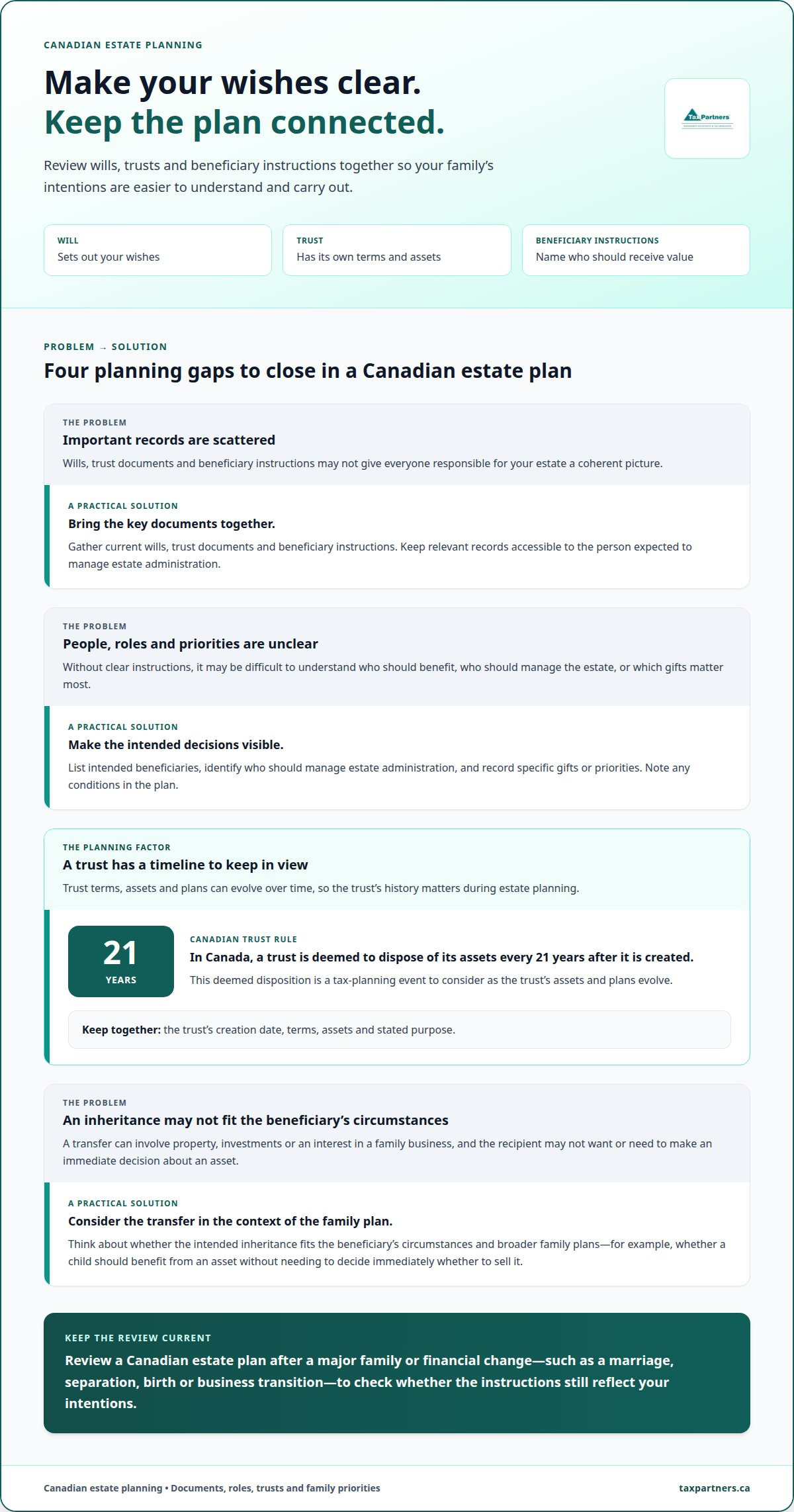
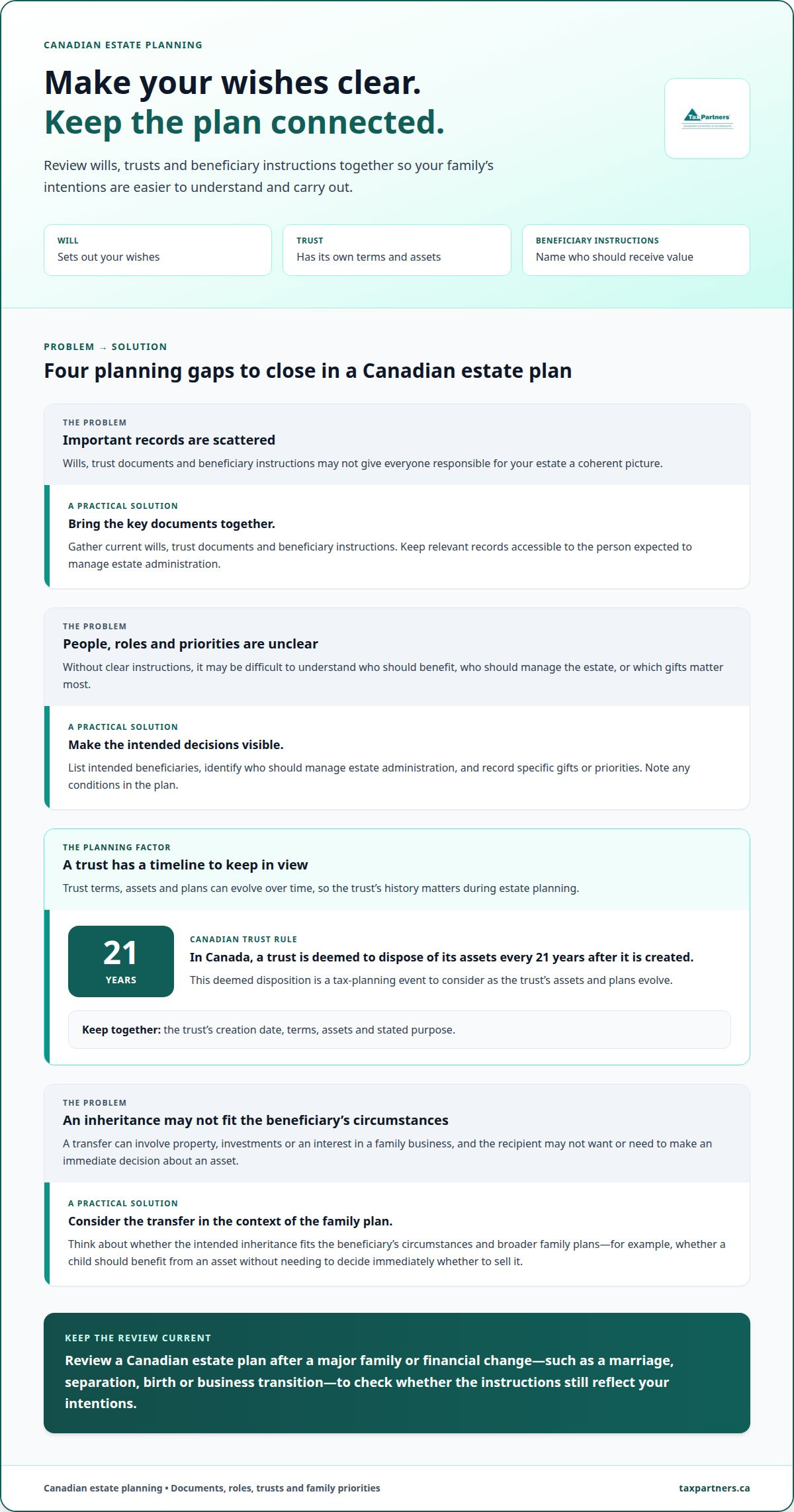
For a Canadian estate plan, the central task is to make your wishes clear and keep documents and arrangements consistent. A will, a trust, and beneficiary instructions can each play a distinct role. Review them together so the people responsible for carrying out your intentions have a coherent picture.
Begin with the people and decisions that matter. Name the intended beneficiaries, identify who you want to manage estate administration, and record specific gifts or priorities. For example, a parent may want a particular asset preserved for a child while other estate assets support the family more broadly. Clear instructions make these priorities easier to understand.
Trusts need ongoing attention, not just careful creation. In Canada, a trust is deemed to dispose of its assets every 21 years after it is created. This deemed disposition is a tax-planning event to consider as the trust’s assets and plans evolve. Keep the trust’s creation date, terms, and asset information together so the planning discussion can account for the trust’s timeline.
A Canadian estate plan should also consider how beneficiaries may receive value. An inheritance could include property, investments, or an interest in a family business. Consider whether the intended transfer fits the beneficiary’s circumstances and the family’s broader plans. For instance, a parent might want a child to benefit from an asset without needing to decide immediately whether to sell it.
Organize a review around practical records and decisions:
- Gather current wills, trust documents, and beneficiary instructions.
- Record the trust’s creation date and summarize its assets and stated purpose.
- List intended beneficiaries and note any specific gifts or conditions in the plan.
- Identify the person expected to manage estate administration and make sure the relevant records are accessible.
Review the plan after a major family or financial change, such as a marriage, separation, birth, or business transition. These events can affect who should benefit and whether existing instructions still reflect your intentions. A Canadian estate review can also consider how future income needs and long-term family goals fit the planned transfers.
Keeping the records organized gives your estate-planning discussions a practical starting point. If you need help considering Canadian tax implications alongside your financial plan, discuss your estate-planning needs.
Canada-US cross-border financial advisory firms
For a Canadian household, a sound financial plan starts with Canadian residency, income, assets, and goals. An advisory firm can coordinate financial planning with Canadian tax advice, bringing investment choices and future income needs into the same discussion. This Canadian focus helps organize decisions without treating each account or financial goal in isolation.
Planner Credentials
When assessing a financial advisor’s background, consider credentials such as CFP, TEP, and CIM. Each designation reflects a professional focus, so look for experience that matches your needs, such as retirement planning, estate considerations, or family wealth. Ask how recommendations fit your financial priorities and how tax-related questions are addressed in the planning process.
Professional fit also depends on the work involved. A planner should explain the scope of their advice clearly, including how investment recommendations connect with your wider financial plan. When a decision calls for tax or legal expertise, the planning process should identify those responsibilities and coordinate the relevant input.
Tax-Aware Planning Across Borders
A Canadian tax-aware financial plan considers the relationship between investment choices, account structures, income, and residency. An investment’s tax treatment can depend on the account holding it and the owner’s circumstances. Review these factors before changing an investment strategy, especially when a decision could affect future income or estate objectives.
Currency exposure can also influence the Canadian-dollar value of investments and income. A plan should consider how that exposure relates to your goals and risk preferences, rather than treating exchange-rate movements as a standalone investment decision. This keeps tax and portfolio discussions grounded in the household’s Canadian financial picture.
Coordinating Canadian and U.S. Income Taxes
For a Canadian-focused plan, start by organizing Canadian income sources, account ownership, and investment activity. A Canadian tax professional can assess how these details relate to Canadian tax reporting, while a financial advisor considers their effect on savings and cash flow. Keep the roles distinct, then coordinate advice when a tax decision may affect the financial plan.
For example, a change in employment income or an investment sale can affect both the household’s available funds and its tax planning. Recording the transaction’s timing, ownership, and purpose gives each professional a shared basis for advice.
Planning for a Move Between Countries
A planned move can affect a Canadian financial plan through changes in residency, income, and asset management. Before relocating, organize records of Canadian accounts, investments, property, and expected income. This gives the planning team a clear view of assets connected to Canada and decisions that may need attention before departure.
Canadian departure-tax considerations can depend on asset type. Canadian real estate, Canadian business property, and assets held in Canadian registered accounts are identified as exceptions to departure tax. A Canadian tax professional can assess the relevant asset categories, while the financial plan accounts for the timing and purpose of investment decisions.
Retirement planning for expatriates and dual-country households
Retirement planning needs to reflect where you live, where your income comes from, and which accounts you hold. For households connected to Canada and the United States, these details shape planning for relocation, retirement income, and potential double taxation.
Planning for Relocation and Retirement
Before relocating, map your expected retirement date, income sources, account locations, and intended country of residence. For example, someone moving from Canada to the United States may need to consider Canadian retirement accounts alongside U.S. income and future living costs. These details help organize decisions around the move instead of treating relocation and retirement as separate events.
People who move between Canada and the United States may be able to keep their retirement accounts. The key planning questions are how those accounts will be managed and when withdrawals will support the household. A coordinated review considers the move’s timing, account structure, and retirement goals before an investment is changed or income is drawn.
Build the plan around the household’s actual transition. One spouse may relocate while another remains in Canada, or both may move before retirement begins. In either case, record each person’s residence plans, account ownership, expected income, and retirement timeline. This gives the planning team a clearer picture of the family’s needs across countries.
Cross-Border Retirement Income
Retirement income planning brings account withdrawals, government benefits, currency exposure, and tax considerations into the same view. For a household with Canadian RRSP savings and a U.S. 401(k), the plan should consider how each account fits the retirement timeline. Withdrawal timing matters because income from accounts in different countries may affect the overall cash-flow plan.
Double taxation is another consideration for individuals with income or retirement accounts connected to both countries. Tax professionals can assess how income is treated in Canada and the United States, while financial planning aligns expected withdrawals with household needs. The aim is an informed plan, not an assumption that one country’s treatment automatically determines the other’s.
A practical retirement income review can group decisions into three areas:
- List each Canadian and U.S. retirement account, its owner, and its intended role.
- Project when the household may need income from each account.
- Include government benefits, currency exposure, and tax coordination in the cash-flow discussion.
Revisit the plan when a move, retirement date, or income source changes. For example, a new U.S. residence can change the context for managing Canadian accounts, while a shift in retirement timing can alter expected withdrawal needs. Coordinating these updates helps keep the plan connected to the household’s changing circumstances.
Family wealth planning for children with dual citizenship
A child with Canadian and U.S. citizenship can connect a family’s wealth to two countries, even while living in Canada. Planning should consider the child’s future, the parents’ assets, and how wealth may be transferred. The central task is to align decisions about education, support, and inheritance across borders.
Begin with a family map: identify each child’s citizenship, current residence, education plans, and any assets already held in their name. For example, parents may be saving for a child who could study in either country. That possibility can shape which accounts, ownership arrangements, and future sources of support need a coordinated review.
Consider account structure before transferring money. A Canadian RESP, a trust, and an investment account serve different purposes and have different ownership arrangements. A family should consider who contributes, controls the assets, and benefits, and how each choice fits the child’s plans. Coordinated tax and financial advice can assess cross-border implications without treating every account as interchangeable.
Inheritance planning adds another layer. If a child may inherit Canadian investments, U.S. property, or assets held by a trust, the family’s documents should reflect those intended transfers. Estate planning can connect beneficiary choices with the broader wealth plan, while advisors consider asset location and ownership. This helps parents plan for a child’s future without assuming where that child will live as an adult.
Families can also discuss how and when children receive financial support. For instance, parents may want to fund education first, then transfer other wealth later. The plan can record those priorities, the assets intended to support them, and who is responsible for carrying out the arrangements. A cross-border wealth professional can coordinate these decisions with relevant tax and estate advice.
Use a family review to bring the main decisions into focus:
- List each child’s citizenship, residence plans, and anticipated education needs.
- Map accounts, trusts, property, and other assets by owner and intended beneficiary.
- Connect planned gifts or inheritances to the family’s estate documents and financial goals.
This approach keeps family wealth planning centred on the child, not just the account. A child’s future move between Canada and the United States may change which questions need attention, so revisit the plan when residence, education, or inheritance plans shift.
For help coordinating family wealth across borders, discuss your family’s cross-border planning needs.
Tax Partners: US & Cross-Border Accounting & Tax Services
Tax Partners helps individuals and families coordinate cross-border tax and financial needs through US & Cross-Border Accounting & Tax Services and Wealth Management & Financial Planning. Turn to the firm when U.S. and Canadian ties affect tax compliance, retirement decisions, or family wealth planning.
For U.S. expats and dual citizens, Tax Partners assists with 1040 and 1040-NR filings, ITIN applications, and FBAR/FATCA compliance. Its team can connect these tax matters with broader planning needs, helping you consider how decisions fit your financial picture across both countries.
To discuss your cross-border tax or financial planning needs, contact Tax Partners.
Make your next financial decision with a clear plan
Your next step can be a focused planning conversation, not a complete overhaul. Choose the decision on the horizon, such as a move, retirement date, or future transfer of family wealth, and clarify its timing and who it affects. This gives a cross border financial planner a practical starting point for connecting your priorities with the financial and tax details involved.
Keep the plan responsive as family circumstances change. A child preparing to study in another country, a change in residence, or a new source of income can shift which decisions need attention. Reviewing developments as they arise helps you make deliberate choices instead of treating each one in isolation.
Tax Partners can help you consider the Canadian and U.S. accounting and tax implications alongside your broader financial priorities. Contact Tax Partners to discuss your cross-border planning needs and identify a useful starting point for your family.
Frequently Asked Questions
What does a financial planner do for Canadians with U.S. financial ties?
A cross border financial planner connects financial decisions involving Canada and the United States. For example, a Canadian household with U.S. employment income and investments can coordinate cash-flow needs, tax work, and investment decisions. The planner helps identify which professionals should address each part and how decisions relate to goals such as preparing for a move or supporting a child’s education.
How do I find a qualified planner for cross-border needs in Canada?
Look for relevant experience with Canadian and U.S. financial planning, as well as appropriate credentials and licensing for the work involved. CFP, TEP, and CIM designations are among those to consider, and appropriate licensing in both countries matters for advice spanning both jurisdictions. Describe your situation, such as owning U.S. investments while living in Canada, and ask how the planner addresses those complexities.
What estate planning issues arise for Canadians who own U.S. property or assets?
Review ownership records and the intended transfer of U.S. property alongside the Canadian estate plan. Keep an inventory of each asset, its legal owner, any co-owners, and the documents that express your wishes. For a Canadian family with U.S. vacation property, these details help advisors understand the estate, how the property fits inheritance plans, and the family’s need for available funds.
How do planners compare with tax accountants and investment advisers?
A cross border financial planner focuses on how decisions fit together, while a tax accountant handles tax analysis and related filings, and an investment adviser focuses on investment decisions. Their responsibilities can overlap, but they are not identical. For example, a retirement withdrawal can affect both portfolio strategy and tax planning. Coordinated roles help the household understand who addresses each decision and how recommendations connect.
What should I ask before hiring a planner in Canada?
Ask which Canadian and U.S. situations the planner handles, how recommendations are coordinated with tax professionals, and how the plan accounts for your family’s goals. Clarify how the advice distinguishes financial planning, tax preparation, and investment management. A specific scenario, such as relocating while holding accounts in both countries, can show whether the planner explains responsibilities and decision points clearly.
What risks and common mistakes should Canadians with U.S. financial ties avoid?
Avoid assuming that Canadian citizenship alone determines Canadian tax treatment; residency is central to Canada’s approach. Other pitfalls include changing account ownership or beneficiaries without considering wider effects, overlooking currency exposure, and treating Canadian and U.S. accounts as identical. Keep records of ownership and major changes, then revisit your plan when residence, family circumstances, or retirement intentions shift.

Article by
Mahad Mohamed
Mahad Mohamed is an accountant and the CEO of Tax Partners, with over 26+ years of Canadian and international tax and accounting experience. His expertise includes corporate reorganization, cross-border tax structuring (Canada & US), tax disputes, CRA audits, and tax planning for small owner-managed private corporations. Most recently, Mahad is a pioneer in Canadian crypto taxation and founded Block3 Finance.
Previously, Mahad worked for the Canada Revenue Agency (CRA), Big4 accounting firms, and served as a Rulings Officer for the Federal Tax Authority of the UAE before acquiring Tax Partners in 2014.
Tax Partners has 44 full-time accountants and over 18,400+ clients.
Disclaimer
This article provides general information only and is current as of its publication date. It has not been updated and may be out of date. It does not constitute legal advice and should not be relied upon as such. Every tax situation is unique and may differ from the examples discussed in this article. If you have specific questions, you should seek the advice of our accountants for your unique circumstances. Book a FREE Initial Consultation Today!
Frequently Asked Questions
What does a financial planner do for Canadians with U.S. financial ties?
A cross border financial planner connects financial decisions involving Canada and the United States. For example, a Canadian household with U.S. employment income and investments can coordinate cash-flow needs, tax work, and investment decisions. The planner helps identify which professionals should address each part and how decisions relate to goals such as preparing for a move or supporting a child’s education.
How do I find a qualified planner for cross-border needs in Canada?
Look for relevant experience with Canadian and U.S. financial planning, as well as appropriate credentials and licensing for the work involved. CFP, TEP, and CIM designations are among those to consider, and appropriate licensing in both countries matters for advice spanning both jurisdictions. Describe your situation, such as owning U.S. investments while living in Canada, and ask how the planner addresses those complexities.
What estate planning issues arise for Canadians who own U.S. property or assets?
Review ownership records and the intended transfer of U.S. property alongside the Canadian estate plan. Keep an inventory of each asset, its legal owner, any co-owners, and the documents that express your wishes. For a Canadian family with U.S. vacation property, these details help advisors understand the estate, how the property fits inheritance plans, and the family’s need for available funds.
How do planners compare with tax accountants and investment advisers?
A cross border financial planner focuses on how decisions fit together, while a tax accountant handles tax analysis and related filings, and an investment adviser focuses on investment decisions. Their responsibilities can overlap, but they are not identical. For example, a retirement withdrawal can affect both portfolio strategy and tax planning. Coordinated roles help the household understand who addresses each decision and how recommendations connect.
What should I ask before hiring a planner in Canada?
Ask which Canadian and U.S. situations the planner handles, how recommendations are coordinated with tax professionals, and how the plan accounts for your family’s goals. Clarify how the advice distinguishes financial planning, tax preparation, and investment management. A specific scenario, such as relocating while holding accounts in both countries, can show whether the planner explains responsibilities and decision points clearly.
What risks and common mistakes should Canadians with U.S. financial ties avoid?
Avoid assuming that Canadian citizenship alone determines Canadian tax treatment; residency is central to Canada’s approach. Other pitfalls include changing account ownership or beneficiaries without considering wider effects, overlooking currency exposure, and treating Canadian and U.S. accounts as identical. Keep records of ownership and major changes, then revisit your plan when residence, family circumstances, or retirement intentions shift.