Corporate tax deferral strategies in Canada for managing cash flow

Incorporation can create room to manage when personal tax is paid. The core of corporate tax deferral strategies in Canada is retaining some corporate earnings instead of withdrawing them, which defers the owner’s personal tax on that income until it is paid out. This can support cash flow, but it does not make the tax disappear.
It is natural to focus on the corporate tax rate, but the timing and amount of money you withdraw also shape the outcome. Retained earnings, salary or dividends, eligible deductions and credits, and your business structure all deserve consideration.
This article explains how these choices can affect cash flow, what to consider when reviewing incentives and year-end timing, and why incorporation may suit some businesses but not others. You will come away with a clearer framework for assessing the trade-offs and planning with confidence.
Key Takeaways
- Retaining earnings can defer personal tax on money left in a corporation, while keeping funds available for business needs.
- Plan salary, dividends and year-end timing around both cash requirements and the tax effects of withdrawing income.
- Accurate records help support eligible expense deductions and make it easier to identify relevant credits and incentives.
- Review federal and provincial tax incentives regularly, since eligibility and rates can depend on your business circumstances.
- Assess incorporation against your income needs, expected retained profits and administrative responsibilities before choosing a structure.
1. Administrative complexity and corporate cash flow
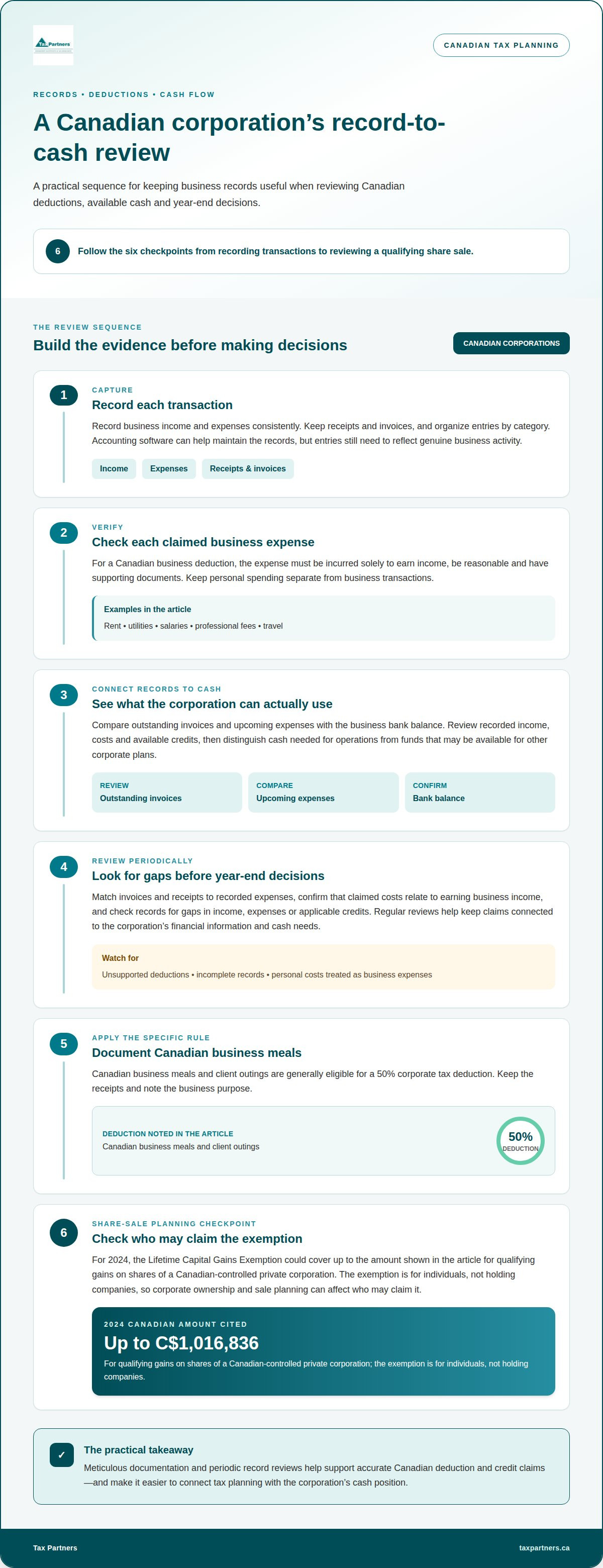
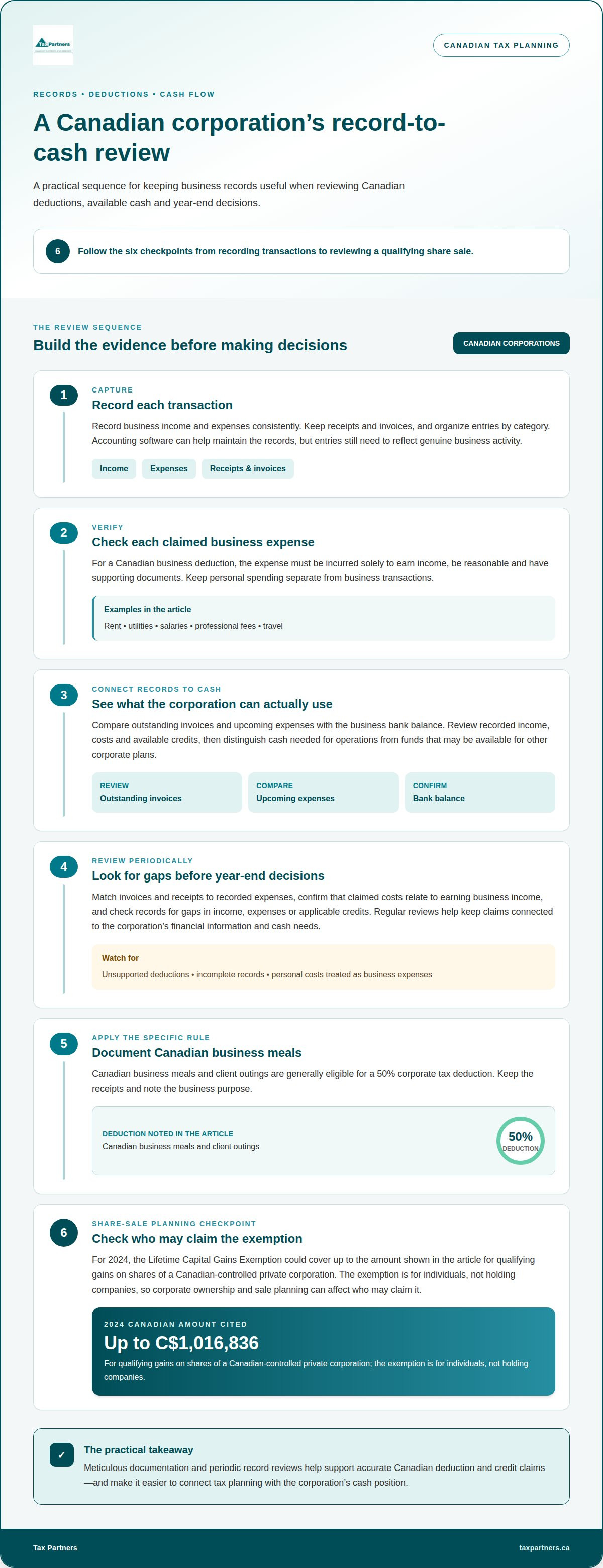
Corporate cash flow depends on more than sales and bills. A corporation’s records show the income it earned, the expenses it incurred, and the cash available. Reviewing financial information periodically can help identify missed deductions or credits before year-end planning decisions are made.
Start with a consistent accounting process. Record each transaction, keep receipts and invoices, and organize income and expenses by category. Accounting software can help maintain these records, but entries still need to reflect genuine business activity. Clear records make it easier to assess tax obligations and plan cash needs.
For a business deduction, the expense must be incurred solely to earn income, be reasonable, and have supporting documents. Eligible expenses can include rent, utilities, salaries, professional fees, and travel. Canadian business meals and client outings are generally eligible for a 50% corporate tax deduction, so retain the receipts and note the business purpose.
Use periodic reviews to connect accounting records with decisions about available cash. For example, compare outstanding invoices and upcoming expenses with the business’s bank balance, then confirm that recorded costs have supporting documents. This helps distinguish cash needed for operations from funds that may be available for other corporate plans.
A practical review can cover:
- Matching invoices and receipts to recorded business expenses.
- Checking that each claimed deduction relates to earning business income.
- Reviewing recorded income, expenses, and available credits for gaps.
- Separating business transactions from owners’ personal spending.
Capital gains also matter when planning a qualifying share sale. For 2024, the Lifetime Capital Gains Exemption could cover up to C$1,016,836 in qualifying gains on shares of a Canadian-controlled private corporation. The exemption is for individuals, not holding companies, so corporate ownership and sale planning can affect who may claim it.
Risks include unsupported deductions, incomplete records, and treating personal costs as business expenses. For corporate tax deferral strategies in Canada, keep receipts and invoices, document the business purpose of expenses, and review accounting records regularly. These steps support accurate claims and help identify cash commitments before distributions or other year-end decisions.
Corporate accounting and tax planning are closely connected: Canadian tax planning can help frame how records, deductions, and cash-flow decisions fit together.
Connect current financial information with decisions about the cash available to the corporation. Canadian corporations can review financial records periodically to confirm they are claiming applicable deductions and credits. Making this review part of the accounting routine helps ensure records support the claims being considered and relevant documents are available. It also provides a regular opportunity to consider income and expenses alongside cash needs, rather than treating tax review as separate from cash planning.
Maintaining meticulous records can make these checks easier to carry out consistently. Accounting software can help organize and maintain the information, supporting the corporation’s effort to claim deductions and credits that apply. The software is a tool for the process: records still need to be kept carefully, and claims should be grounded in the business’s actual records. Periodic reviews, supported by meticulous documentation, help keep deduction and credit claims connected to the financial information the corporation uses to understand its cash position.
2. Corporate tax deferral through retained earnings
A Canadian corporation can defer its owners’ personal tax by keeping some after-tax earnings in the business. The deferral applies to personal tax on money not withdrawn; corporate tax still applies to corporate income. Retained cash can support operating needs, planned investment, or a future distribution.
Begin by separating the company’s expected cash needs from the owner’s personal withdrawals. For example, forecast upcoming payroll, supplier payments, and equipment purchases before deciding how much profit can remain in the corporation. This connects tax planning to cash flow rather than treating retained earnings as money without a future purpose.
Corporate tax rates can make retaining earnings attractive, but eventual withdrawals matter too. Salary and dividends have different personal tax consequences, and the corporation’s circumstances affect the comparison. An eligible deduction may reduce taxable corporate income, but it does not make retained profit permanently tax-free.
Investment income inside a Canadian corporation needs separate attention. A holding company may recover taxes paid on investment income through the Refundable Dividend Tax On Hand mechanism when it pays dividends. Passive investment income can also affect the small business limit: for associated corporations, that limit is reduced when the group’s adjusted aggregate investment income for the previous year exceeds C$50,000.
Intercorporate dividends require care, too. In Canada, dividends between corporations can attract Part IV tax or be recharacterized as capital gains under subsection 55(2). Canada’s general anti-avoidance rule, or GAAR, is another anti-avoidance provision to consider when evaluating tax-driven arrangements; corporate steps should have clear business context and careful documentation.
Capital dividend account tracking and eligible-dividend planning address different parts of a distribution. The account records amounts relevant to potential capital dividends, while eligible-dividend designation affects the recipient’s tax treatment. Keeping these records distinct helps prevent a distribution plan from relying on an incorrect balance or characterization.
A practical retained-earnings review can follow these steps:
- Forecast business commitments before setting a withdrawal amount.
- Compare the cash retained with planned investment and operating needs.
- Review passive income and its effect on associated corporations’ small business limit.
- Track dividend accounts and document the basis for corporate transactions.
These decisions can involve several connected tax records and ownership relationships. A discussion about corporate tax planning can help bring retained earnings, investment income, and future distributions into one coordinated plan.
Where operations use a Canadian partnership, it does not pay taxes itself; its profits and losses pass through to partners and are taxed at their personal income tax rates. Canadian business expenses must be incurred for the sole purpose of earning income, be reasonable and have supporting documents such as receipts or invoices. Clause 129(1)(a)(ii)(B) permits recovery of ERDTOH through payment of non-eligible dividends under Canada’s refundable tax framework.
3. Cash-flow and tax timing
For Canadian business owners, the timing of income and expenses can shape taxable profit and available cash. Year-end planning may include deferring revenue into the next fiscal year and accelerating eligible expenses into the current one. These choices should reflect when transactions genuinely occur, not simply the preferred tax result.
Salary and dividends affect corporate and personal tax differently. Salary is generally a corporation expense and creates RRSP contribution room for the recipient; dividends are paid from corporate after-tax income and do not create RRSP room. The right mix depends on corporate cash, the owner’s income needs, and personal tax consequences.
Capital Cost Allowance, or CCA, lets a Canadian corporation deduct the cost of eligible depreciable assets over time. Equipment and buildings are examples. CCA can reduce taxable income without requiring the corporation to spend cash again in the year it claims the deduction, but buying an asset still affects cash flow when payment is due.
A useful year-end review connects the accounting period to actual business events. For example, identify customer work completed before year-end, invoices awaiting payment, planned purchases, and bills for services already received. Then assess whether each item belongs in the current period and how it affects taxable income and operating funds.
Family compensation needs particular care. Salary paid to a family member can reduce taxable business income only when the work is real, defined, and useful, the pay is reasonable, and the employment is properly documented. A role such as bookkeeping or customer support should have records showing the duties performed and compensation paid.
Dividend timing between related corporations can also affect cash and tax refunds. Canada’s Budget 2025 proposed suspending a payer corporation’s dividend refund when the affiliated recipient’s balance-due day for the receipt year falls after the payer’s balance-due day for the payment year. The proposed Canadian draft rules also include a 30-day limitation, so intercorporate dividend plans need careful timing review.
Use a consistent sequence for year-end decisions:
- Update forecasts for cash receipts and operating payments.
- Match revenue and expenses to the relevant fiscal period.
- Review asset purchases and available CCA deductions.
- Compare salary and dividend plans against personal cash needs.
- Document family employment and related-corporation transactions.
This approach keeps tax timing connected to real operations. A deduction may lower taxable income, but a sound plan also accounts for payment dates, business commitments, and the owner’s personal cash-flow needs.
4. Federal and provincial tax incentives
A Canadian corporation’s income tax can depend on its province, income type, and eligibility for incentives. For January 2026, the federal small business corporate income tax rate was 9%, according to the Canada Revenue Agency. In Ontario and Quebec, the provincial small business rate was 3.2% that month, making the combined rate 12.2%.
Rates and eligibility can change the cash a corporation keeps available for operations or investment. Ontario’s provincial small business rate was set to decrease to 2.2% starting in July 2026. Quebec’s reduced provincial corporate tax rate applies to fiscal years starting on or after April 30, 2026, so the relevant year-end matters when estimating tax.
Not all corporate income qualifies for the small business rate. In 2026, the federal general corporate income tax rate was 15%; Ontario and Quebec’s provincial general rate was 11.5%, for a combined rate of 26.5%. Eligible businesses should review the Small Business Deduction each year, since eligibility affects which tax rate applies.
Credits can also reduce the tax burden when a corporation undertakes qualifying activities. Canadian businesses may find incentives related to research and development, clean technology investment, energy efficiency, or hiring apprentices and interns. For example, a company planning equipment upgrades can document the project’s purpose, costs, and records before assessing whether a relevant incentive applies.
Holding companies add another layer to planning. Canadian corporations can use a holding company to manage investments, but passive income has tax consequences that should be modelled alongside operating-company cash needs. A holding company may recover taxes paid on investment income through the Refundable Dividend Tax On Hand mechanism when it pays dividends.
Intercorporate dividends aren’t automatically a simple way to defer tax. Draft proposals released by Canada’s Department of Finance on January 29, 2026 address tax deferral through tiered corporate structures. Under the proposed measure, a payer corporation’s dividend refund could be suspended when the affiliated recipient’s balance-due day for the year of receipt falls after the payer’s balance-due day for the year of payment.
For planning, map the company structure and dividend dates before moving funds between corporations. Consider these review points:
- Identify the province and fiscal year relevant to each corporation.
- Assess annual eligibility for the Small Business Deduction.
- Match incentive claims to qualifying projects and supporting records.
- Model passive income and dividend timing within any holding-company structure.
This review connects tax rates, incentives, and corporate cash flow. It also helps distinguish an available tax reduction from a timing strategy that may affect when a corporation can receive a dividend refund.
5. Incorporation and corporate tax deferral
Incorporation can change when personal tax becomes payable because a corporation is a separate taxpayer. The corporation pays tax on its taxable income, while owners generally pay personal tax on salary or dividends they receive. Retaining some after-tax profit can defer the owner’s personal tax on that amount, but it does not erase the corporation’s tax liability.
Consider a Canadian business earning C$300,000 in profit per taxation year, with its owner needing C$150,000 yearly for living expenses. In the example, the incorporated owner takes C$150,000 in employment income and leaves the remaining C$150,000 in the company. The retained amount stays available for business use, while the owner’s personal tax applies to income received.
In Ontario and Quebec, the combined federal and provincial small business corporate income tax rate was 12.2% in January 2026. That rate can make incorporation worth examining when a business earns more than its owner needs to withdraw. The comparison should include personal tax, corporate tax, administrative work, and the timing of future distributions.
Incorporation also doesn’t multiply access to the small business limit. Associated corporations share one C$500,000 limit in Canada, as of October 2026. A structure with an operating company and a holding company therefore needs to be assessed as a group, rather than as separate entities each entitled to a full limit.
A holding company can hold investments or receive corporate funds, but passive income creates additional tax considerations. A Canadian holding company may recover taxes paid on investment income through the Refundable Dividend Tax On Hand mechanism when it pays dividends. Only individuals, not holding companies, can claim the Lifetime Capital Gains Exemption.
Ownership changes need careful planning, too. A Canadian share transfer to a newly incorporated holding company may use subsection 85(1), which concerns transfers of property to a taxable Canadian corporation. The transaction’s purpose, share ownership, and tax consequences should be reviewed together before assets move between corporations.
Before incorporating or adding a holding company, model expected business profit, owner withdrawals, retained cash, and passive investments. Also consider whether a planned share sale or succession changes the value of keeping assets in the operating company. This analysis shows whether deferral supports the business’s goals or adds complexity without improving cash flow.
- Estimate the amount the owner needs to withdraw.
- Project corporate profit and funds available to retain.
- Review associated corporations and the shared small business limit.
- Include investment income and future share-sale plans.
For a tailored review of incorporation and retained earnings, discuss your corporate tax planning.
Tax Partners
Tax Partners helps Canadian business owners connect corporate tax decisions with cash-flow needs. If you are weighing incorporation, retained earnings, salary and dividends, or investment income, its Canadian accounting and tax services can bring these factors together in a coordinated plan.
Turn to Tax Partners when your business structure changes, you are considering a holding company, or year-end decisions involve several related tax and accounting records. Bookkeeping and payroll services can support accurate financial records, while wealth management and financial planning can help align business decisions with longer-term financial goals.
Share the business decisions you are considering and the cash-flow priorities they need to support. Contact Tax Partners to discuss your corporate tax planning.
Make your next tax decision with clarity
The next step is to turn a tax idea into a decision that fits your business goals. Before changing how you pay yourself or structure your company, consider how that choice affects plans for growth, personal finances, and future ownership. A coordinated view can help keep current decisions aligned with longer-term priorities.
Tax Partners supports business owners through Canadian Accounting & Tax Services, Bookkeeping and Payroll Services, and US & Cross-Border Accounting & Tax Services when their circumstances involve more than one country. The right corporate tax deferral strategies in Canada depend on how business and personal considerations fit together; a tailored review can help clarify the trade-offs.
Bring your questions about your business structure, cash-flow priorities, or cross-border considerations to a conversation with the team. Contact Tax Partners to discuss your options and take a considered next step with confidence.
Frequently Asked Questions
How does corporate tax deferral work in Canada?
In Canada, a corporation pays tax on its income, while owners generally pay personal tax when they receive salary or dividends. Leaving some profit in the company can defer the owner’s personal tax on that amount, though corporate tax still applies. For example, a corporation might retain funds for a planned business purchase rather than distribute them, changing when personal tax is paid rather than eliminating the tax obligation.
How does the small business deduction enable tax deferral in Canada?
The Small Business Deduction (SBD) reduces the corporate tax rate for eligible Canadian small businesses. That can leave more after-tax money in the corporation to support business needs instead of being withdrawn by an owner. The deduction does not itself defer personal tax; deferral arises when the owner leaves funds in the company. Consider eligibility for each year as part of corporate tax planning.
What are the tax consequences of retaining profits in a Canadian corporation?
Retained profits remain corporate funds, not an owner’s personal cash. The corporation pays applicable tax on its income, and the owner generally faces personal tax when funds are later paid out as salary or dividends. If the corporation invests retained funds, investment income can have separate tax consequences. For instance, money reserved for future equipment may remain available to the business, while investing those funds creates another tax-planning consideration.

Article by
Mahad Mohamed
Mahad Mohamed is an accountant and the CEO of Tax Partners, with over 26+ years of Canadian and international tax and accounting experience. His expertise includes corporate reorganization, cross-border tax structuring (Canada & US), tax disputes, CRA audits, and tax planning for small owner-managed private corporations. Most recently, Mahad is a pioneer in Canadian crypto taxation and founded Block3 Finance.
Previously, Mahad worked for the Canada Revenue Agency (CRA), Big4 accounting firms, and served as a Rulings Officer for the Federal Tax Authority of the UAE before acquiring Tax Partners in 2014.
Tax Partners has 44 full-time accountants and over 18,400+ clients.
Disclaimer
This article provides general information only and is current as of its publication date. It has not been updated and may be out of date. It does not constitute legal advice and should not be relied upon as such. Every tax situation is unique and may differ from the examples discussed in this article. If you have specific questions, you should seek the advice of our accountants for your unique circumstances. Book a FREE Initial Consultation Today!
Frequently Asked Questions
How does corporate tax deferral work in Canada?
In Canada, a corporation pays tax on its income, while owners generally pay personal tax when they receive salary or dividends. Leaving some profit in the company can defer the owner’s personal tax on that amount, though corporate tax still applies. For example, a corporation might retain funds for a planned business purchase rather than distribute them, changing when personal tax is paid rather than eliminating the tax obligation.
How does the small business deduction enable tax deferral in Canada?
The Small Business Deduction (SBD) reduces the corporate tax rate for eligible Canadian small businesses. That can leave more after-tax money in the corporation to support business needs instead of being withdrawn by an owner. The deduction does not itself defer personal tax; deferral arises when the owner leaves funds in the company. Consider eligibility for each year as part of corporate tax planning.
What are the tax consequences of retaining profits in a Canadian corporation?
Retained profits remain corporate funds, not an owner’s personal cash. The corporation pays applicable tax on its income, and the owner generally faces personal tax when funds are later paid out as salary or dividends. If the corporation invests retained funds, investment income can have separate tax consequences. For instance, money reserved for future equipment may remain available to the business, while investing those funds creates another tax-planning consideration.