Capital gains inclusion rate in Canada: how much is taxable

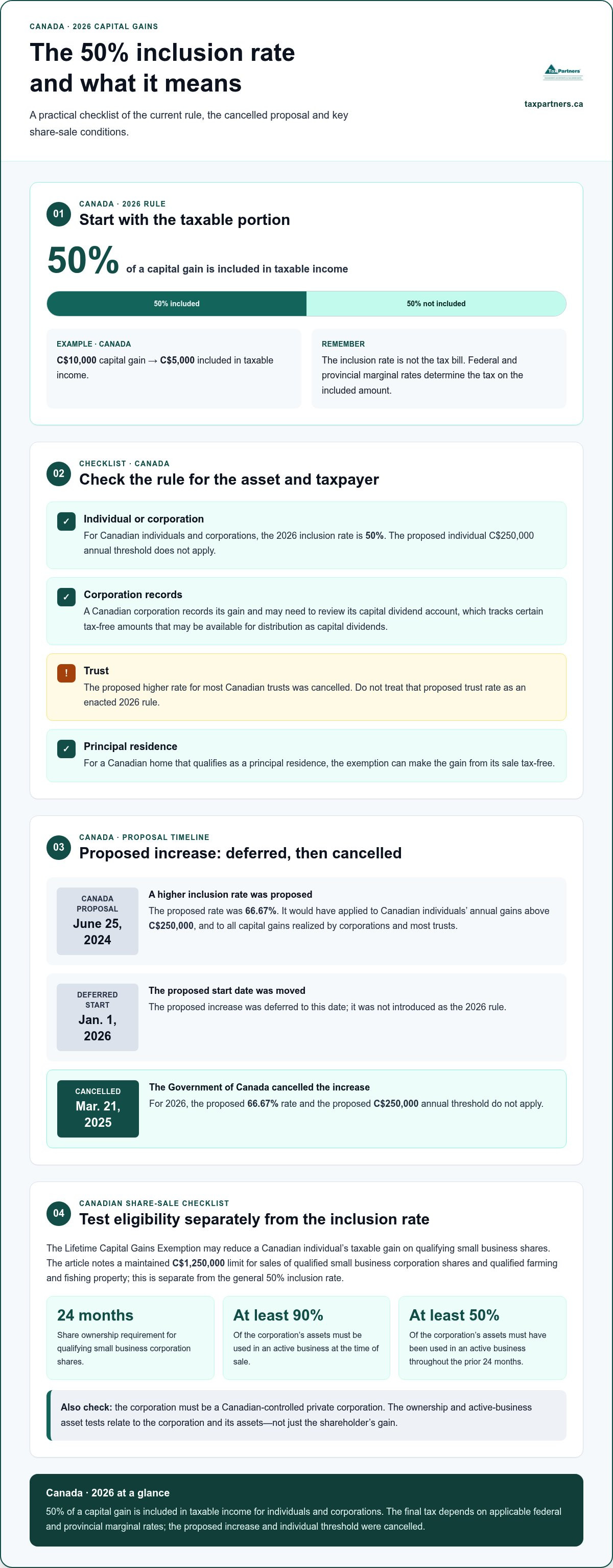
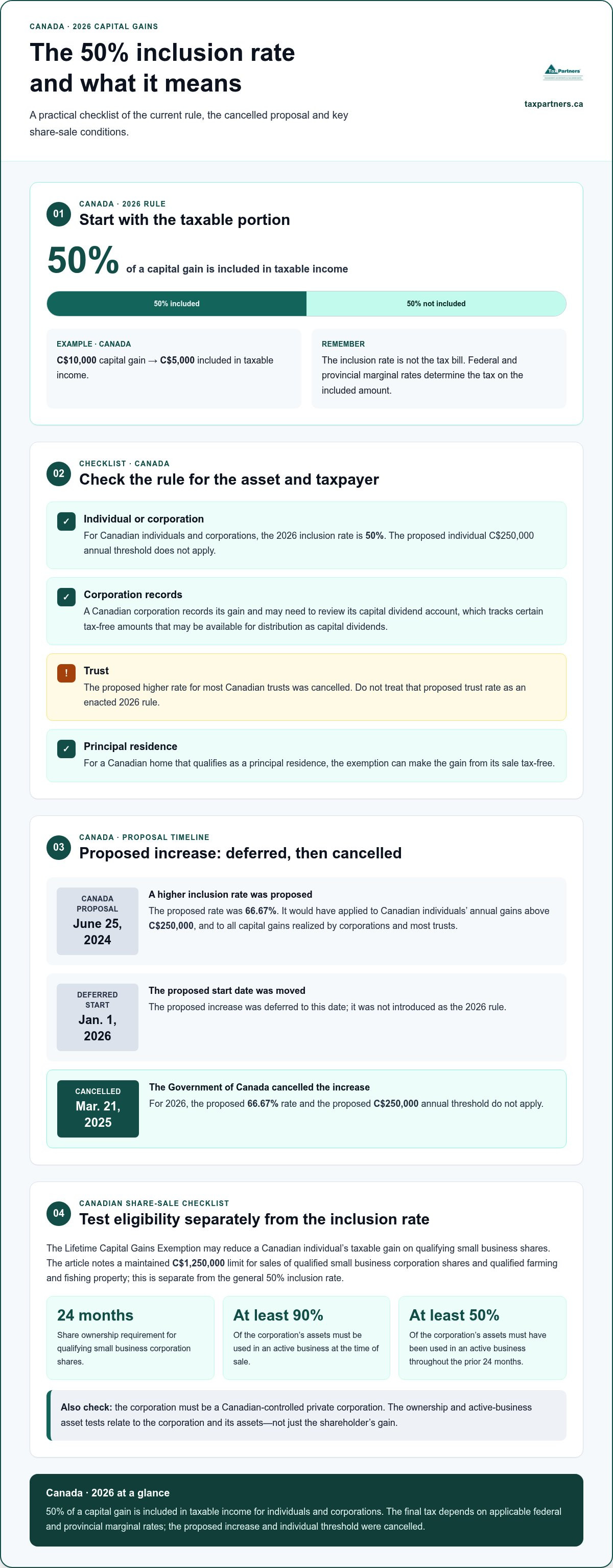
Canada’s capital gains inclusion rate in 2026 is 50%, so half of a capital gain is included in taxable income. The proposed increase and annual C$250,000 threshold were cancelled, so the higher rate does not apply in 2026.
Changes to the proposal can make it hard to tell which rules apply. The key point is that the amount included in taxable income is not the same as the tax you ultimately pay.
This article explains how the 50% inclusion rate works, how taxable gains are taxed at federal and provincial marginal rates, and what the cancelled threshold means for individuals. You’ll also see how the rules differ for corporations and trusts, so you can understand the tax treatment before making a decision about an asset.
Key Takeaways
- For 2026, the proposed increase to Canada’s capital gains inclusion rate was cancelled, and the inclusion rate is 50%.
- Half of a capital gain is included in taxable income; the resulting tax depends on your federal and provincial marginal rates.
- The proposed C$250,000 annual threshold for individuals does not apply under the cancelled changes.
- Understand how the inclusion rate applies to individuals, corporations and trusts before assessing the tax impact of a sale.
- Consider how the asset, your other income and any relevant exemptions or deductions affect the taxable gain.
What is the capital gains inclusion rate in Canada for 2026?
For 2026, Canada’s capital gains inclusion rate is 50%. That means half of a capital gain is included in taxable income, rather than the full gain.
For a principal residence in Canada, the Principal Residence Exemption can make the gain from a sale tax-free. The exemption remains available despite the proposed inclusion-rate changes.
For example, a C$10,000 capital gain at the 50% rate means C$5,000 is included in taxable income. That amount is then considered alongside other taxable income when calculating tax at the applicable marginal rates.
Proposed Inclusion-Rate Increase
On June 25, 2024, the federal government proposed raising Canada’s inclusion rate from 50% to 66.67%. The proposal would have applied a higher rate to individuals’ annual capital gains above C$250,000, and to all capital gains realized by corporations and most types of trusts.
This distinction mattered because the proposal treated individuals differently from corporations and most trusts. Under the proposed rules, an individual’s gains below the annual threshold would have remained subject to the one-half inclusion rate, while the higher rate would have applied to gains above it. The proposal also raised questions about asset sales and the Lifetime Capital Gains Exemption.
Cancellation of the Proposed Increase
On March 21, 2025, the Government of Canada announced it would cancel the proposed capital gains inclusion-rate increase. The proposed 66.67% rate and the annual C$250,000 threshold therefore do not apply in 2026.
For individuals and corporations, the 2026 inclusion rate is 50%. In practical terms, half of a capital gain is included in taxable income; the inclusion rate determines the taxable portion, not the final tax bill. A taxpayer’s marginal rates determine how that included amount affects tax payable. The cancellation also means the proposal’s higher rate for most trusts does not take effect.
Transition Dates and Rules
The proposed increase was first set to apply from June 25, 2024, then deferred to January 1, 2026. The Government of Canada cancelled it on March 21, 2025, before that deferred start date.
For 2026, the applicable inclusion rate is 50%, not the proposed 66.67%. The dates explain why the proposal and the current rule differ: the increase was deferred, then cancelled, rather than introduced for 2026. Taxpayers assessing a capital gain should distinguish the rules that took effect from proposals that did not.
Other capital-gains measures are separate. The Government of Canada announced that it would maintain a $1,250,000 Lifetime Capital Gains Exemption limit for sales of qualified small business corporation shares and qualified farming and fishing property. It does not change the general 50% inclusion rate for other gains.
Canada’s principal-residence rules are also distinct from the inclusion-rate proposal. The exemption remains in place for gains from selling a home that qualifies as a principal residence. For Canadian tax matters involving property sales, Canadian tax services can help clarify how the applicable rules relate to your circumstances.
Capital gains inclusion rates for individuals, corporations and trusts
For individuals and corporations in Canada, the capital gains inclusion rate in 2026 is 50%. The rate identifies the portion of a gain included in taxable income; it does not, by itself, determine the final income tax payable.
For Canadian individuals selling qualifying small business shares, the Lifetime Capital Gains Exemption may reduce the taxable gain. Eligibility depends on share ownership and the corporation’s assets, so a share sale requires more analysis than simply applying the inclusion rate.
For the exemption, qualifying small business corporation shares must meet a 24-month ownership requirement. The corporation must be a Canadian-controlled private corporation, and at least 90% of its assets must be used in an active business at the time of sale. At least 50% of its assets must have been used in an active business throughout the prior 24 months.
These tests focus on the corporation and its assets, not just the shareholder’s gain. For example, a company with substantial investment assets may need careful review against the active-business requirements before a shareholder assumes the exemption applies.
Corporations also need to distinguish the taxable portion of a gain from amounts relevant to the capital dividend account (CDA). The CDA tracks certain tax-free amounts that may be available for distribution as capital dividends. Records separating the proceeds, cost base and resulting gain help support the corporate tax calculation and CDA review.
For a corporation, the 50% inclusion rate applies to capital gains in 2026. The proposed higher rate would have applied to all corporate capital gains, without a lower rate on an initial portion, but the federal government cancelled that proposal. A corporation therefore does not use the proposed individual threshold to calculate its 2026 inclusion rate.
Trusts require separate attention. The proposed increase would have applied to all capital gains realized by most types of trusts, but that increase was cancelled. The available 2026 rate information specifically identifies individuals and corporations, so trust administrators should not treat the proposed trust rate as an enacted rule.
The practical distinction is who reports the gain: an individual, corporation or trust. A shareholder selling qualifying shares may also need to assess the exemption separately, while a corporation records its own gain and considers its CDA treatment.
For a Canadian share sale, reviewing ownership history, active-business assets, and corporate records together can clarify which rules matter. You can discuss a corporate capital gain when the transaction involves qualifying shares or a capital dividend account.
How taxable gains are taxed at federal and provincial marginal rates
Across Canada, the inclusion rate for individuals is 50% in 2026. The taxable portion is added to income, then federal and provincial or territorial income tax rates determine the tax payable.
The inclusion rate does not vary by province or territory. What varies is the applicable marginal tax rate, the rate on the next portion of taxable income. As a result, residents with the same gain can face different tax bills in different jurisdictions.
To calculate the taxable capital gain, start with the realized gain and include 50% in taxable income under Canada’s 2026 rules. The inclusion rate identifies the taxable amount; it is not itself a tax rate charged on the full gain.
For example, a C$10,000 realized capital gain produces C$5,000 of taxable capital gain at the 50% rate. That C$5,000 is added to taxable income, where federal and provincial or territorial marginal rates apply.
The federal tax impact depends on the taxpayer’s income bracket. At the highest federal marginal rate, the rate applied to capital gains with a 50% inclusion rate is 16.5%. This describes the federal portion, not the combined federal and provincial tax.
Ontario illustrates how provincial rates affect the result. In 2026, its top marginal rate is approximately 53.53%, producing an effective capital gains tax rate of roughly 26.77% for high-income Ontario residents. The effective rate reflects the inclusion rate and the applicable marginal rate.
Those Ontario figures are not a Canada-wide rate. Provinces and territories set their own income tax rates, so the provincial or territorial portion depends on the jurisdiction and the taxpayer’s income. The 50% inclusion rate remains the same across Canada.
A gain can also push income into a higher tax bracket, affecting the marginal rate on some other taxable income. That does not mean the higher rate applies to all income: marginal rates apply only to the portions of taxable income within their respective brackets.
When estimating the effect of selling an asset, separate three figures: the realized capital gain, the taxable portion and the tax calculated using federal and provincial or territorial rates. A qualifying exemption or deduction may reduce the taxable amount, while an incentive or indexed limit applies only if its specific eligibility rules are met.
Federal rates also vary by year: for Canadian tax year 2025, the federal tax rate on taxable income over C$253,414 is 33%, while the lowest Canadian federal income tax rate is 14% for 2026. Canada’s lifetime capital gains exemption has historically been indexed and adjusted periodically by the federal government.
Annual $250,000 threshold for individuals
The proposed C$250,000 threshold was an annual limit for individuals’ capital gains eligible for the 50% inclusion rate. It was tied to the proposed increase scheduled for January 1, 2026, but the federal government cancelled that increase on March 21, 2025.
As a result, the threshold does not apply to individuals’ capital gains in Canada in 2026. The inclusion rate is 50%, rather than 50% up to C$250,000 and a higher rate on gains above that amount.
The proposal would have treated an individual’s annual gains in two portions. The first C$250,000 would have remained subject to a 50% inclusion rate, while gains above that threshold would have faced a 66.67% inclusion rate.
That example describes the proposal only.
The difference matters for planning asset sales. Owners who had considered dividing sales across years to remain below the proposed threshold should not treat C$250,000 as an active 2026 tax boundary. The cancelled proposal does not create a special inclusion rate above that amount.
The threshold was also distinct from an exemption. It would have determined which inclusion rate applied to an individual’s annual gains; it would not have made gains below C$250,000 tax-free. A taxable gain is still included in income under the applicable rate.
Nor was the proposed threshold a general limit for every taxpayer. The proposal described a threshold for individuals, while corporations and most types of trusts would have faced a higher inclusion rate on all capital gains. The federal government cancelled that proposed increase as well, so the threshold does not create a different 2026 rate for individuals.
Other capital-gains measures have their own eligibility rules. For example, Canada’s Lifetime Capital Gains Exemption may apply to qualifying small business corporation shares and qualified farming or fishing property. That exemption is separate from the cancelled annual threshold and does not turn C$250,000 into a current-year exemption.
Canada's capital gains inclusion rate in 2026
Canada’s 2026 capital gains inclusion rate is 50% for individuals and corporations. This determines the portion of a gain included in taxable income, while the final tax depends on other factors, including the taxpayer’s marginal rates and any applicable tax treatment.
To assess a sale, first calculate the capital gain, then consider whether a reserve, exemption or loss affects the taxable amount. The sale proceeds alone do not establish the taxable gain. Keep records of the asset’s cost and transaction details to support the calculation.
Canadian residents report capital gains on Schedule 3, with taxable capital gains flowing to line 12700 of the T1 return. Organizing the supporting records alongside the return can make it easier to explain how the reported amount was calculated.
Net capital losses may be carried forward indefinitely or carried back against capital gains from any of the three immediately preceding tax years. Applying a loss can reduce the gains left to offset, but does not change the inclusion rate itself.
A home sale may be treated differently. Canada’s Principal Residence Exemption can make a qualifying principal-residence gain tax-free. However, converting a rental property to or from a principal residence triggers a deemed disposition: tax rules treat the property as sold even though no actual sale took place.
For qualifying small business corporation shares and qualified farming or fishing property, Canada’s Lifetime Capital Gains Exemption limit is C$1,275,000 in 2026. This exemption is separate from the general rule, and eligibility depends on requirements involving the corporation and its active-business assets.
The Canadian Entrepreneurs’ Incentive is a separate measure from the general inclusion rate. It was designed to apply a one-third inclusion rate to eligible gains, up to a lifetime maximum of C$2 million when fully implemented. Its purpose and eligibility are distinct from the general treatment of capital gains.
Some taxpayers may also need to consider federal alternative minimum tax (AMT), a separate tax calculation compared with regular income tax. For AMT purposes, the inclusion rate for capital gains is 100%, and AMT paid may generally be recovered over the next seven years. This calculation can affect the overall tax result.
Understanding the 2026 Canadian capital gains inclusion rate alongside exemptions, losses, and AMT can clarify what a transaction means for your return. If a sale involves a home, business shares, or multiple tax calculations, discuss your capital gains tax situation and the rules that apply.
Tax Partners: Canadian Accounting & Tax Services
Tax Partners can help you apply Canadian capital gains rules to an asset sale, business shares or a principal residence. Its Canadian Accounting & Tax Services help individuals and businesses assess gains, review relevant exemptions and understand how taxable amounts fit into their broader tax picture.
Consider getting tax guidance before a significant transaction, especially if it involves qualifying small business shares, multiple assets or potential alternative minimum tax. Reviewing transaction records and applicable rules can help clarify what to report and how the gain may affect your tax position.
For support with your Canadian tax situation, contact Tax Partners.
Plan your next move with clarity
A planned sale gives you time to organize records and consider how the proceeds fit into your wider financial picture. Gather purchase documents, improvement costs, sale details and ownership records before reviewing the transaction’s tax treatment.
The capital gains inclusion rate in Canada for 2026 is one part of that review. The asset, your circumstances, and any relevant exemption or other tax treatment can also shape the outcome. Considering these factors before a transaction can help you make decisions with a clearer understanding of potential tax effects.
Tax Partners can help assess Canadian tax questions, including transactions involving business records or cross-border considerations. Bring your questions and relevant transaction details to discuss the factors that may affect your next steps.
Contact Tax Partners to discuss your tax situation and move forward with greater clarity.
Frequently Asked Questions
How do federal and provincial taxes apply?
In Canada, federal and provincial or territorial income taxes both contribute to the tax payable on taxable income, including taxable capital gains. The combined result depends on the taxpayer’s income and province or territory of residence. If a transaction involves a move between provinces, keep residence dates and sale records together so the applicable provincial tax treatment can be assessed accurately.
What is Canada's capital gains inclusion rate in 2026?
Canada’s inclusion rate for individuals and corporations in 2026 is 50%. To apply it to a transaction, identify the capital gain rather than using the asset’s full sale proceeds. Keep documents showing the acquisition, sale, and related costs, then use them to support the reported gain. The inclusion rate determines the portion included in taxable income, not the final tax payable.
Did Canada cancel the proposed capital gains inclusion rate increase?
Yes. The Government of Canada cancelled the proposed increase. For practical planning, use the applicable rules for the tax year of the disposition rather than calculations based on the proposal. If you have earlier estimates for an asset sale, revisit the assumptions and retain the sale records and the calculation used for tax reporting.
What capital gains inclusion rate applies to corporations and trusts in 2026?
Canadian corporations have a 50% inclusion rate in 2026. The proposed higher rate for most trusts was cancelled, so trustees should not use that proposed rate as the basis for a return. Keep records identifying the trust, the asset, and how the gain is reported or allocated. Trust treatment can depend on the trust’s circumstances and the transaction.
Are there different inclusion rates for gains above a certain threshold?
No higher inclusion rate applies to an individual’s gains merely because they exceed the proposed annual threshold. That threshold was part of the cancelled proposal, not a current dividing line. For a transaction, distinguish an inclusion-rate threshold from a separate exemption or deduction, which has its own eligibility requirements. Keep documentation to support any exemption or deduction claimed on a Canadian return.

Article by
Mahad Mohamed
Mahad Mohamed is an accountant and the CEO of Tax Partners, with over 26+ years of Canadian and international tax and accounting experience. His expertise includes corporate reorganization, cross-border tax structuring (Canada & US), tax disputes, CRA audits, and tax planning for small owner-managed private corporations. Most recently, Mahad is a pioneer in Canadian crypto taxation and founded Block3 Finance.
Previously, Mahad worked for the Canada Revenue Agency (CRA), Big4 accounting firms, and served as a Rulings Officer for the Federal Tax Authority of the UAE before acquiring Tax Partners in 2014.
Tax Partners has 44 full-time accountants and over 18,400+ clients.
Disclaimer
This article provides general information only and is current as of its publication date. It has not been updated and may be out of date. It does not constitute legal advice and should not be relied upon as such. Every tax situation is unique and may differ from the examples discussed in this article. If you have specific questions, you should seek the advice of our accountants for your unique circumstances. Book a FREE Initial Consultation Today!
Frequently Asked Questions
How do federal and provincial taxes apply?
In Canada, federal and provincial or territorial income taxes both contribute to the tax payable on taxable income, including taxable capital gains. The combined result depends on the taxpayer’s income and province or territory of residence. If a transaction involves a move between provinces, keep residence dates and sale records together so the applicable provincial tax treatment can be assessed accurately.
What is Canada's capital gains inclusion rate in 2026?
Canada’s inclusion rate for individuals and corporations in 2026 is 50%. To apply it to a transaction, identify the capital gain rather than using the asset’s full sale proceeds. Keep documents showing the acquisition, sale, and related costs, then use them to support the reported gain. The inclusion rate determines the portion included in taxable income, not the final tax payable.
Did Canada cancel the proposed capital gains inclusion rate increase?
Yes. The Government of Canada cancelled the proposed increase. For practical planning, use the applicable rules for the tax year of the disposition rather than calculations based on the proposal. If you have earlier estimates for an asset sale, revisit the assumptions and retain the sale records and the calculation used for tax reporting.
What capital gains inclusion rate applies to corporations and trusts in 2026?
Canadian corporations have a 50% inclusion rate in 2026. The proposed higher rate for most trusts was cancelled, so trustees should not use that proposed rate as the basis for a return. Keep records identifying the trust, the asset, and how the gain is reported or allocated. Trust treatment can depend on the trust’s circumstances and the transaction.
Are there different inclusion rates for gains above a certain threshold?
No higher inclusion rate applies to an individual’s gains merely because they exceed the proposed annual threshold. That threshold was part of the cancelled proposal, not a current dividing line. For a transaction, distinguish an inclusion-rate threshold from a separate exemption or deduction, which has its own eligibility requirements. Keep documentation to support any exemption or deduction claimed on a Canadian return.