Capital dividend account: Eligibility, balance and tax-free payouts

A Canadian private corporation can pay a capital dividend tax-free to shareholders only when its capital dividend account (CDA) has a positive balance, and only up to that balance. The capital dividend account explained here is a notional tax account: it tracks eligible tax-free amounts, not cash held in a separate account. The corporation must elect under subsection 83(2) of the Income Tax Act to designate the payment as a capital dividend.
That distinction matters: a tax-free payout depends on the corporation’s calculated CDA balance and a properly made election, not simply on how much cash the business has available. If you’re unsure what contributes to the account or how a balance can change, the rules can feel intricate. This article explains what the CDA tracks, how gains, losses and life insurance proceeds may affect its balance, and how a corporation uses Form T2054 to elect a capital dividend. You’ll also see why accurate calculations matter before a corporation declares a payout.
Key Takeaways
- Use the corporation’s calculated CDA balance, not its available cash, to assess how much may be paid as a capital dividend.
- In general, the non-taxable portion of capital gains can increase the balance, while the non-deductible portion of capital losses can reduce it.
- Life insurance proceeds and capital dividends received from other corporations may also affect the account, so include them when assessing eligibility.
- For a Canadian capital dividend election, file Form T2054 on or before the payment date and elect the full dividend amount.
- A Canadian corporation that pays more than its CDA balance may face a 60% tax on the excess, making a careful calculation essential.
Capital dividend account: What is it for?
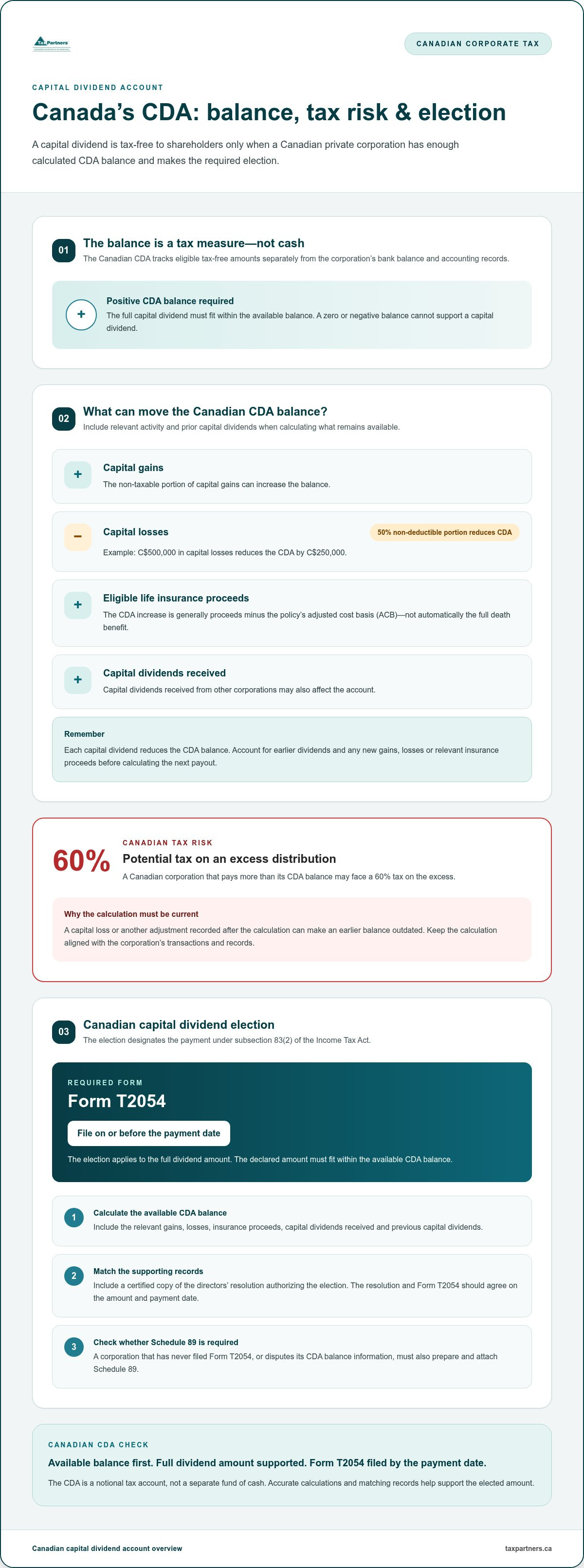
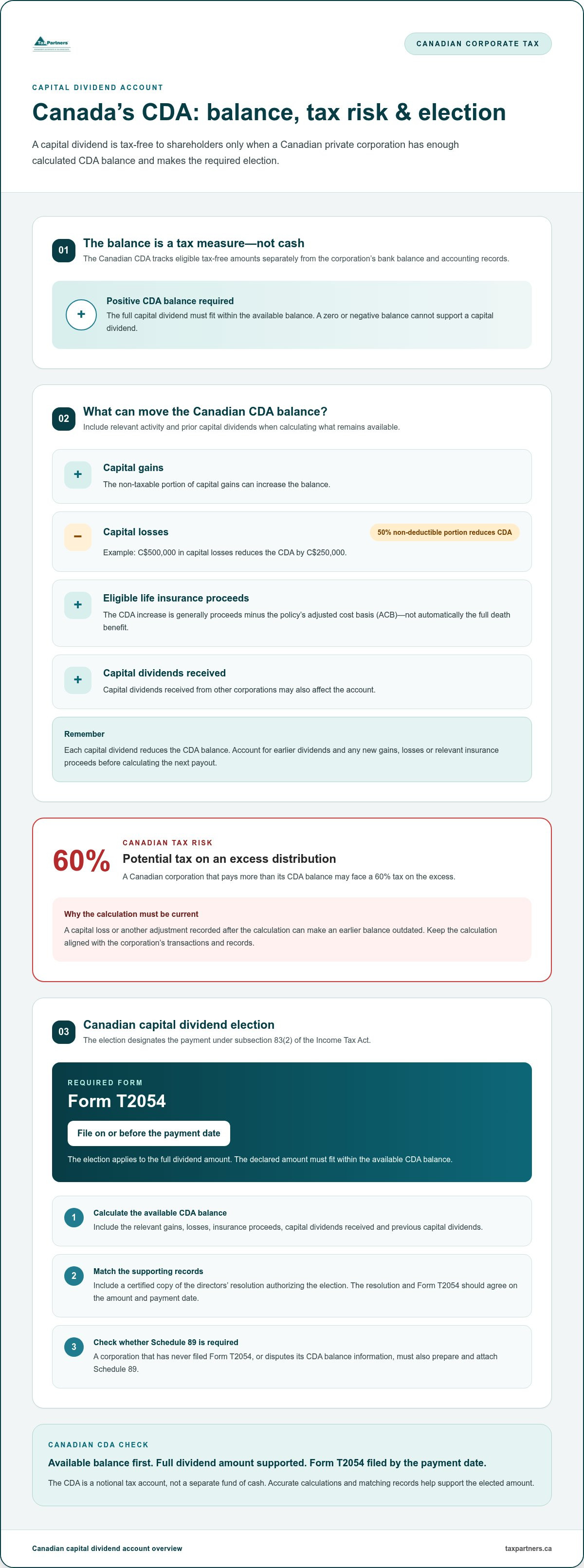
In Canada, a capital dividend account (CDA) is a notional tax account that tracks certain tax-free amounts a private corporation may distribute to shareholders. A capital dividend can be paid only when the corporation has a positive CDA balance, and the payment cannot exceed that balance.
CDA Purpose and Balance Requirements
The CDA allows a Canadian private corporation to distribute eligible amounts without treating them as taxable dividends for shareholders. Its balance is calculated separately from the corporation’s cash and accounting records, so available funds alone do not establish how much qualifies.
Before declaring a capital dividend, the corporation needs a positive balance that covers the full amount of its election. If the balance is zero or negative, it cannot declare a capital dividend from the account. The Income Tax Act sets the federal rules for this treatment.
Exceeding the available balance creates a direct tax risk. A Canadian corporation that distributes more than its CDA limit is subject to a 60% tax, according to the stated rule. For example, if an eligible balance supports only part of a proposed payout, the unsupported excess can trigger this tax rather than receive capital-dividend treatment.
The risk can arise from timing as well as arithmetic. A corporation might calculate its balance before recording a capital loss or another adjustment, then authorize a dividend based on an outdated figure. Since each capital dividend reduces the CDA balance, the amount remaining must account for earlier capital dividends before the next distribution.
Capital losses can shrink the account or make its balance negative. For a Canadian corporation, the non-deductible 50% portion of a capital loss reduces the CDA. For example, realizing C$500,000 in capital losses reduces the CDA by C$250,000, which may limit or prevent a later capital-dividend distribution.
Errors can also matter if the Canada Revenue Agency reviews the corporation’s tax reporting. If the CDA calculation does not support the elected amount, the corporation may face a reassessment and a different tax result for the payment. Keep the calculation and transaction records aligned, including capital gains, losses, prior dividends and relevant insurance proceeds.
Life Insurance Proceeds in the CDA
Life insurance proceeds can increase a corporation’s CDA when an insured person dies, but the full death benefit is not automatically added. The increase is generally calculated as the proceeds minus the policy’s adjusted cost basis (ACB), the policy-cost figure used for tax purposes.
This calculation matters because the eligible amount, not the total proceeds, affects the balance available for a capital dividend. For a private corporation receiving a death benefit after 2013 under a 10/8 policy, the CDA increase is limited to proceeds exceeding the outstanding loan immediately before death.
Capital dividend elections and Form T2054
Form T2054, “Election for a Capital Dividend Under Subsection 83(2),” is the Canadian corporation’s election to designate a dividend as a capital dividend. The corporation must file it on or before the payment date, not after distributing the funds.
The election applies to the full dividend amount. A corporation cannot elect only the eligible portion of a larger dividend, so the declared amount must fit within the available CDA balance.
Supporting records matter. Form T2054 must include a certified copy of the directors’ resolution authorizing the election. When preparing official corporate records and minute book documentation, Canadian companies often consult legal professionals like Szekely Law to ensure resolutions are validly executed. The resolution and form should agree on the dividend amount and payment date, while the CDA calculation should support the full elected amount.
A corporation that has never filed Form T2054, or disputes the CDA balance information, must also prepare and attach Schedule 89. That schedule concerns the corporation’s capital dividend account balance verification, so its figures should align with the calculation behind the election.
Late filing may be available under subsection 83(3) of the Income Tax Act and Regulation 2101(e), subject to their conditions. The estimated penalty is the lesser of C$41.67 or 1/12 of 1% of the dividend amount, multiplied by the number of months and part-months late.
A late election does not remove the need to calculate the CDA correctly. If capital gains, losses or life insurance proceeds were recorded incorrectly, the corporation may still have elected more than its balance supports.
An excessive election can lead to additional tax. Under subsection 184(2) of the Income Tax Act, a corporation may file an election concerning an excessive capital dividend; under subsection 184(3), it can treat the excess as a taxable dividend.
For an election under subsection 184(3) to avoid Part III tax, the deadline is on or before the 90th day after the notice of assessment is sent, according to the Department of Justice Canada. This is a separate election and deadline from filing Form T2054 by the payment date.
Before a corporation declares a dividend, organize the CDA calculation, directors’ resolution, payment details and required forms together. If the filing or calculation needs careful review, discuss your Canadian corporate tax question.
Purpose and tax-free withdrawals from the CDA
A Canadian private corporation can use its capital dividend account to distribute certain tax-free surpluses to shareholders. The CDA election is a mechanism for private corporations, and tax treatment may differ for shareholders who live outside Canada.
Tax-Free Capital Dividends to Shareholders
A capital dividend lets a private Canadian corporation pass eligible amounts to shareholders without treating them as taxable dividends in their hands. This can matter when corporate funds include tax-free surpluses rather than income already treated as taxable.
For example, a corporation realizing a C$100,000 capital gain may have a C$50,000 non-taxable portion available for its CDA. That portion can support a capital dividend, subject to the corporation’s calculated account balance and election.
The CDA is notional, meaning it is a tax calculation rather than a separate pool of cash. A corporation may have a positive balance but insufficient cash to distribute it, or have cash available without enough CDA room for tax-free treatment.
That distinction helps shareholders understand why the form of a corporate withdrawal matters. In Canada, taking money from a corporation is generally taxable as salary or a dividend, while a valid capital dividend provides a separate route for eligible amounts.
Paying a Tax-Free Capital Dividend
A Canadian corporation pays a tax-free capital dividend by electing under subsection 83(2) of the Income Tax Act and distributing an amount supported by its CDA. It may pay the dividend in cash, stock, property in kind, or as a deemed dividend.
A deemed dividend is an amount treated as a dividend for tax purposes, even without a conventional cash payment. The form of payment does not remove the need for the corporation’s election or for a balance that supports the amount distributed.
For shareholders, this means a capital dividend is not limited to cash transfers. A property distribution or deemed dividend can also engage the CDA rules, so the corporation must account for the transaction’s tax treatment and its effect on shareholders.
Private corporations use this mechanism to distribute eligible tax-free amounts; public corporations do not use the private-corporation CDA election described here. Non-resident shareholders face a separate Canadian withholding tax consideration, so a capital dividend is not necessarily tax-free for every recipient. For organizations managing international operations or foreign entities, such as those collaborating with a business accountant Nunawading, corporate distributions must be carefully coordinated with each jurisdiction’s specific accounting rules.
Capital losses also affect what the corporation can distribute: a loss can reduce the CDA and constrain later payments. The purpose is to let qualifying corporate surpluses reach shareholders without treating them as ordinary taxable dividends.
In practice, the value to shareholders depends on the source of the surplus, the corporation’s CDA calculation, the form of payment and each recipient’s status. These factors determine whether the distribution qualifies for Canadian capital-dividend treatment.
What the capital dividend account (CDA) tracks
For Canadian corporations, the CDA tracks specific tax-free amounts that may be available for capital dividends. It is a notional tax account, calculated separately from regular accounting books. A practical explanation of the Canadian capital dividend account starts with the transactions that change its balance.
Calculating and Tracking the CDA
The CDA balance is calculated by adding eligible account components and subtracting applicable amounts. For a Canadian private corporation, the calculation uses components A, B, C and D, less component E.
The balance changes as relevant transactions occur, so a corporation needs records that connect each amount to its source and tax year. It tracks the account on Schedule 89, Request for Capital Dividend Account Balance Verification, when filing its T2 Corporation Income Tax Return.
Schedule 89 provides a way to report or verify the balance, but the underlying calculation still matters. For example, a corporation should reconcile capital gains, losses, insurance proceeds and prior capital dividends before relying on its figure. Reviewing these entries together gives a clear, transaction-based picture of the account.
Amounts Added to the CDA
Amounts added include the non-taxable portion of capital gains, eligible life insurance proceeds, capital dividends received from other corporations and certain trust distributions. For a Canadian corporation, 50% of a capital gain is generally non-taxable and may be credited to the CDA.
For example, a C$100,000 capital gain can contribute C$50,000 to the CDA as its non-taxable portion. A capital dividend received from another corporation under subsection 83(2) can also increase the recipient corporation’s balance.
Life insurance proceeds may add the amount by which the death benefit exceeds the policy’s adjusted cost basis. For an eligible gift of publicly traded securities, the non-taxable portion credited to the CDA is 100%.
These additions depend on the tax treatment of each transaction, not simply its cash value. Recording the eligible portion separately helps corporations distinguish CDA amounts from taxable income.
Amounts Deducted from the CDA
The CDA decreases when the corporation pays a capital dividend, and the non-taxable portion of capital losses also reduces the balance. For a Canadian corporation, 50% of a capital loss reduces its CDA.
For instance, C$500,000 in realized capital losses reduces the account by C$250,000. Losses can reduce the available balance or make it negative, limiting or preventing later capital-dividend distributions.
A corporation should record each capital dividend and eligible loss against the account rather than treating the opening balance as permanently available. This keeps the calculated CDA tied to the transactions that change it.
Capital Dividend Account eligibility and calculation
For a Canadian private corporation, CDA eligibility depends on amounts recorded under the account’s tax rules, not simply on retained earnings. The calculation combines eligible additions and deductions, with the corporation’s history and transactions shaping the balance available for a dividend.
The calculation period begins at the start of the corporation’s first tax year that began after it last became a private corporation and ended after 1971. This starting point matters because earlier transactions may affect the account, even if they occurred before current owners began managing the corporation.
For a Canadian private corporation, the CDA calculation adds components A, B, C and D, then subtracts component E. These components bring together eligible amounts from different sources, so a single gain or insurance payment does not establish the full balance.
Capital gains contribute their non-taxable portion. Under the current 50% inclusion-rate facts provided for this article, a C$100,000 gain produces a C$50,000 non-taxable portion for the CDA. Historical calculations can differ: a gain included for a tax year ending in 1999 had a 25% non-taxable portion, and the later inclusion-rate change does not adjust that amount.
Other possible additions include capital dividends received from another corporation under subsection 83(2), eligible trust distributions, and qualifying life insurance proceeds. For the insurance calculation, the policy’s adjusted cost basis affects the amount; for periods after 2016, that ACB applies regardless of who receives the death benefit.
Transactions involving former eligible capital property also require attention. From January 1, 2017, gains from disposing of property formerly eligible as capital property are no longer added under Component 3. For an eligible gift of publicly traded securities, the non-taxable portion credited to the CDA is 100%.
Deductions include the non-taxable portion of capital losses and capital dividends paid. A Canadian corporation’s balance generally rises by 50% of capital gains and falls by 50% of capital losses, making the timing and classification of realized transactions important.
For example, C$500,000 in capital losses reduces the CDA by C$250,000. A trust distribution received at the tax year-end can also increase the balance, so record its timing alongside gains, losses, insurance proceeds and prior dividends.
Corporations can calculate and pay from the CDA throughout the year, but the supporting records must reflect transactions through the relevant date. Schedule 89, filed with the T2 Corporation Income Tax Return, is used to track or verify the balance. For an assessment of how gains, losses or an insurance policy affect your corporation’s calculation, discuss your CDA calculation.
Tax Partners: Canadian Accounting & Tax Services
Tax Partners can help Canadian corporations assess their capital dividend account balance and understand how it affects a proposed shareholder distribution. Its Canadian Accounting & Tax Services can support corporate tax calculations, record-keeping and filing decisions, including matters involving capital gains, losses or life insurance proceeds.
Consider this support before declaring a dividend, especially when the CDA calculation involves historical transactions or several adjustment components. A careful review helps connect the supporting records with the amount the corporation plans to elect and distribute.
Contact Tax Partners to discuss your Canadian corporate tax needs.
Make your next corporate tax decision with clarity
A capital dividend decision can shape how you plan corporate funds and communicate with shareholders. Treat the calculation and election as part of a broader view of your corporation’s records, upcoming transactions and distribution plans. Having the capital dividend account explained in this context can help you identify the right questions before deciding on a payout.
Tax Partners offers Canadian Accounting & Tax Services, US & Cross-Border Accounting & Tax Services, and Bookkeeping and Payroll Services. These services can support businesses managing corporate tax matters alongside bookkeeping or cross-border reporting needs.
If you’re considering a capital dividend or reviewing a past calculation, contact Tax Partners about your CDA needs. A thoughtful next step can help you approach the decision with greater clarity and confidence.
Frequently Asked Questions
How Does the CDA Work?
In Canada, the capital dividend account records eligible tax-free amounts a private corporation may distribute to shareholders. Additions can include the non-taxable portion of capital gains and qualifying insurance proceeds; capital losses and paid capital dividends reduce the balance. The account is a tax calculation, not a cash account. For a shareholder, the corporation’s election and the recipient’s tax status affect how a distribution is treated.
How is a Canadian corporation's CDA balance calculated?
A Canadian corporation calculates its CDA by adding eligible account components and subtracting applicable deductions. For a private corporation, the calculation uses components A, B, C and D, less component E. A practical review groups supporting records by transaction, such as realized gains, capital losses, dividends received and insurance proceeds. This helps distinguish tax-free amounts from amounts that belong in taxable income or do not affect the account.
What are the deadlines and procedures for electing a capital dividend under section 83(2)?
For a Canadian corporation, file Form T2054 on or before the dividend payment date to elect under subsection 83(2) of the Income Tax Act. The election must cover the full dividend amount and include a certified copy of the directors’ authorizing resolution. Align the resolution, payment date and elected amount before filing. A corporation that has never filed the form, or disputes its CDA information, must also prepare and attach Schedule 89.
What penalties or tax consequences apply if a capital dividend exceeds the CDA balance?
In Canada, a corporation that distributes more than its CDA limit is subject to a 60% tax on the excess. The amount above the available balance therefore creates a corporate tax consequence, even if the corporation intended the entire payment to be tax-free. Under subsection 184(3) of the Income Tax Act, an election can treat the excess as a taxable dividend. The corporation must meet the applicable election conditions and deadline.
How can a corporation verify and track its CDA balance with the CRA?
A Canadian corporation tracks and requests verification of its CDA balance using Schedule 89 with its T2 Corporation Income Tax Return. The corporation must also prepare and attach Schedule 89 if it has never filed Form T2054 or disputes the balance information. To support the calculation, reconcile Schedule 89 with transaction records, including gains, losses, insurance proceeds and previous capital dividends. This makes differences easier to identify before another election.

Article by
Mahad Mohamed
Mahad Mohamed is an accountant and the CEO of Tax Partners, with over 26+ years of Canadian and international tax and accounting experience. His expertise includes corporate reorganization, cross-border tax structuring (Canada & US), tax disputes, CRA audits, and tax planning for small owner-managed private corporations. Most recently, Mahad is a pioneer in Canadian crypto taxation and founded Block3 Finance.
Previously, Mahad worked for the Canada Revenue Agency (CRA), Big4 accounting firms, and served as a Rulings Officer for the Federal Tax Authority of the UAE before acquiring Tax Partners in 2014.
Tax Partners has 44 full-time accountants and over 18,400+ clients.
Disclaimer
This article provides general information only and is current as of its publication date. It has not been updated and may be out of date. It does not constitute legal advice and should not be relied upon as such. Every tax situation is unique and may differ from the examples discussed in this article. If you have specific questions, you should seek the advice of our accountants for your unique circumstances. Book a FREE Initial Consultation Today!
Frequently Asked Questions
How Does the CDA Work?
In Canada, the capital dividend account records eligible tax-free amounts a private corporation may distribute to shareholders. Additions can include the non-taxable portion of capital gains and qualifying insurance proceeds; capital losses and paid capital dividends reduce the balance. The account is a tax calculation, not a cash account. For a shareholder, the corporation’s election and the recipient’s tax status affect how a distribution is treated.
How is a Canadian corporation's CDA balance calculated?
A Canadian corporation calculates its CDA by adding eligible account components and subtracting applicable deductions. For a private corporation, the calculation uses components A, B, C and D, less component E. A practical review groups supporting records by transaction, such as realized gains, capital losses, dividends received and insurance proceeds. This helps distinguish tax-free amounts from amounts that belong in taxable income or do not affect the account.
What are the deadlines and procedures for electing a capital dividend under section 83(2)?
For a Canadian corporation, file Form T2054 on or before the dividend payment date to elect under subsection 83(2) of the Income Tax Act. The election must cover the full dividend amount and include a certified copy of the directors’ authorizing resolution. Align the resolution, payment date and elected amount before filing. A corporation that has never filed the form, or disputes its CDA information, must also prepare and attach Schedule 89.
What penalties or tax consequences apply if a capital dividend exceeds the CDA balance?
In Canada, a corporation that distributes more than its CDA limit is subject to a 60% tax on the excess. The amount above the available balance therefore creates a corporate tax consequence, even if the corporation intended the entire payment to be tax-free. Under subsection 184(3) of the Income Tax Act, an election can treat the excess as a taxable dividend. The corporation must meet the applicable election conditions and deadline.
How can a corporation verify and track its CDA balance with the CRA?
A Canadian corporation tracks and requests verification of its CDA balance using Schedule 89 with its T2 Corporation Income Tax Return. The corporation must also prepare and attach Schedule 89 if it has never filed Form T2054 or disputes the balance information. To support the calculation, reconcile Schedule 89 with transaction records, including gains, losses, insurance proceeds and previous capital dividends. This makes differences easier to identify before another election.