Canadian tax on US inheritance: How much can you inherit

There’s no Canadian tax on the amount you inherit from the US, and Canada has no tax-free inheritance limit. The inheritance itself isn’t taxable income and isn’t reported as income on your Canadian tax return. Canadian tax on a US inheritance may still matter if the estate owes tax before distributing assets, or if your inheritance earns income or increases in value later.
It’s understandable to want a clear figure, especially when an inheritance includes investments or money in another currency. The key distinction is between receiving inherited property and earning income or realizing gains from it afterward.
This article explains what Canadians can inherit without Canadian income tax, when foreign assets and investment income affect your tax return, and how foreign tax credits may help with qualifying taxes paid abroad. It also covers how inherited securities are treated and when foreign-property reporting may apply, so you can distinguish tax questions about the inheritance itself from those that arise later.
Key Takeaways
- Receiving an inheritance generally isn’t taxable income in Canada, but income or gains from inherited assets may have Canadian tax consequences.
- U.S. estate tax may affect certain U.S.-situated assets, so the estate’s tax position can matter before assets reach a Canadian beneficiary.
- Inherited foreign securities can bring reporting obligations: Form T1135 applies for Canadian tax purposes when specified foreign property exceeds C$100,000.
- Foreign tax credits may help offset Canadian tax on qualifying foreign taxes paid, depending on the income and tax involved.
- Currency changes, investment income and cross-border estate filings can affect the final tax outcome, making the type of asset and how it is handled important.
How Can I Report a Foreign Inheritance to the Canada Revenue Agency?
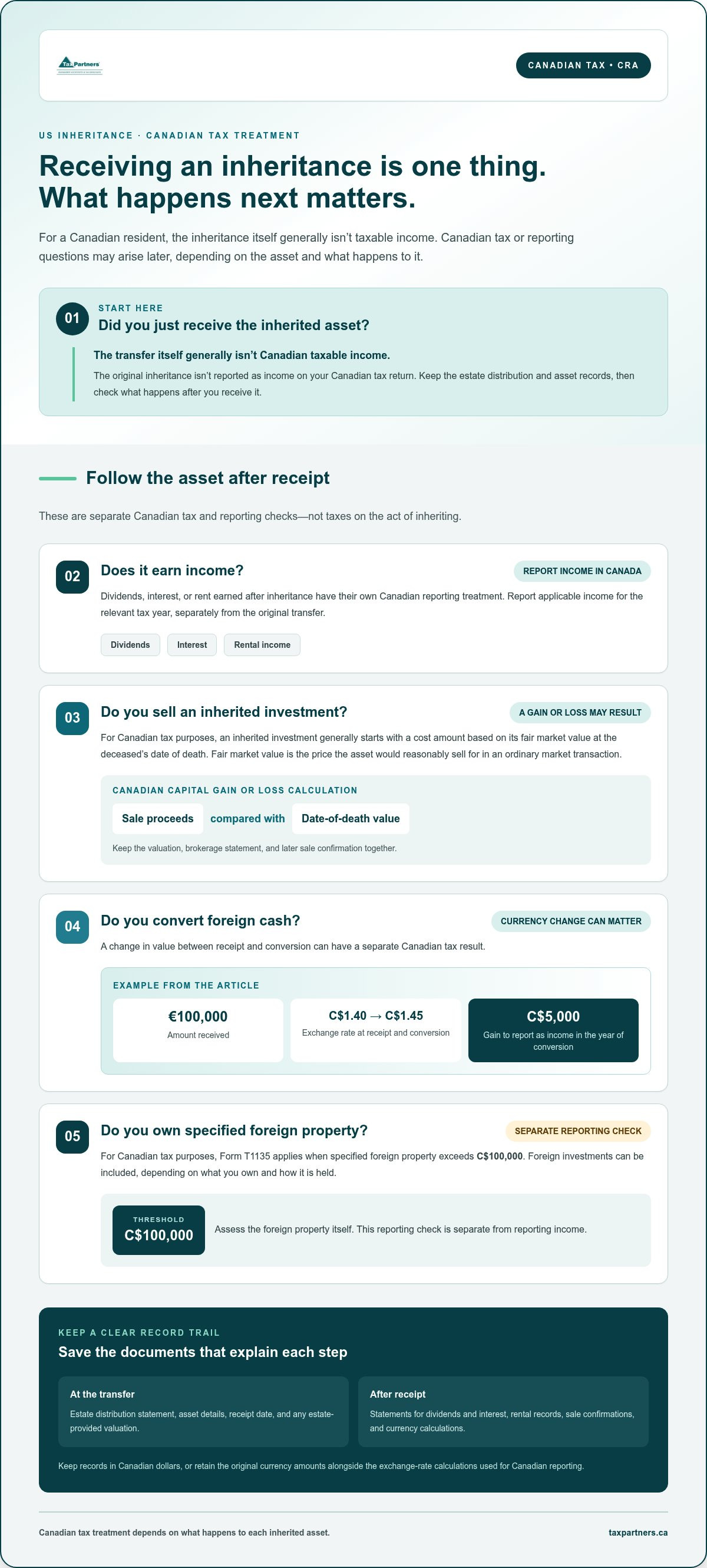
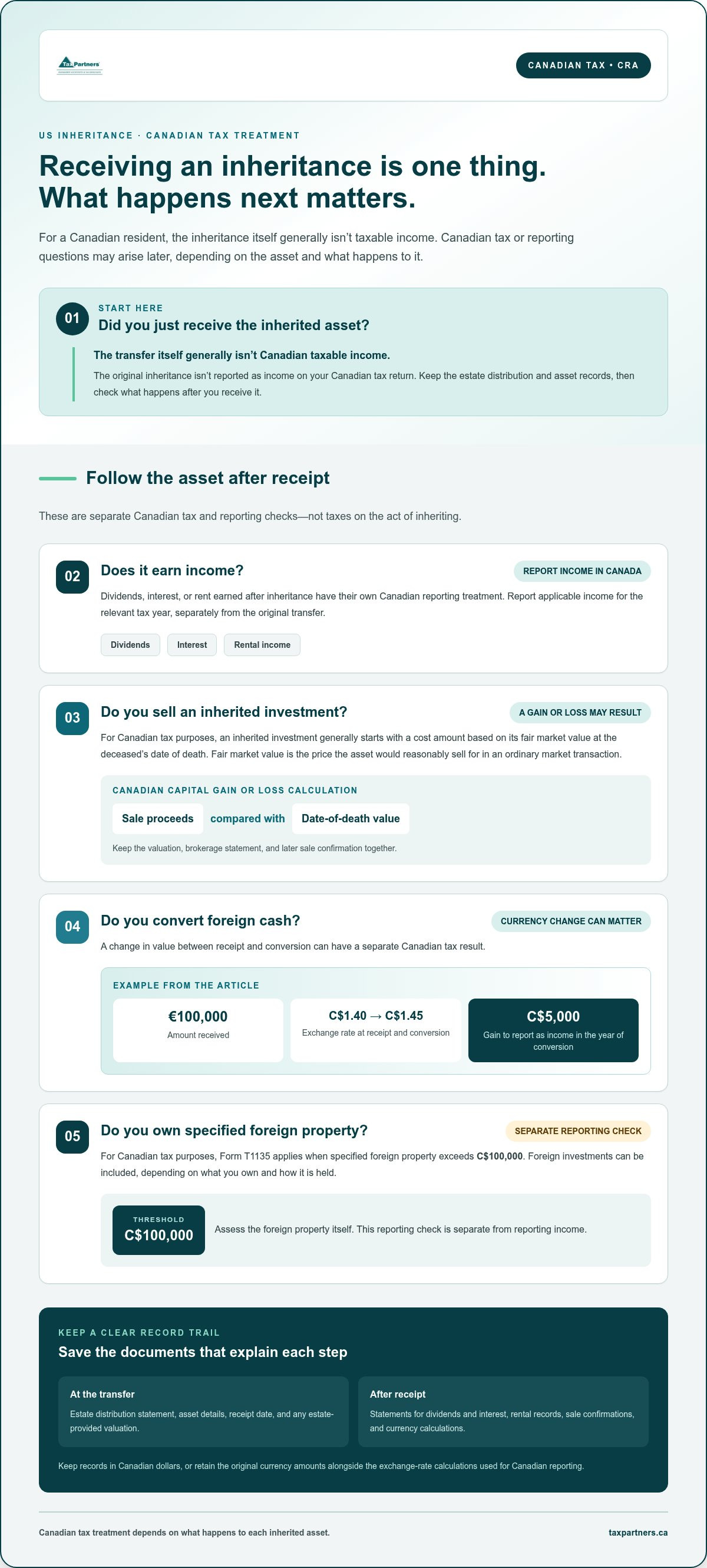
For a Canadian resident, receiving inherited foreign assets isn’t taxable income and doesn’t need to be reported as income on a Canadian tax return. Canadian reporting may apply later if the assets earn income, are sold, or meet foreign-property reporting requirements. Keep records of the inheritance separate from records of what happens after you receive the assets.
Start with the estate distribution statement and list each asset transferred to you. Record when you received it, the account or property involved, and any value provided by the estate. These details help distinguish inherited capital from income earned afterward, such as dividends, interest, or rent.
For Canadian tax purposes, inherited investments generally have a cost amount based on fair market value at the deceased’s date of death. Fair market value means the price an asset would reasonably sell for in an ordinary market transaction. This value provides a starting point for calculating a Canadian capital gain or loss if you later sell the investment.
For example, keep the date-of-death valuation with the brokerage statement and any later sale confirmation. You can then compare the sale proceeds with the recorded starting value. Keep records in Canadian dollars, or retain the original currency figures alongside the exchange-rate calculations used for Canadian reporting.
Foreign-property reporting is separate from reporting income. Form T1135 applies for Canadian tax purposes when specified foreign property exceeds C$100,000. This category can include foreign investments, but the reporting assessment depends on what you own and how it is held. Review the assets themselves rather than relying only on an account’s name or balance.
How are inherited U.S. assets valued and taxed when later sold by a Canadian resident? For Canadian tax purposes, use the asset’s fair market value at the deceased’s date of death as the starting cost for inherited investments. A later sale may result in a Canadian capital gain or loss based on that value and the sale proceeds.
Income earned after inheritance has its own Canadian reporting treatment. Keep annual account statements showing dividends and interest, along with rental records if inherited property earns rent. Report that income in Canada for the applicable tax year, separately from the original transfer of assets.
- Save the estate distribution statement and supporting asset valuations.
- Keep investment income, rental records, sale confirmations, and currency calculations organized by tax year.
- Assess Form T1135 reporting for Canadian purposes when specified foreign property exceeds C$100,000.
These records create a clear trail from the estate distribution to later Canadian income and sales. Organizing them by asset helps you prepare accurate CRA reporting and explain how each amount was calculated.
Does inheritance count as income?
For Canadian income-tax purposes, receiving an inheritance generally isn’t income. Tax questions arise separately if inherited property later earns income, is converted from foreign currency, or is sold.
Does Canada tax inheritances received from the United States? Canada doesn’t impose inheritance tax on the amount a beneficiary receives. The original transfer isn’t reported as income on a Canadian tax return, but income generated afterward may have Canadian tax implications.
What is the U.S. estate tax exemption for nonresident noncitizens in 2026? Canada has no U.S. estate-tax exemption, so that figure isn’t a Canadian tax rule. Confirm the current 2026 U.S. exemption directly with the IRS.
For Canadian tax purposes, cash received in another currency can have a separate result if its value changes before conversion. For example, receiving €100,000 when the rate is C$1.40 and converting it when the rate is C$1.45 creates a C$5,000 gain to report as income in the year of conversion.
Account and policy details matter too. For a TFSA or life-insurance payout, distinguish the amount received from any income or growth arising afterward. Keep the account or insurer’s statements, beneficiary records, and distribution documents so you can identify what the payment represents for Canadian reporting.
How do probate, withholding, and currency conversion affect an inheritance received in Canada? Probate can affect when funds are distributed, while tax withheld before transfer can change the net amount received. For Canadian reporting, keep the estate’s statements and record any foreign-currency conversion separately.
Organize records by asset and tax year. This makes it easier to distinguish an inheritance from later earnings or currency changes when preparing your Canadian return. If an inherited account includes several types of assets, retain statements showing each component rather than relying on the final deposit alone.
For help assessing how the Canadian rules apply to your records, discuss your tax situation.
What Are General Inheritance Tax Implications in Canada?
Canada doesn’t impose an estate tax, but an inheritance can still have Canadian tax consequences. The estate’s tax obligations and a beneficiary’s later income or asset sales are separate matters.
Tax Treatment by Inherited Asset Type
Cash, real estate, shares, and retirement accounts each need to be considered according to what they produce or how they are used. For Canadian tax purposes, dividends from inherited shares and rent from inherited property are income to report.
Keep separate records for cash received, investment statements, rental activity, and retirement-account distributions. These documents help identify later income or transactions without treating every inherited asset as the same kind of payment.
Canadian Estate Tax for Beneficiaries
Canada has no estate tax charged simply because a beneficiary receives property. However, Canadian tax law treats a deceased person’s assets as sold at fair market value at death, which can leave the estate with tax on capital gains accrued before distribution.
A spousal rollover is a Canadian tax rule that allows qualifying assets to pass directly to a surviving spouse with tax deferred until a later disposition. This can change when tax is paid, rather than eliminate the need to consider future gains.
Trusts and Estate-Tax Planning Strategies
A trust holds assets for beneficiaries under terms set by its creator. In Canada, a discretionary trust generally faces a deemed disposition every 21 years, meaning its assets are treated as sold at fair market value for tax purposes even if no actual sale occurs.
Estate planning should account for the trust’s terms, the assets it holds, and how distributions may affect beneficiaries. Provincial rules also matter: estates are distributed under a will or provincial intestacy laws, which apply when someone dies without a will.
For inherited real estate, rental income and a later sale are separate Canadian tax considerations. A Canadian resident who rents out foreign property may need to report rental income and expenses in Canada, as well as in the country where the property is located.
A sale may create a Canadian capital gain based on appreciation after inheritance. The principal residence exemption may apply to foreign property in some circumstances, but a family can designate only one property as its principal residence.
These rules make the estate’s records important for beneficiaries. Keep the will or distribution documents, property and investment statements, rental records, and details of any trust distributions together. They help distinguish estate-level tax from income or gains arising after you receive the assets.
Inherited foreign securities and foreign tax credits
Inherited shares can create separate Canadian tax questions after the estate distributes them. Track dividends, interest, sale proceeds, and foreign taxes paid, since these affect income reporting and potential foreign tax credits in different ways.
For Canadian purposes, income generated by inherited foreign assets, including dividends and rental income, must be reported on your Canadian tax return. The original inheritance and the income it produces are distinct. An investment account statement can help identify dividends received after distribution.
A foreign tax credit may offset Canadian tax on qualifying foreign taxes paid. For example, if a foreign government taxes dividends from inherited shares, keep the tax statement with the dividend record. The credit depends on whether the foreign tax qualifies for relief and on the related Canadian tax liability.
CRA Form T1135 applies when specified foreign property exceeds C$100,000. This Canadian reporting requirement concerns foreign property, which can include inherited securities. Keep the account statements and asset records that show what you held, where it was held, and the relevant values for the reporting period.
Financial account records also help distinguish securities from cash and other property. A brokerage statement may show shares, cash balances, dividends, and fees separately. That detail matters because the assets held in an account, rather than the account label alone, inform Canadian income and foreign-property reporting.
Foreign trust distributions need their own records. Ask the executor or trustee for statements identifying the amount distributed and the assets or income it represents. For a distribution involving securities, the transfer date and value can help establish the starting point for later Canadian reporting.
The deceased’s estate documents may show whether a distribution came from an investment account, a trust, or real estate proceeds. Keep those documents with your Canadian tax records rather than treating every transfer as a single cash inheritance. A distribution can involve capital, income, or property that later produces income.
Cross-border tax review is especially useful when a portfolio combines U.S. shares, foreign dividends, and tax withheld before payment. Compare the brokerage’s gross income figures with the net cash received. The difference may reflect foreign tax paid, which is relevant when assessing a Canadian foreign tax credit.
- Save brokerage and trust statements, including dividend and withholding details.
- Separate inherited capital from income earned after distribution.
- Assess Canadian Form T1135 reporting when specified foreign property exceeds C$100,000.
Accurate records connect each foreign tax payment to the income it relates to. That link is central to assessing a credit against Canadian tax, rather than assuming every cross-border tax payment automatically reduces your Canadian balance.
Cross-border double taxation planning
For a Canadian resident receiving a U.S. inheritance, separate estate-level tax from tax on later income and sales. U.S. estate-tax filings concern the estate; Canadian reporting concerns the beneficiary’s income, assets, and transactions after receiving them.
Start with an asset-by-asset record. Note what the estate distributed, when you received it, its value, and any foreign tax paid. This helps distinguish tax charged to the estate from tax on your own Canadian income, rather than treating every deduction as a credit against your Canadian balance.
Foreign tax credits may offset Canadian tax liabilities for qualifying foreign taxes paid. For example, if inherited shares generate dividends and foreign tax is withheld, retain both the dividend statement and the withholding record. The credit relates to qualifying foreign tax and Canadian tax on the relevant income, not automatically to every estate tax or withholding amount.
Real estate requires separate tracking. A Canadian who inherits foreign property and rents it out may have to report rental income and expenses both where the property is located and in Canada. A foreign tax credit may help with qualifying tax on that income, so keep rental statements, expense records, and foreign tax documents together.
Selling property creates another tax event. For Canadian purposes, the inherited property’s fair market value at the deceased’s date of death can establish the starting value for measuring later appreciation. Keep the valuation and sale documents separate from rental income records, since the sale and rental activity involve different calculations.
Currency changes also matter. If you inherit foreign cash, record its value when received and the exchange rate when you later convert it. A change in value can produce a separate Canadian-dollar gain, so distinguish the inherited capital from income or gains arising afterward.
Some countries require inheritance tax to be paid before assets are transferred to a Canadian heir. That timing can affect when you receive property and which estate records accompany the transfer. Keep distribution statements and proof of foreign tax together, especially when the estate handles tax before releasing assets.
According to H&R Block Canada, 54% of Canadians surveyed in 2025 were unsure whether loved ones had explored ways to minimize inheritance tax liability. Cross-border planning is clearer when the estate’s U.S. obligations, Canadian reporting, and any foreign tax credits are reviewed as distinct parts of the same situation.
- Separate estate tax from taxes on your later income or sale.
- Keep records of fair market value, rental activity, currency conversion, and foreign tax paid.
- Match each foreign tax payment to the income or asset it concerns.
For help coordinating Canadian and U.S. tax considerations around an inheritance, discuss your cross-border tax situation.
Tax Partners: Canadian Accounting & Tax Services
Tax Partners can help clarify Canadian reporting when a U.S. inheritance includes investments, rental property, or foreign income. Its Canadian Accounting & Tax Services and US & Cross-Border Accounting & Tax Services address the Canadian tax filings and cross-border considerations involved.
Consider support when you need to distinguish inherited assets from later income, assess foreign tax credits, or understand whether foreign-property reporting applies. Organized estate records, investment statements, and details of taxes withheld help connect each asset to its Canadian tax treatment.
For guidance on your inheritance and related Canadian tax matters, contact Tax Partners.
Make your next decision with a clear plan
An inheritance can bring choices that extend beyond filing a return: whether to retain investments, sell property, convert funds, or distribute assets among family members. A considered plan can connect those decisions with your broader financial priorities before you act.
For Canadian tax on a US inheritance, gather the estate and account records related to the decisions ahead. A focused review can clarify which questions concern tax reporting and which belong to your longer-term financial plan.
Tax Partners can help you consider the cross-border tax and financial-planning aspects of your situation. Contact Tax Partners to discuss your next step.
With a thoughtful plan in place, you can move forward with greater clarity and confidence.
Frequently Asked Questions
How much can you inherit without paying taxes in Canada?
Canada has no inheritance tax or tax-free inheritance limit for beneficiaries. The amount received isn’t, by itself, Canadian taxable income. Tax can arise later if inherited investments earn income or assets increase in value and are sold. For example, receiving cash differs from receiving shares that later pay dividends. Keep estate statements and account records so you can distinguish the original inheritance from later income and transactions.
When you inherit and sell a house, is it taxable in Canada?
A Canadian resident may have a taxable capital gain when selling an inherited house, based on its change in value after inheritance. For Canadian tax purposes, the property’s fair market value at the deceased’s date of death provides the starting point for measuring later appreciation. Keep a valuation supporting that value, along with purchase, improvement, and sale records. If the property was rented, track rental income separately from the gain on sale.
Is a U.S. inheritance taxable income for a Canadian resident?
No, the inheritance itself generally isn’t taxable income for a Canadian resident. Income the inherited assets produce afterward can be taxable in Canada. For instance, interest earned in an inherited account after distribution is different from the principal inherited. If funds remain in U.S. dollars and are converted later, a change in their Canadian-dollar value may also have a separate tax consequence. Keep dates and conversion records to support your calculations.
Does the U.S. federal estate tax apply to assets inherited by a Canadian resident?
It can apply to an estate that includes U.S.-situated assets, but it is an estate-level tax, not automatically a tax charged to the Canadian beneficiary. The estate’s asset location and value, along with applicable U.S. rules and treaty relief, affect the result. Review the estate distribution statement to see whether tax was paid or assets were reduced before transfer.
What U.S. estate tax treaty rules apply to Canadian residents inheriting U.S. assets?
The Canada-U.S. tax treaty can provide relief through a prorated unified credit when determining U.S. estate-tax exposure. “Prorated” means the credit is adjusted under treaty rules rather than simply applied in full in every cross-border estate. The calculation depends on the estate’s U.S.-situated assets and broader estate information. Keep the estate’s tax records and distribution details, since the beneficiary’s Canadian residence alone doesn’t establish the credit.
How do Canadian beneficiaries report inherited U.S. income and claim foreign tax credits?
Report income from inherited U.S. assets on your Canadian return for the year it is earned. Keep statements showing gross dividends, interest, or rental income, along with any U.S. tax withheld. A Canadian foreign tax credit may offset Canadian tax on qualifying foreign tax paid, but the payment must relate to income eligible for the credit. Match each tax record to the income statement rather than combining it with estate-level tax.
Are there Canadian reporting requirements for large foreign inheritances or inherited foreign accounts?
Receiving a large inheritance isn’t, by itself, a Canadian income-reporting requirement. However, CRA Form T1135 applies when specified foreign property exceeds C$100,000 for Canadian tax purposes. Inherited foreign securities may count as specified foreign property, depending on the property and how it is held. Review the assets in the account, not just its balance, and keep statements that identify the holdings and their values.
What steps should a Canadian take when receiving an inheritance from a U.S. estate?
Start by obtaining the estate’s distribution statement and an inventory of assets. Keep the date received, asset values, account statements, and records of U.S. tax withheld. Next, separate inherited principal from income earned after transfer, then record any sales, rental activity, and currency conversions. Finally, assess Canadian income reporting and foreign-property reporting for the assets you hold. These records also help explain the transfer if CRA asks about it later.

Article by
Mahad Mohamed
Mahad Mohamed is an accountant and the CEO of Tax Partners, with over 26+ years of Canadian and international tax and accounting experience. His expertise includes corporate reorganization, cross-border tax structuring (Canada & US), tax disputes, CRA audits, and tax planning for small owner-managed private corporations. Most recently, Mahad is a pioneer in Canadian crypto taxation and founded Block3 Finance.
Previously, Mahad worked for the Canada Revenue Agency (CRA), Big4 accounting firms, and served as a Rulings Officer for the Federal Tax Authority of the UAE before acquiring Tax Partners in 2014.
Tax Partners has 44 full-time accountants and over 18,400+ clients.
Disclaimer
This article provides general information only and is current as of its publication date. It has not been updated and may be out of date. It does not constitute legal advice and should not be relied upon as such. Every tax situation is unique and may differ from the examples discussed in this article. If you have specific questions, you should seek the advice of our accountants for your unique circumstances. Book a FREE Initial Consultation Today!
Frequently Asked Questions
How much can you inherit without paying taxes in Canada?
Canada has no inheritance tax or tax-free inheritance limit for beneficiaries. The amount received isn’t, by itself, Canadian taxable income. Tax can arise later if inherited investments earn income or assets increase in value and are sold. For example, receiving cash differs from receiving shares that later pay dividends. Keep estate statements and account records so you can distinguish the original inheritance from later income and transactions.
When you inherit and sell a house, is it taxable in Canada?
A Canadian resident may have a taxable capital gain when selling an inherited house, based on its change in value after inheritance. For Canadian tax purposes, the property’s fair market value at the deceased’s date of death provides the starting point for measuring later appreciation. Keep a valuation supporting that value, along with purchase, improvement, and sale records. If the property was rented, track rental income separately from the gain on sale.
Is a U.S. inheritance taxable income for a Canadian resident?
No, the inheritance itself generally isn’t taxable income for a Canadian resident. Income the inherited assets produce afterward can be taxable in Canada. For instance, interest earned in an inherited account after distribution is different from the principal inherited. If funds remain in U.S. dollars and are converted later, a change in their Canadian-dollar value may also have a separate tax consequence. Keep dates and conversion records to support your calculations.
Does the U.S. federal estate tax apply to assets inherited by a Canadian resident?
It can apply to an estate that includes U.S.-situated assets, but it is an estate-level tax, not automatically a tax charged to the Canadian beneficiary. The estate’s asset location and value, along with applicable U.S. rules and treaty relief, affect the result. Review the estate distribution statement to see whether tax was paid or assets were reduced before transfer.
What U.S. estate tax treaty rules apply to Canadian residents inheriting U.S. assets?
The Canada–U.S. tax treaty can provide relief through a prorated unified credit when determining U.S. estate-tax exposure. “Prorated” means the credit is adjusted under treaty rules rather than simply applied in full in every cross-border estate. The calculation depends on the estate’s U.S.-situated assets and broader estate information. Keep the estate’s tax records and distribution details, since the beneficiary’s Canadian residence alone doesn’t establish the credit.
How do Canadian beneficiaries report inherited U.S. income and claim foreign tax credits?
Report income from inherited U.S. assets on your Canadian return for the year it is earned. Keep statements showing gross dividends, interest, or rental income, along with any U.S. tax withheld. A Canadian foreign tax credit may offset Canadian tax on qualifying foreign tax paid, but the payment must relate to income eligible for the credit. Match each tax record to the income statement rather than combining it with estate-level tax.
Are there Canadian reporting requirements for large foreign inheritances or inherited foreign accounts?
Receiving a large inheritance isn’t, by itself, a Canadian income-reporting requirement. However, CRA Form T1135 applies when specified foreign property exceeds C$100,000 for Canadian tax purposes. Inherited foreign securities may count as specified foreign property, depending on the property and how it is held. Review the assets in the account, not just its balance, and keep statements that identify the holdings and their values.
What steps should a Canadian take when receiving an inheritance from a U.S. estate?
Start by obtaining the estate’s distribution statement and an inventory of assets. Keep the date received, asset values, account statements, and records of U.S. tax withheld. Next, separate inherited principal from income earned after transfer, then record any sales, rental activity, and currency conversions. Finally, assess Canadian income reporting and foreign-property reporting for the assets you hold. These records also help explain the transfer if CRA asks about it later.