Canadian Holding Company Structure: Costs, Tax and Benefits

A holding company can create value, but it also brings costs. In a Canadian holding company structure example, weigh those ongoing expenses against the potential benefits of separating business assets and planning for future ownership changes.
Before adding another corporation, weigh the costs against a clear business purpose. This article explains common setup and annual expenses, how an operating company and a holding company can work together, and when tax deferral may apply. It also covers succession planning to help you assess the structure’s practical value.
Key Takeaways
- Budget for both setup and ongoing corporate compliance when weighing the value of a holding company.
- Understand how an operating company can move surplus funds to a holding company, and which assets the structure may separate.
- Tax deferral can leave funds available for investment, but passive income may affect the small business deduction.
- A section 85 rollover may allow eligible property to move to a holding company on a tax-deferred basis in exchange for shares.
- Consider how ownership, asset management and future transfers fit together when planning for succession.
Can a Holding Company Have Expenses?
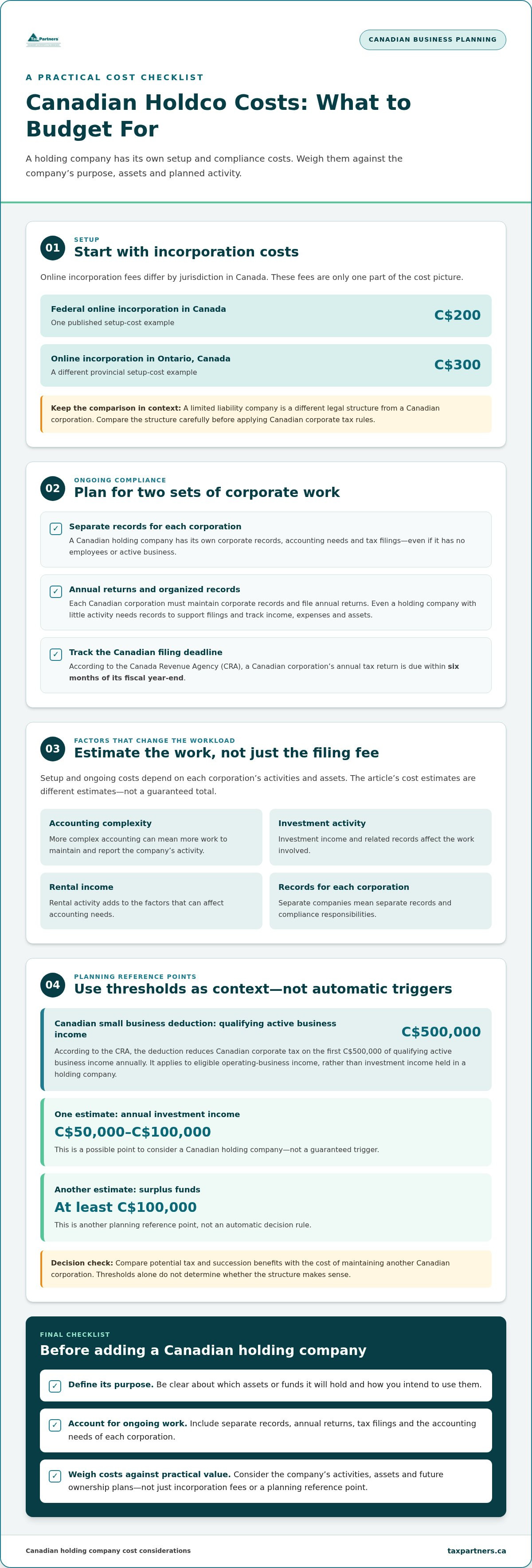
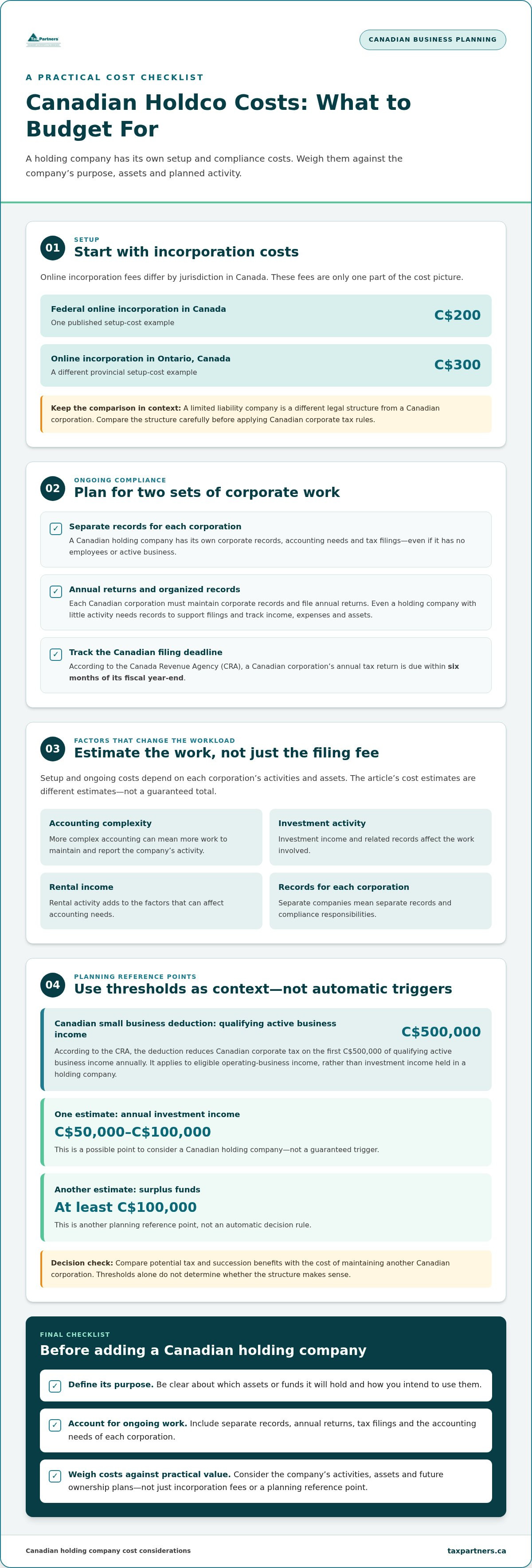
Yes. A Canadian holding company has its own corporate records, tax filings and accounting needs, even if it has no employees or active business. If you already have an operating company, maintaining both means managing separate records and compliance responsibilities for each corporation.
Setup and ongoing costs depend on each company’s activities and assets.
These are different cost estimates, not a guaranteed total. Accounting complexity, investment activity, rental income and the records each corporation needs all affect the work involved.
Incorporation fees are only one part of the picture. Federal online incorporation costs C$200, while online incorporation in Ontario costs C$300. A limited liability company is a different legal structure from a Canadian corporation, so compare the limited liability company structure carefully before applying Canadian corporate tax rules.
After incorporation, each corporation must maintain its own corporate records and file annual returns. According to Canada Revenue Agency, a Canadian corporation’s annual tax return is due within six months of its fiscal year-end. Even a holding company with little activity needs organized records to support its filings and track income, expenses and assets.
Income thresholds can help frame the decision, but they don’t determine it alone. According to Canada Revenue Agency, the small business deduction reduces corporate tax on the first C$500,000 of qualifying active business income annually. In plain terms, it lowers the tax on eligible income earned from operating a business, rather than on investment income held in a holding company.
One estimate identifies annual investment income of C$50,000 to C$100,000 as a possible point to consider a holding company. Another suggests considering one when surplus funds reach at least C$100,000. These are planning reference points, not automatic triggers: compare potential tax and succession benefits with the cost of maintaining another corporation.
For example, an owner with retained earnings, a rental property and an operating company should assess each corporation’s assets and activity separately. If the holding company adds recurring investment and accounting work without a clear purpose, it may not justify the expense. Weigh the compliance workload against how you intend to use the funds and assets.
Holding company and operating company structure
A common Canadian structure separates the company earning business income from a corporation holding selected assets. This distinction affects ownership, cash transfers, creditor exposure and planning for a future sale.
Holding Company Examples
A pure holdco mainly owns investments or shares, an operating holdco also runs a business, and a family holdco holds assets for family owners. For example, a pure holdco might own an operating company’s shares and invest surplus cash, while an operating holdco earns revenue directly. A family holdco can organize ownership among participants, provided its purpose and assets are clearly defined.
Parent Ownership of an Operating Company
A parent holding company owns shares in an operating company, often as its wholly owned subsidiary. The operating company runs the day-to-day business; the parent may hold shares, investments, excess cash or other assets. Owners can hold the parent directly or through personal holding companies. This separates ownership from operations and clarifies which corporation receives income, holds assets and maintains records.
For example, an operating company with C$500,000 in retained earnings could pay a dividend to its holdco. Canadian corporations may generally pay intercorporate dividends tax-free under section 112 of the Income Tax Act. A Canadian operating company can generally pay dividends to a holdco without tax when the holdco owns more than 10% of it. The dividend moves funds between corporations; it doesn’t erase either corporation’s filing responsibilities.
Separating assets can reduce the amount held inside an operating company, where business claims may arise. In one example, Bob’s Building Co had C$1,000,000 in investments at risk when it was sued. Moving surplus assets to a separate holdco may limit their exposure to operating risks, but assets left in the operating company remain there. Transfers also need careful timing and proper records; a holding company isn’t a guarantee against creditor claims.
Purification means removing excess passive assets from an operating company before a potential share sale, to help meet the Lifetime Capital Gains Exemption’s asset tests. For the Canadian test, at least 90% of assets must be used in active business at sale, and at least 50% throughout the previous 24 months. Moving appreciated non-cash assets can trigger tax because the transfer may be treated as a disposition at fair market value.
The sequence matters: identify surplus assets, determine the tax consequences of each transfer, and keep records that support the company’s asset mix. A holdco can receive excess cash through dividends, but that transfer alone doesn’t establish that the operating company meets the exemption tests. Ownership history and business use also matter when assessing a sale.
Owners assessing a parent-and-subsidiary arrangement can discuss Canadian corporate tax planning through a conversation about their corporate structure.
Holding company incorporation and structure
A Canadian holding company is incorporated federally or provincially as a separate legal entity. The choice affects its governing framework, setup costs and how owners arrange shares and assets.
Incorporation and Regulatory Requirements
Incorporation creates a corporation distinct from its shareholders, with its own assets, records and tax responsibilities. Clear documentation of investments, profits and transactions is essential. Canadian corporations must file annual returns and keep corporate records up to date. A lawyer can help with complex ownership arrangements, including plans involving real estate or professional corporations.
Holding Company Share Structure
A share structure defines who owns the holding company and the rights attached to each share. Voting control, distributions and future transfers depend on how ownership is documented. For example, Don, Bertram and Roger each owned one-third of Sterling Cooper Inc.’s common voting shares. Different share classes can support distinct ownership goals, but their terms should match the intended arrangement.
Federal and provincial incorporation are separate routes for creating a Canadian corporation. Online federal incorporation costs C$200, while online incorporation in Ontario costs C$300. The lower filing fee alone doesn’t determine the best choice; the corporation’s activities, owners and applicable rules also matter. Some Canadian provinces may restrict a holding company from owning shares of a professional corporation, so professional ownership structures require particular attention.
At incorporation, owners decide who subscribes for shares and how the holding company will own or receive assets. In a parent structure, the holdco can own shares in an operating company; in an investment structure, it can hold investments or excess cash. Documenting these decisions clearly helps distinguish corporate capital from personal funds and supports accurate accounting across related companies.
Real estate needs separate consideration. Moving property into a corporation may trigger land transfer tax, and transferring appreciated investments to a Canadian holdco can trigger capital gains tax if treated as a disposition at fair market value. A section 85 rollover may offer tax deferral for eligible property transferred in exchange for shares, but it involves specific tax treatment, not an automatic exemption.
After incorporation, maintain each corporation’s records and complete its annual filings. A holding company that owns shares, investments or real estate still needs documentation for its transactions and income. Keep the share register, ownership records and asset information aligned to support accurate reporting and future planning.
Tax deferral and passive investment income
When investing business profits in Canada, funds owned personally are taxed to you when received. A holding company, by contrast, may retain eligible intercorporate dividends for corporate investment. This can defer personal tax until funds leave the corporation, but investment returns inside the holdco remain subject to corporate tax.
For example, an operating company may pay a dividend to its holding company, which then invests the funds. Canadian corporations may generally pay intercorporate dividends tax-free under section 112 of the Income Tax Act. This is tax deferral, not tax elimination: distributing funds later to an individual shareholder can create personal tax.
Passive investment income includes returns such as interest and portfolio income earned outside an active business. For associated Canadian-controlled private corporations, adjusted aggregate investment income, the tax-calculated total of relevant passive investment income after adjustments, between C$50,000 and C$150,000 can reduce the small business deduction limit. This reduction can affect access to a deduction tied to active business income elsewhere in the corporate group.
Investment income also faces corporate tax, with rates varying by province and income type. In Ontario, corporate investment income is taxed at a combined rate of 50.17% in 2026; Alberta’s corporate investment income tax rate is 46.67% in 2026. These rates illustrate why a holding company’s investment returns shouldn’t be compared with personal returns by looking only at the initial tax deferral.
Part of the tax on investment income may be refundable when a private corporation pays taxable dividends. The refundable dividend tax on hand (RDTOH) tracks refundable tax that may be recovered through dividend payments. A Canadian holding company’s aggregate investment income adds 30.67% to its RDTOH account each year, and the CRA refunds 38.33% of a taxable dividend, up to the corporation’s RDTOH balance.
An example involving Harvey compares C$50,000 per year in interest income with C$19,300 in holding-company tax and C$24,000 in additional taxes on that income. Those figures illustrate one scenario, not a universal tax saving. The outcome depends on province, income type, corporate associations, timing of dividends and whether the shareholder needs the money personally.
Family dividends require additional review. The tax on split income (TOSI) rules can restrict income splitting through certain private-company payments to related people. A holding company doesn’t automatically make family dividends tax-efficient. Before distributing income, consider the recipient, the nature of the payment and the applicable TOSI treatment.
Compare the after-tax amount available for reinvestment with the cost of keeping funds in a corporation and the eventual tax on personal withdrawals. Include corporate investment income, potential RDTOH refunds, reduced small business deduction room and the owner’s plans for using the funds.
How do you set up a Canadian holding company and transfer shares under a section 85 rollover?
A section 85 rollover may let eligible property move to a Canadian holding company on a tax-deferred basis in exchange for shares. Tax deferral means postponing tax that could otherwise arise on a transfer; it doesn’t automatically eliminate tax.
Start by defining what the new holdco will own and why. For example, an owner might transfer shares of an operating company so the holdco becomes its parent. Transferring investments or other property is different: each asset has its own value, ownership history and tax considerations.
Incorporate the holding company before transferring property. Choose a federal or provincial corporation, determine its shareholders and share structure, and document its purpose and ownership. The holdco must exist as a separate legal entity to receive shares in exchange for transferred property.
Next, identify the property being transferred and establish its fair market value and tax cost. Fair market value is the price the property could reasonably fetch in an open market; tax cost is the amount used to calculate a potential gain. These figures help determine whether a transfer could otherwise create a taxable disposition.
With a section 85 rollover, the transferor receives shares of the holding company in exchange for eligible property. The agreed transfer terms affect the amount of tax deferred and the holdco’s records. For example, transferring operating-company shares in exchange for holdco shares changes the ownership chain: the original owner holds the parent, and the parent holds the operating-company shares.
Keep the supporting documents together. Record the property transferred, its valuation, the consideration received, the effective date and the resulting share ownership. Corporate resolutions, transfer agreements and updated share registers help document how the transaction was completed and how the new structure operates.
Tax treatment depends on the property and transaction details. Moving appreciated investments to a corporation can trigger capital gains tax if the transfer is treated as a disposition at fair market value. A section 85 rollover may provide deferral for eligible property, but it doesn’t make every asset or transfer tax-free. Real estate may also raise land transfer tax considerations.
After the transfer, update the holdco’s accounting records to reflect its new ownership. Track the shares received, dividends, investment income and any later sale or distribution separately from the operating company’s records. This separation helps explain future transactions and supports corporate tax reporting.
Because the rollover depends on asset values, ownership and transfer terms, get help mapping the transaction before completing it. Discuss a section 85 rollover and holding-company transfer to plan the accounting and Canadian tax treatment.
Tax Partners: Canadian Accounting & Tax Services
Tax Partners helps business owners assess Canadian holding-company tax considerations, corporate reporting and the practical demands of a multi-company structure. Its Canadian Accounting & Tax Services support planning around company income, dividends and transfers. Bookkeeping and Payroll Services help keep financial records organized across business activities.
Consider this support when you’re weighing a new holdco, planning a section 85 rollover or reviewing how corporate investments fit your succession goals. Tax Partners can also connect corporate decisions with Wealth Management & Financial Planning where personal and business planning intersect. To discuss your structure, contact Tax Partners.
Plan for the Next Chapter of Ownership
A Canadian holding company structure example can clarify the questions behind a long-term ownership plan, but the right arrangement should reflect your priorities. Consider who should control decisions, how future owners might enter or exit, and the role each corporation should play as the business changes. A clear plan connects today’s corporate choices with tomorrow’s succession goals.
Before making changes, bring together your ownership records, business objectives and plans for future transfers. This gives the discussion a practical starting point and helps identify where tax, accounting and succession considerations intersect. Tax Partners can help you assess those considerations in the context of your Canadian business and its ownership goals. Discuss your holding company structure with Tax Partners and take the next step with greater clarity.
Frequently Asked Questions
What is a Business Holding?
A business holding is an informal term for a company that owns assets or shares in another business. It isn’t a separate legal category. For example, one corporation might hold shares in an operating company, investments or intellectual property, while another handles sales and daily operations. The distinction matters because each corporation has separate records, income and responsibilities.
What is a Holding Corporation in Canada?
A holding corporation in Canada is an incorporated legal entity that may own assets or shares in other corporations. It can hold investments, excess cash, real estate or intellectual property rather than directly selling goods or services. Its activities depend on its articles, ownership and transactions. Even if it mainly holds shares, it remains a corporation with its own records and tax reporting obligations.
What is a Canadian holding company and how does it work?
A Canadian holding company owns assets or investments, often including shares in an operating business. The operating company conducts business, while the holding company can receive dividends and retain or invest funds. For example, an owner might keep operations in one corporation and place eligible surplus funds in another. This can support asset organization and future planning, but it doesn’t remove taxes or filing duties.
What is an example Canadian holding company structure with an operating company and shareholders?
One Canadian holding company structure example has three shareholders owning shares in Holdco, which owns all the shares in Opco. Opco runs the business and earns operating income; Holdco owns the Opco shares and may receive dividends. If each shareholder has an individual holding company, those companies can instead own interests in the parent structure. The share register and corporate records show who controls each company and receives distributions.
How do Canadian holding companies receive tax-free intercorporate dividends?
A Canadian corporation may generally pay an intercorporate dividend to another Canadian corporation without ordinary Part I tax under section 112 of the Income Tax Act. The recipient company records the dividend and reports it in its corporate tax return. “Tax-free” doesn’t mean every payment escapes tax: Part IV tax is a separate tax that can apply to certain dividends received by private corporations, including in circumstances involving a dividend refund on passive investment income.
What are the Canadian tax rules for passive investment income in a holding company?
Passive investment income earned by a Canadian holding company is subject to corporate tax. Its treatment depends on the income type and the corporation’s circumstances: interest, dividends and capital gains can have different tax consequences. For associated Canadian-controlled private corporations, adjusted aggregate investment income can affect the small business deduction limit. Keep investment transactions separate from active-business records to track income and related tax balances accurately.
What are the costs and annual filing requirements for a Canadian holding company?
Costs vary with the company’s transactions, investments, accounting complexity and professional support required. A Canadian corporation generally needs to maintain corporate records, file annual returns and submit a T2 return, the corporation’s income tax return, for each tax year, even when inactive or owing no tax. According to the Canada Revenue Agency, the annual tax return is due within six months of the corporation’s fiscal year-end. Compliance continues even when the company holds few assets.
What are the risks of creditor claims, personal guarantees, and asset transfers involving a Canadian holding company?
A holding company can separate assets from operating risks, but it doesn’t protect property that remains in the operating company or property covered by a personal guarantee. A guarantee can make the guarantor personally liable for the debt covered by its terms. Directors may also face liability for matters such as unpaid taxes or wages. Transferring appreciated assets can trigger tax, and transferring real estate may involve land transfer tax.

Article by
Mahad Mohamed
Mahad Mohamed is an accountant and the CEO of Tax Partners, with over 26+ years of Canadian and international tax and accounting experience. His expertise includes corporate reorganization, cross-border tax structuring (Canada & US), tax disputes, CRA audits, and tax planning for small owner-managed private corporations. Most recently, Mahad is a pioneer in Canadian crypto taxation and founded Block3 Finance.
Previously, Mahad worked for the Canada Revenue Agency (CRA), Big4 accounting firms, and served as a Rulings Officer for the Federal Tax Authority of the UAE before acquiring Tax Partners in 2014.
Tax Partners has 44 full-time accountants and over 18,400+ clients.
Disclaimer
This article provides general information only and is current as of its publication date. It has not been updated and may be out of date. It does not constitute legal advice and should not be relied upon as such. Every tax situation is unique and may differ from the examples discussed in this article. If you have specific questions, you should seek the advice of our accountants for your unique circumstances. Book a FREE Initial Consultation Today!
Frequently Asked Questions
What is a Business Holding?
A business holding is an informal term for a company that owns assets or shares in another business. It isn’t a separate legal category. For example, one corporation might hold shares in an operating company, investments or intellectual property, while another handles sales and daily operations. The distinction matters because each corporation has separate records, income and responsibilities.
What is a Holding Corporation in Canada?
A holding corporation in Canada is an incorporated legal entity that may own assets or shares in other corporations. It can hold investments, excess cash, real estate or intellectual property rather than directly selling goods or services. Its activities depend on its articles, ownership and transactions. Even if it mainly holds shares, it remains a corporation with its own records and tax reporting obligations.
What is a Canadian holding company and how does it work?
A Canadian holding company owns assets or investments, often including shares in an operating business. The operating company conducts business, while the holding company can receive dividends and retain or invest funds. For example, an owner might keep operations in one corporation and place eligible surplus funds in another. This can support asset organization and future planning, but it doesn’t remove taxes or filing duties.
What is an example Canadian holding company structure with an operating company and shareholders?
One Canadian holding company structure example has three shareholders owning shares in Holdco, which owns all the shares in Opco. Opco runs the business and earns operating income; Holdco owns the Opco shares and may receive dividends. If each shareholder has an individual holding company, those companies can instead own interests in the parent structure. The share register and corporate records show who controls each company and receives distributions.
How do Canadian holding companies receive tax-free intercorporate dividends?
A Canadian corporation may generally pay an intercorporate dividend to another Canadian corporation without ordinary Part I tax under section 112 of the Income Tax Act. The recipient company records the dividend and reports it in its corporate tax return. “Tax-free” doesn’t mean every payment escapes tax: Part IV tax is a separate tax that can apply to certain dividends received by private corporations, including in circumstances involving a dividend refund on passive investment income.
What are the Canadian tax rules for passive investment income in a holding company?
Passive investment income earned by a Canadian holding company is subject to corporate tax. Its treatment depends on the income type and the corporation’s circumstances: interest, dividends and capital gains can have different tax consequences. For associated Canadian-controlled private corporations, adjusted aggregate investment income can affect the small business deduction limit. Keep investment transactions separate from active-business records to track income and related tax balances accurately.
What are the costs and annual filing requirements for a Canadian holding company?
Costs vary with the company’s transactions, investments, accounting complexity and professional support required. A Canadian corporation generally needs to maintain corporate records, file annual returns and submit a T2 return, the corporation’s income tax return, for each tax year, even when inactive or owing no tax. According to the Canada Revenue Agency, the annual tax return is due within six months of the corporation’s fiscal year-end. Compliance continues even when the company holds few assets.
What are the risks of creditor claims, personal guarantees, and asset transfers involving a Canadian holding company?
A holding company can separate assets from operating risks, but it doesn’t protect property that remains in the operating company or property covered by a personal guarantee. A guarantee can make the guarantor personally liable for the debt covered by its terms. Directors may also face liability for matters such as unpaid taxes or wages. Transferring appreciated assets can trigger tax, and transferring real estate may involve land transfer tax.