Canadian corporate effective tax rates and how they compare

Canada’s marginal effective tax rate on new investment measures how taxation affects corporate investment decisions. It offers a different perspective from statutory rates on taxable income and helps explain why a headline percentage may not tell the whole story.
A single corporate tax rate can seem like a straightforward guide to a business’s tax burden. In practice, the result depends on how Canadian tax rules apply to the corporation’s income and investment decisions.
This article explains marginal effective and integrated tax rates, how provincial differences affect comparisons, and how statutory and effective rates differ. You’ll get a clearer framework for understanding corporate tax burdens in Canada and identifying the factors that matter to your business.
Key Takeaways
- A marginal effective tax rate shows how taxes affect the return required to make a new investment worthwhile, not simply the tax rate applied to corporate income.
- For an eligible Canadian-controlled private corporation, the Small Business Deduction can reduce tax on qualifying active business income; eligibility and provincial rates shape the overall result.
- Alberta’s combined federal and provincial corporate income tax rate is 23%, but a province-wide comparison may not reflect a corporation’s specific tax position.
- Canada’s marginal effective tax rate on new investment is 6.3 per cent under current law, compared with Finance Canada’s U.S. estimate of 16.9 per cent.
- Separate the statutory rate from the effective rate, then consider provincial rules and investment-related deductions to understand the corporate tax burden more clearly.
What is a marginal effective tax rate?
In Canada, the marginal effective tax rate measures how tax affects the return required on a new investment. A corporation’s income tax return and payment have separate deadlines based on its taxation year and balance owing.
CCPCs and the Small Business Deduction
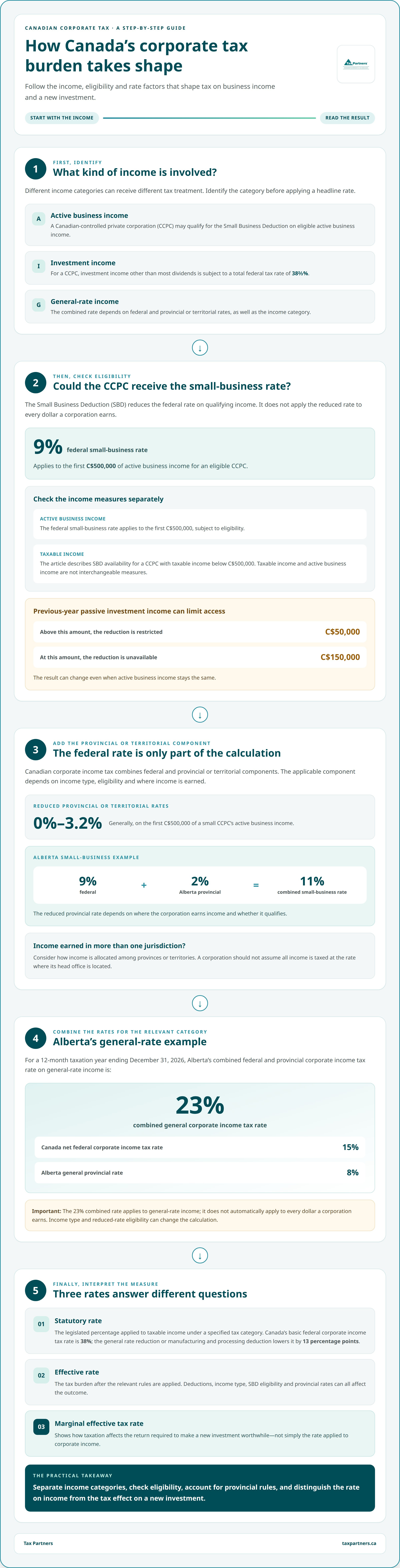
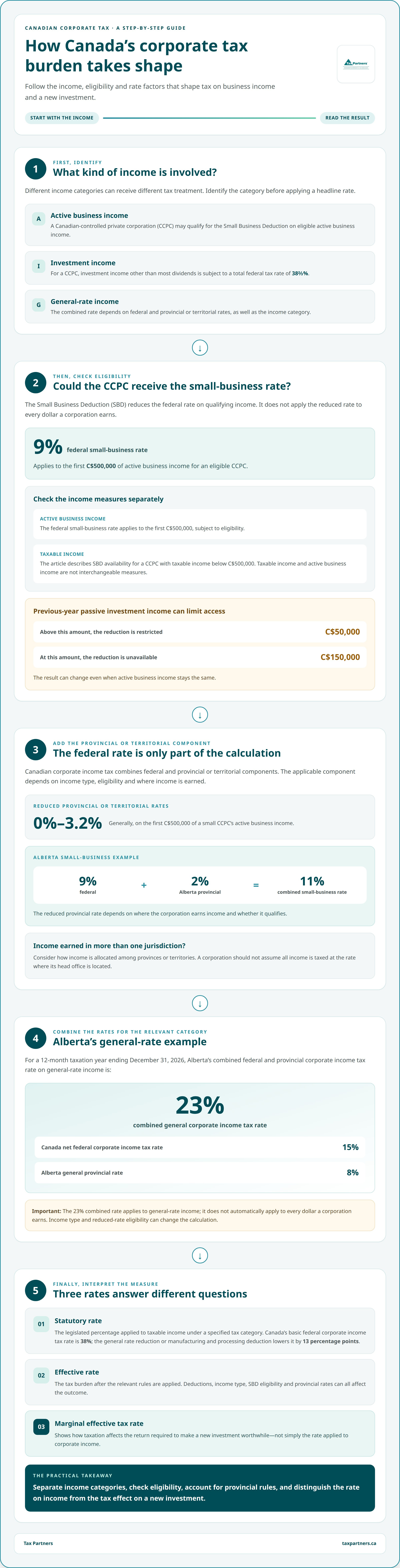
A Canadian-controlled private corporation (CCPC) may qualify for the federal Small Business Deduction (SBD) on eligible active business income. The SBD reduces the federal tax rate on qualifying income, rather than applying the general rate to every dollar the corporation earns.
In Canada, a CCPC’s access to the reduced federal rate can be limited by passive investment income earned in the previous taxation year. The reduction is restricted when that income exceeds C$50,000 and is unavailable at C$150,000 of investment income. The result can change even when active business income stays the same.
Small-Business Rates and Income Thresholds
For a CCPC in Canada, the federal small-business rate is 9% on the first C$500,000 of active business income, subject to eligibility. The threshold matters because income beyond the qualifying limit does not receive that same reduced federal treatment.
The SBD is available to a Canadian-controlled private corporation whose taxable income is less than C$500,000. Active business income and taxable income are not interchangeable measures, so the applicable amount depends on the income being considered. Identifying the income category helps explain which rate applies.
Federal and Provincial Rate Components
Canadian corporate income tax on active business income combines federal and provincial or territorial components. In Canada, reduced provincial or territorial rates on the first C$500,000 of a small CCPC’s active business income generally range from 0% to 3.2%.
Alberta illustrates how the components add up: its small-business rate is 11%, comprising a 9% federal rate and a 2% provincial rate. The applicable provincial rate depends on where the corporation earns income and its eligibility for the reduced rate. A single federal percentage therefore cannot describe every corporation’s combined tax burden.
Statutory and Effective Corporate Tax Rates
A statutory corporate tax rate is the legislated percentage applied to taxable income under a specified tax category. In Canada, the basic federal corporate income tax rate is 38%, while the general rate reduction or manufacturing and processing deduction lowers it by 13 percentage points.
An effective rate describes the tax burden after the relevant rules are applied to a corporation’s income. Deductions, income type, SBD eligibility, and provincial rates can all affect the outcome for a Canadian business. A headline rate alone may not show the tax cost of the next dollar earned or a proposed investment.
For annual planning, distinguish the rate on eligible active business income from the rate on other income. A Canadian CCPC earning qualifying income below the small-business threshold may face a different result from a corporation with higher income or substantial passive investments. These distinctions make the marginal measure useful for assessing how a new investment could affect the tax burden.
What’s an Integrated Tax Rate and How Does It Impact You?
An integrated corporate tax rate combines federal and provincial income tax rates. In Canada, the combined rate depends on the income category and the province or territory connected to that income.
Alberta’s Combined Corporate Tax Rate
For a 12-month taxation year ending December 31, 2026, Alberta’s combined federal and provincial corporate income tax rate is 23%. It combines Canada’s net federal corporate income tax rate of 15% with Alberta’s general provincial rate of 8%.
This combined rate applies to general-rate income, not automatically to every dollar a corporation earns. Income type and eligibility for a reduced rate can change the calculation, so Alberta’s headline rate alone may not describe a business’s tax position.
Alberta’s Provincial Corporate Tax Rate
Alberta’s general provincial corporate income tax rate is 8.0% for a 12-month taxation year ending December 31, 2026. It is the provincial component, separate from the federal rate, within Alberta’s combined general rate.
The distinction matters when reviewing corporate tax rates or comparing income in different tax categories. For example, Alberta provincial tax is only part of the total: federal income tax also applies.
Businesses active in more than one province or territory need to consider how income is allocated among those jurisdictions. A corporation shouldn’t assume all its income is taxed at the rate where its head office is located. The allocation affects which provincial or territorial rate enters the combined calculation, making business activity relevant to income tax planning.
Income splitting means distributing income among people connected with a business or its owner. Canada’s Tax on Split Income (TOSI) matters because split income may receive different tax treatment from income retained by the corporation or paid to its owner. The label alone doesn’t determine how a distribution is taxed; the source and nature of the income matter.
CCPC investment income also has a distinct treatment: in Canada, investment income other than most dividends is subject to a total federal tax rate of 38⅔%. This rate differs from the rate on active business income, so identifying income type is essential when considering the corporation’s overall tax burden.
Keep sales tax separate from corporate income tax. A sales tax credit and an income tax deduction also work differently: a credit reduces tax payable, while a deduction reduces the income used to calculate tax.
For a corporation with income across jurisdictions or categories, discussing its Canadian tax position can help clarify how federal and provincial components fit together.
Corporate marginal effective tax rate in Canada
For Canadian businesses, the marginal effective tax rate (METR) helps assess how taxes influence the cost of a new investment. It focuses on the tax effects connected with investing, rather than simply the rate applied to existing taxable profits.
Under current Canadian law, Canada’s METR on new investment is 6.3%. This national estimate offers context, but it does not describe every sector or project. The type of investment and the tax provisions that apply can produce a different result for an individual business.
Industry figures show that variation. In Canada, the METR is 21.0% for retail trade and 17.5% for wholesale trade. A business considering a new store, distribution facility, or other investment should treat these sector estimates as context, not as a calculation of its own tax payable.
Investment-related deductions can also affect the measure. Finance Canada estimates a Canadian METR of 13.0% without the Mega Deduction and 6.4% with it. The estimates illustrate how tax treatment of investment costs can influence the tax burden associated with a project.
These measures support planning by connecting taxation with investment choices. A corporation considering new equipment or a facility can assess how applicable Canadian deductions affect the required return. The METR does not, on its own, show the company’s annual tax bill or the after-tax result of every project.
Sector and asset mix matter. A Canadian retailer’s investment profile may differ from a mining business’s, so their METRs need not match. Read a national estimate alongside the industry and investment assumptions behind a particular decision.
Canada’s investment METR has also changed over time. It peaked at about 49% in 1990, was about 43% by 2000, reached 24% by 2010, and stood at 16% by 2019. This history provides context for current Canadian estimates, but each figure belongs to its stated period.
For a Canadian investment assessment, identify the sector, proposed asset, and applicable Canadian deductions before drawing conclusions from a METR. This keeps the measure focused on investment incentives, rather than treating it as a universal Canadian corporate tax rate or a forecast of tax payable.
Alberta’s tax advantage compared with other provinces
Alberta’s provincial general corporate income tax rate is 8.0% for a 12-month taxation year ending December 31, 2026. Comparing that rate with other provinces shows how location can change a corporation’s combined tax rate.
For the same taxation year, British Columbia’s general provincial rate is 12.0%, Ontario’s is 11.5%, and New Brunswick’s is 14.0%. Alberta’s 8.0% rate is lower than each of these provincial rates, although provincial tax is only one part of a corporation’s total tax calculation.
With Canada’s net federal corporate income tax rate of 15% for a 12-month taxation year ending December 31, 2026, the combined general rates are 23% in Alberta, 27% in British Columbia, 26.5% in Ontario, and 29% in New Brunswick. These comparisons use the general provincial rates, not reduced rates for qualifying small-business income.
The gap is relevant when a corporation considers where to invest capital or expand operations. For example, a business weighing an Alberta project against an Ontario project can compare the provincial components, then account for federal tax and the income category involved. A provincial rate alone does not establish the effective tax rate for Canadian corporations.
Alberta’s tax advantage for 2026-27 is estimated at $16.9 billion. This is an economy-wide estimate, not a tax saving promised to each corporation. A private company’s result depends on its taxable income, applicable rate category, and where its business income is allocated.
Location comparisons should reflect actual business activity. A corporation should not assume that choosing an Alberta address means all its income qualifies for Alberta’s provincial rate. If business activity spans more than one province, income allocation can affect which provincial rates apply.
Small-business income calls for a separate comparison. A qualifying Canadian-controlled private corporation may face reduced provincial rates on eligible active business income, while general-rate income follows the applicable general rate. The rate category, eligibility, and province must all align for a headline comparison to apply.
A lower corporate income tax rate does not settle every location decision. A project’s capital needs, workforce, customers, and operating plans also shape its commercial case. Tax rates are one input, not a complete measure of a province’s business costs or expected returns.
Use Alberta’s 23% combined general rate as a useful reference point for 2026, then compare the corresponding provincial rate and income category elsewhere. That approach keeps the comparison consistent and avoids treating Alberta’s advantage as an automatic outcome for every corporation.
What is the difference between the statutory corporate tax rate and the effective tax rate in Canada?
A statutory rate is the legislated percentage applied to a defined category of taxable corporate income in Canada. An effective rate describes the tax burden after applicable deductions and rate adjustments. The distinction matters because a corporation’s headline rate may not match the tax it ultimately pays.
Canada’s basic federal corporate income tax rate is 38%. The federal abatement gives provinces and territories room to impose corporate income taxes, reducing the federal rate by 10 percentage points. The general rate reduction or manufacturing and processing deduction reduces the federal corporate income tax rate by a further 13 percentage points.
These adjustments show why “statutory rate” needs context. The 38% basic federal rate is not automatically the final federal rate applied to every corporation’s taxable income. For a 12-month taxation year ending December 31, 2026, Canada’s net federal corporate income tax rate is 15%, after the applicable federal provisions are considered.
An effective rate can be calculated by dividing corporate income tax payable by the relevant income measure, then expressing the result as a percentage. The denominator matters: taxable income, accounting profit, and income before tax may differ. Don’t compare a calculation based on one measure with another based on a different measure.
Income category also affects the comparison. A Canadian corporation with qualifying active business income may receive different tax treatment from one earning investment income or general-rate income. Deductions and rate provisions influence the result, so corporations with similar accounting profits can have different effective rates.
The word “marginal” adds another distinction. A marginal rate concerns the tax effect on an additional dollar of income or a proposed investment, while an average effective rate summarizes tax across a broader income base. Canada’s marginal effective tax rate on new investment is 6.3% under current law, but that figure measures investment incentives, not the tax on all corporate profits.
For a useful comparison, first identify the jurisdiction, taxation year, income category, and rate measure. Then distinguish the statutory percentage from the resulting tax payable, and don’t compare an investment METR with a corporation’s average tax burden. This makes the effective tax rate for Canadian corporations clearer without treating one headline figure as universal.
Discuss your corporation’s tax rate analysis to understand how its income categories and applicable Canadian deductions affect the calculation.
Tax Partners: Canadian Accounting & Tax Services
Tax Partners helps Canadian businesses interpret corporate tax rates and apply relevant rules to their income and tax planning. Its Canadian Accounting & Tax Services can help when provincial differences, income categories, or deductions make a company’s tax position harder to assess.
Bookkeeping and Payroll Services support organized financial records, while Wealth Management & Financial Planning helps owners consider business and personal financial decisions together.
Discuss your business’s tax questions with Contact Tax Partners.
Put Tax Insight to Work in Your Next Decision
Use tax analysis as a planning tool, not just a year-end calculation. Before committing to a major purchase, expansion, or change in how the business pays its owners, model how the decision could affect cash available for operations and future investment.
The effective tax rate for Canadian corporations is most useful when considered alongside a company’s goals, income sources, and growth plans. Tax Partners supports this process through Canadian Accounting & Tax Services, US & Cross-Border Accounting & Tax Services, and Bookkeeping and Payroll Services, connecting tax considerations with financial records and the business’s operating context.
For a clearer view of your next corporate tax decision, contact Tax Partners about corporate tax. A considered plan can help you move forward with greater confidence.
Frequently Asked Questions
What is the combined federal and provincial corporate income tax rate in Canada?
In Canada, the combined rate depends on the province or territory, income category, and applicable deductions. General corporate rates are usually around 26% to 31%, while the combined rate for qualifying Canadian-controlled private corporation income is between 9% and 12.2%. These ranges are useful starting points, not a single rate for every corporation. To interpret a company’s effective rate, distinguish its income tax payable from its accounting profit.
What are the 2026 federal corporate tax rates for general and small business income in Canada?
For a 12-month Canadian taxation year ending December 31, 2026, the net federal corporate income tax rate is 15% for general-rate income. Eligible active business income of a Canadian-controlled private corporation may qualify for the 9% federal small-business rate on the first C$500,000. These are federal rates, not combined federal and provincial rates. The corporation’s income type and eligibility determine which federal rate applies.
What are the provincial and territorial corporate income tax rates in Canada?
Canadian provincial and territorial rates vary by jurisdiction and income category. For a 12-month taxation year ending December 31, 2026, general provincial rates include 8.0% in Alberta, 12.0% in British Columbia, 11.5% in Ontario, and 14.0% in New Brunswick. Reduced rates on the first C$500,000 of a small CCPC’s active business income generally range from 0% to 3.2% across provinces and territories.
Which Canadian corporations qualify for the small business deduction, and what is the rate?
A Canadian-controlled private corporation may qualify for the Small Business Deduction on eligible active business income. The federal small-business rate is 9% on the first C$500,000 of that income, while the provincial or territorial rate depends on jurisdiction. The deduction is also connected to taxable income below C$500,000. Passive investment income can restrict access: the federal reduction is restricted above C$50,000 and unavailable at C$150,000 of investment income.
How do corporate tax rates vary by province and territory?
Rates differ because each province and territory sets its own corporate income tax rates alongside federal tax. For example, the general provincial rate for a 12-month taxation year ending December 31, 2026, ranges from Alberta’s 8.0% to New Brunswick’s 14.0% among the provinces listed here. A corporation should compare the same income category and taxation year across jurisdictions, rather than comparing one province’s small-business rate with another’s general rate.
How do tax credits, deductions, and capital cost allowance affect a Canadian corporation’s effective tax rate?
In Canada, deductions reduce the income used to calculate tax, while tax credits reduce tax payable. Capital cost allowance generally lets a business deduct capital investment costs over time rather than all at once. The timing and amount of deductions can therefore affect taxable income and the tax burden in a given year. For a meaningful comparison, consider tax payable alongside the corporation’s income and deductions.
How are corporate tax rates affected by income type, such as active business, investment, and capital gains income?
In Canada, the tax treatment depends on how corporate income is classified. Eligible active business income may qualify for the small-business rate, while CCPC investment income other than most dividends is subject to a total federal rate of 38⅔%. Capital gains also require separate consideration: their tax treatment can differ from ordinary business income. Keep each income category distinct when estimating the effective tax rate.
How do federal and provincial corporate tax rates apply to corporations operating in multiple provinces?
A corporation operating in multiple Canadian provinces must account for federal tax and the provincial tax connected to its income allocation. Its head-office location alone may not show where all its business income is taxed. For example, a company operating in Alberta and Ontario should consider the activity and income associated with each jurisdiction. Allocation can affect the provincial component, so one province’s rate may not represent the full tax calculation.

Article by
Mahad Mohamed
Mahad Mohamed is an accountant and the CEO of Tax Partners, with over 26+ years of Canadian and international tax and accounting experience. His expertise includes corporate reorganization, cross-border tax structuring (Canada & US), tax disputes, CRA audits, and tax planning for small owner-managed private corporations. Most recently, Mahad is a pioneer in Canadian crypto taxation and founded Block3 Finance.
Previously, Mahad worked for the Canada Revenue Agency (CRA), Big4 accounting firms, and served as a Rulings Officer for the Federal Tax Authority of the UAE before acquiring Tax Partners in 2014.
Tax Partners has 44 full-time accountants and over 18,400+ clients.
Disclaimer
This article provides general information only and is current as of its publication date. It has not been updated and may be out of date. It does not constitute legal advice and should not be relied upon as such. Every tax situation is unique and may differ from the examples discussed in this article. If you have specific questions, you should seek the advice of our accountants for your unique circumstances. Book a FREE Initial Consultation Today!
Frequently Asked Questions
What is the combined federal and provincial corporate income tax rate in Canada?
In Canada, the combined rate depends on the province or territory, income category, and applicable deductions. General corporate rates are usually around 26% to 31%, while the combined rate for qualifying Canadian-controlled private corporation income is between 9% and 12.2%. These ranges are useful starting points, not a single rate for every corporation. To interpret a company’s effective rate, distinguish its income tax payable from its accounting profit.
What are the 2026 federal corporate tax rates for general and small business income in Canada?
For a 12-month Canadian taxation year ending December 31, 2026, the net federal corporate income tax rate is 15% for general-rate income. Eligible active business income of a Canadian-controlled private corporation may qualify for the 9% federal small-business rate on the first C$500,000. These are federal rates, not combined federal and provincial rates. The corporation’s income type and eligibility determine which federal rate applies.
What are the provincial and territorial corporate income tax rates in Canada?
Canadian provincial and territorial rates vary by jurisdiction and income category. For a 12-month taxation year ending December 31, 2026, general provincial rates include 8.0% in Alberta, 12.0% in British Columbia, 11.5% in Ontario, and 14.0% in New Brunswick. Reduced rates on the first C$500,000 of a small CCPC’s active business income generally range from 0% to 3.2% across provinces and territories.
Which Canadian corporations qualify for the small business deduction, and what is the rate?
A Canadian-controlled private corporation may qualify for the Small Business Deduction on eligible active business income. The federal small-business rate is 9% on the first C$500,000 of that income, while the provincial or territorial rate depends on jurisdiction. The deduction is also connected to taxable income below C$500,000. Passive investment income can restrict access: the federal reduction is restricted above C$50,000 and unavailable at C$150,000 of investment income.
How do corporate tax rates vary by province and territory?
Rates differ because each province and territory sets its own corporate income tax rates alongside federal tax. For example, the general provincial rate for a 12-month taxation year ending December 31, 2026, ranges from Alberta’s 8.0% to New Brunswick’s 14.0% among the provinces listed here. A corporation should compare the same income category and taxation year across jurisdictions, rather than comparing one province’s small-business rate with another’s general rate.
How do tax credits, deductions, and capital cost allowance affect a Canadian corporation’s effective tax rate?
In Canada, deductions reduce the income used to calculate tax, while tax credits reduce tax payable. Capital cost allowance generally lets a business deduct capital investment costs over time rather than all at once. The timing and amount of deductions can therefore affect taxable income and the tax burden in a given year. For a meaningful comparison, consider tax payable alongside the corporation’s income and deductions.
How are corporate tax rates affected by income type, such as active business, investment, and capital gains income?
In Canada, the tax treatment depends on how corporate income is classified. Eligible active business income may qualify for the small-business rate, while CCPC investment income other than most dividends is subject to a total federal rate of 38⅔%. Capital gains also require separate consideration: their tax treatment can differ from ordinary business income. Keep each income category distinct when estimating the effective tax rate.
How do federal and provincial corporate tax rates apply to corporations operating in multiple provinces?
A corporation operating in multiple Canadian provinces must account for federal tax and the provincial tax connected to its income allocation. Its head-office location alone may not show where all its business income is taxed. For example, a company operating in Alberta and Ontario should consider the activity and income associated with each jurisdiction. Allocation can affect the provincial component, so one province’s rate may not represent the full tax calculation.