Building a Financial Plan for Early Retirement in Canada

Early retirement is less about reaching one savings target and more about making your money work across a longer, less predictable timeline. Building a financial plan for early retirement means looking beyond your target date to the spending, income and Canadian tax considerations that will shape life after work.
It’s reasonable to wonder whether your savings can support the lifestyle you want, especially when they may need to last for decades. You’ll also need to understand how your TFSA and RRSP fit into your income plan, and how to cover the years before CPP and OAS may begin.
A clear plan can turn those questions into decisions you can test and revisit. This guide will help you estimate retirement spending, map income from savings and other sources, and consider how CRA tax treatment may affect withdrawals. You’ll also see how to account for changing priorities, inflation and market uncertainty, so your retirement timeline can adapt as your circumstances evolve.
Key Takeaways
- Start with a target retirement date, then estimate spending by separating essentials, flexible costs and major purchases.
- Building a financial plan for early retirement means mapping savings, pensions and other income against the longer period your resources may need to support.
- Compare Canadian registered accounts, workplace pensions and taxable investments by considering how each may fit your withdrawal plan and CRA tax considerations.
- Stress-test your assumptions against changing expenses, investment performance, health needs and a shift in your retirement date.
- Document your choices and revisit the plan when your priorities, finances or circumstances change.
What building a financial plan for early retirement in Canada involves
A Canadian early retirement plan connects your chosen work-exit date with the spending you expect and the resources available to support it. It helps you assess whether your income and savings can support your plans over time, and highlights assumptions that need closer attention.
Leaving work earlier can mean fewer years to earn and save, followed by a longer period when your resources must fund your lifestyle. Your plan needs to account for when income starts, how spending may change and what flexibility you have if circumstances shift.
Financial independence is personal. The amount you need depends on your household, priorities, expected income and retirement timing, so no single savings figure can establish readiness for everyone. Building a financial plan for early retirement gives you a way to test your own timeline and choices rather than rely on a general benchmark.
Set a retirement date and describe the life you want
First, define what “retirement” means to you. Leaving full-time work might still include part-time employment, consulting, running a business or other paid work. It could also mean stopping paid work altogether.
Describe the lifestyle you want, the flexibility you value and the priorities you want your finances to support. A target date gives these choices a practical starting point, making it easier to test how different timing or work plans affect your projection.
Why generic retirement rules can miss the mark
Your household’s spending, workplace pension and expected income sources all affect the calculation. So does your chosen retirement date: leaving earlier may mean fewer earning years and a longer period to fund before later income sources begin.
General rules of thumb can prompt useful questions, but a savings multiple or withdrawal rate can’t account for every household’s circumstances. Canadian account types and tax considerations also vary, so assess your choices under applicable Canadian rules instead of relying on assumptions that may not fit your situation.
Instead of treating a shortcut as a pass-or-fail test, use it as a prompt to build a more complete picture. Consider how your plan might look if you:
- Change the date you leave full-time work.
- Continue earning some income after leaving your primary job.
- Prioritize flexibility, travel, caregiving or another major life goal.
- Rely on different combinations of savings, pensions and other income.
These are planning questions, not predictions. A tailored Canadian financial planning approach can connect your retirement goals with income and tax considerations under Canadian rules. The aim is to make your assumptions visible, so you can see what supports your target date and where you may want more flexibility.
Build your Canadian early retirement income and spending model
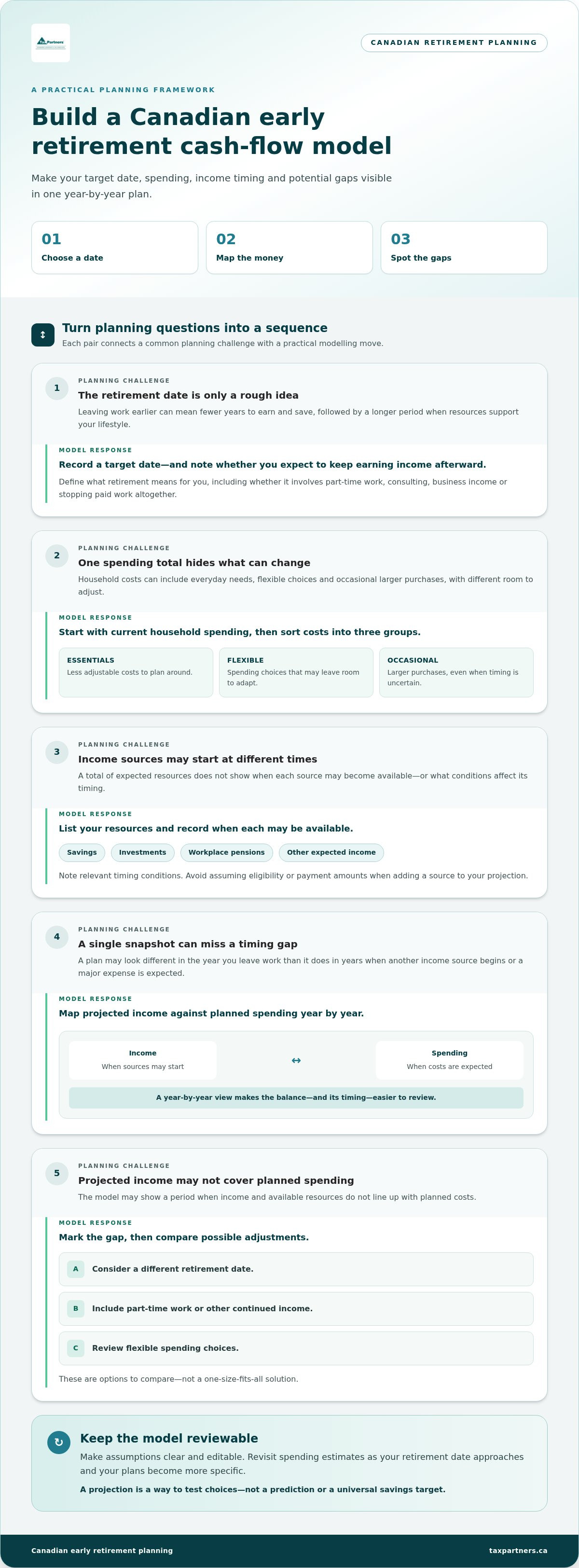
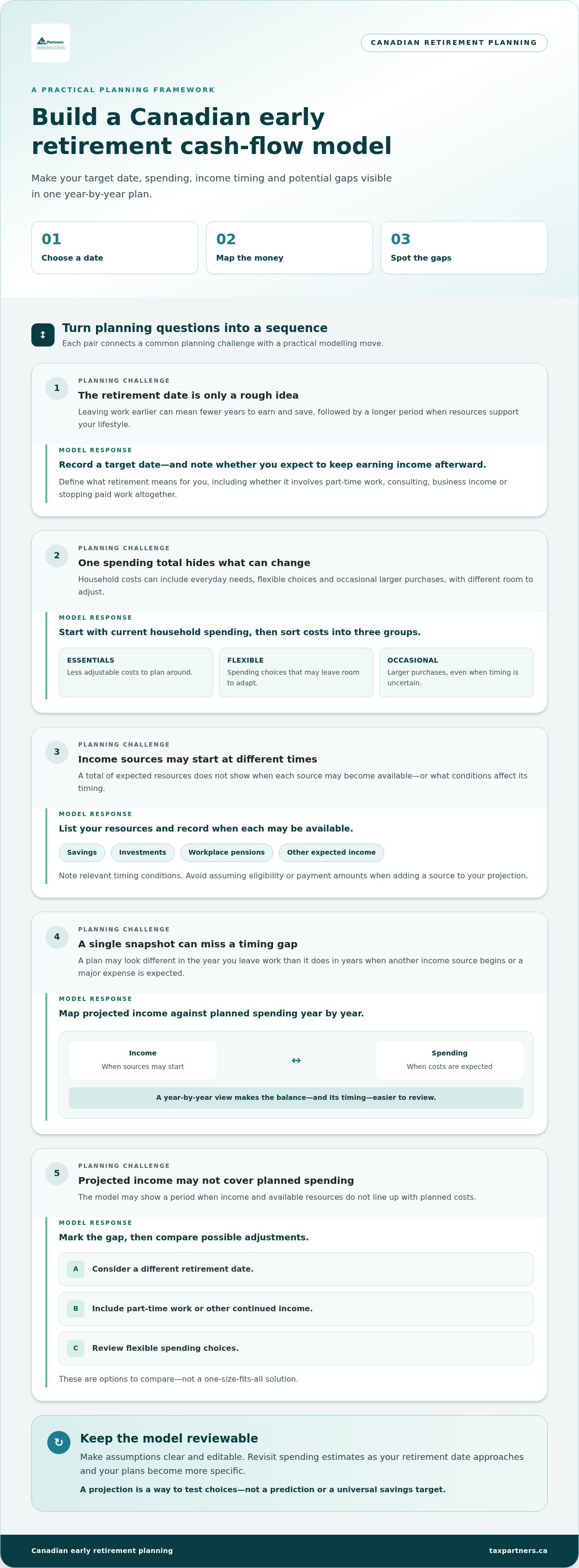
A retirement cash-flow model compares projected income with planned spending. For early retirement, it should show how that balance changes over time, not just whether resources appear sufficient in the year you leave work.
Use a year-by-year view to make timing visible. It can reveal years when employment income ends before another source begins, or when a planned expense may require more savings. Keep assumptions clear and editable rather than relying on a fixed savings target or assumed investment return.
Estimate spending after leaving work
Start with your current household spending, then consider what may change when work ends. Include housing, everyday expenses, travel goals and irregular costs, even if their amounts or timing are uncertain.
Separate essential expenses from flexible spending and occasional major purchases. This makes it easier to identify less adjustable costs and see where you may have room to adapt. Revisit your estimates as your retirement date approaches and your plans become more specific.
Map Canadian income and resources across time
List the resources you expect to draw on, such as workplace pensions, savings, investments and other income sources. For each one, note when it may become available and any conditions that affect its timing, without assuming eligibility or payment amounts.
For an overview of public pension programs in Canada, consult the Government of Canada’s Canadian Public Pensions information. Add expected income to your projection only after considering how its timing fits your circumstances.
Build the model in a sequence you can review and update:
- Choose a target date. Record when you hope to leave full-time work, and note whether you expect to keep earning income afterward.
- Estimate spending. Group costs into essentials, flexible choices and occasional larger purchases. Consider which expenses may change over time.
- List your resources. Record savings, investments, workplace pension income and other expected sources, along with when each may be available.
- Map income against spending. Lay out the expected timing year by year, so you can see how resources may need to support planned costs.
- Identify gaps. Mark periods when projected income may not cover spending, then consider whether timing, work plans or flexible expenses could change.
For example, your projection might show a gap between leaving work and the start of a later income source. You can then compare options such as part-time work, a different retirement date or changes to flexible spending, without assuming one solution will suit every household.
Building a financial plan for early retirement becomes more practical when the model reflects your household’s priorities and timing. A tailored review can connect those assumptions with Canadian financial and tax planning. As you refine your projection, discuss your retirement planning questions.
Compare Canadian account and income choices before leaving work
Account labels matter, but so does when you expect to use the money. Under CRA rules in Canada, the tax treatment of a withdrawal can affect how much income is available to spend, so compare each resource in the context of your wider retirement timeline.
Tax-deferred means tax is generally postponed until money is withdrawn, rather than eliminated. Tax-free describes income or withdrawals that generally aren’t included in taxable income when applicable CRA rules are met. These terms help frame the comparison, but they don’t replace a review of your individual circumstances.
Compare RRSP and TFSA roles in a Canadian plan
A Registered Retirement Savings Plan (RRSP) may suit long-term saving when a contribution deduction and later taxable withdrawals fit your circumstances. A Tax-Free Savings Account (TFSA) doesn’t provide a deduction for contributions, while qualifying investment growth and withdrawals are generally tax-free under CRA rules.
Compare how your current income, expected income after work and planned withdrawal dates may affect each account’s role. A Canadian tax planning overview can provide related context as you consider your options.
| Resource | Planning questions to consider |
|---|---|
| RRSP | How might the timing and taxable treatment of future withdrawals fit with your other income? |
| TFSA | Could access to funds without generally adding taxable income under CRA rules support flexibility in your plan? |
| Workplace pension | What choices, start dates and payment details apply to your specific plan? |
| Taxable investments | What types of investment income might arise, and how could their CRA tax treatment affect cash available to spend? |
Coordinate pensions and government income
Include workplace pension income, the Canada Pension Plan (CPP) and Old Age Security (OAS) in your inventory of potential resources. Their start dates, eligibility and payment amounts depend on individual circumstances and current Canadian rules, so don’t build your projection around an assumed amount.
Review current CPP and OAS details with the relevant Government of Canada source, and compare workplace pension information with your own plan documents. This helps distinguish income that may be available at your chosen retirement date from income that could begin later.
Then compare how different withdrawal timings interact with pension income and planned spending. A year with pension payments and investment withdrawals may look different from a year when savings must cover most expenses. The right sequence depends on your circumstances; there isn’t one order that suits every Canadian household.
Building a financial plan for early retirement means coordinating these choices rather than assessing each account in isolation. A tailored review can connect account use, income timing and Canadian tax considerations. Discuss your retirement income and account strategy with Tax Partners.
Stress-test your early retirement plan against uncertainty
A plan can look workable under one set of assumptions and feel very different if spending rises, investment performance is weaker than expected or your work-exit date changes. Scenario testing helps show where the pressure points are and what choices you might have. It can’t guarantee a particular outcome, but it can make uncertainty easier to discuss and plan around.
Test one change at a time before combining several. That way, you can see which assumption affects the timeline most and whether the plan depends heavily on a single income source or a narrow spending estimate.
Test changes that could alter the timeline
Model a later work-exit date, higher expenses and lower-than-expected income as separate scenarios. Also consider a temporary interruption to household income, such as paid work stopping earlier than planned. Avoid assigning probabilities or invented dollar impacts. Focus on how each change affects your projected resources and the timing of your choices.
Include health needs among the factors you test, without assuming what care will cost or how your needs may change. Review whether a scenario creates a shortfall, delays a goal or leaves less room for unexpected expenses. Then note what could respond: the retirement date, work plans, flexible spending or how you use available resources.
- Expense change: Consider how higher everyday or occasional costs could affect the plan.
- Investment change: Test weaker-than-expected performance without relying on a single return assumption.
- Timing change: Compare leaving work later or having income stop sooner than planned.
- Health change: Consider how new or changing needs could affect spending and flexibility.
These scenarios aren’t predictions. They’re a way to identify which assumptions deserve attention before you rely on them to support an early retirement decision.
Build flexibility into the plan
Separate essential expenses from discretionary choices, such as travel or optional projects, and identify which flexible costs you could adjust if circumstances change. You might also compare a phased transition that includes some paid work with stopping work entirely, or test a revised retirement date to see how it changes the plan.
Keep the adjustments realistic. Flexibility is useful only if the options fit your priorities and circumstances, so record which changes you’d genuinely consider and which goals you want to protect.
Building a financial plan for early retirement is more resilient when it includes clear assumptions and practical alternatives, not just a preferred outcome. Tax Partners’ wealth management planning service can help connect your scenarios with your financial priorities. Discuss a tailored early retirement plan with the team.
Turn your Canadian early retirement plan into a reviewable action plan
A useful plan should be clear enough to guide decisions and flexible enough to change as your life does. Bring your choices together in one working document, so you can see how your target date, spending, income sources, account strategy and tested scenarios fit together.
Keep it practical. A short record of decisions and open questions can make your next review more focused than a collection of disconnected estimates.
Create a concise plan you can update
Record your retirement goal and the assumptions behind it, including expected spending, the timing of income sources, how you may use accounts and which scenarios you’ve tested. Note what you still need to resolve, such as a pension start-date question or an expense that’s difficult to estimate.
Choose a review rhythm that suits your circumstances rather than relying on a universal schedule. Revisit the plan when a change in work, family priorities, health, spending or finances could affect its assumptions.
- Goal: Your intended work-exit date and what retirement means to you.
- Spending: Essential costs, flexible priorities and occasional expenses.
- Income: Expected sources, when they may begin and what remains uncertain.
- Accounts: How you currently expect to use savings and investments.
- Scenarios: The changes you tested and the options you’d consider if the plan comes under pressure.
Mark assumptions that depend on current public-program details. Verify relevant eligibility, start dates and payment information with the appropriate Canadian government source, such as the Canada Revenue Agency (CRA) or Service Canada. Your projection is a planning tool, while program rules and your personal details determine what income may actually be available.
Bring tax and financial planning together
Canadian tax planning can help you examine how retirement income and account use interact, rather than treating each withdrawal as an isolated choice. The timing and source of income may affect the tax picture for a particular year, so your plan should reflect applicable CRA rules and your circumstances.
Tax Partners provides Canadian tax planning, wealth management, accounting and advisory services. Bringing those considerations together can help you assess your assumptions and clarify the questions that need attention, without promising a particular result.
Building a financial plan for early retirement is an ongoing process, not a one-time calculation. Keep your decisions documented, update them as circumstances change and use professional guidance when you want a more tailored review.
To discuss your retirement goals and Canadian tax considerations, book a free initial consultation with Tax Partners.
Take the next step with a plan built around you
Your retirement plan should be a working guide, not a promise that life will follow a fixed path. As your priorities and circumstances evolve, revisit your assumptions and make informed adjustments. Building a financial plan for early retirement is ultimately about creating more clarity around the choices ahead.
Canadian tax and wealth planning can help connect your goals with the income and accounts you expect to rely on. Tax Partners offers 40+ years of trusted service, with Tax Returns Filed 495,000+ and Tax Dollars Saved 87M+.
Start a conversation about the questions that matter to you. Book a free initial consultation to discuss your Canadian early retirement plan and take a considered step towards your next chapter.
Frequently Asked Questions
Can I retire early in Canada if I still have a mortgage?
Yes, you can include a mortgage in an early retirement plan, but its payments need to fit alongside your other household costs and expected income. Compare the remaining payment schedule with your target work-exit date, and account for related housing expenses such as property taxes, utilities and maintenance. Consider how your plan would change if you kept the mortgage or paid it down, without assuming either choice is right for everyone.
What happens to my workplace health and dental benefits when I retire early?
Your workplace benefits may change or end when you leave your job, depending on the employer plan and your circumstances. Before setting your retirement date, review the plan documents and ask your employer how coverage is handled after employment ends, including any options, timing or costs that apply to you. Then account for potential out-of-pocket health and dental expenses in your Canadian retirement budget rather than assuming workplace coverage will continue.
Can I keep working part-time after I retire early in Canada?
Yes. Part-time work can provide income, maintain a professional connection or make the transition from full-time employment more gradual. Add realistic earnings and related expenses to your projection, and consider whether the work is dependable or seasonal. In Canada, employment or self-employment income can affect your taxable income under CRA rules, so include its potential tax impact when estimating how much may be available for spending.
Is early retirement planning different if I am self-employed in Canada?
It can be, because your personal retirement resources may be connected to business income and ongoing operating needs. Separate household funds from money needed for business expenses, taxes and cash-flow interruptions, and avoid treating a strong revenue period as guaranteed future income. If you expect to reduce or stop working, consider how the change could affect both your business finances and personal plan, then include the Canadian tax implications in your planning.
Can my spouse and I retire at different times and still plan together?
Yes. Build a household plan that reflects each person’s expected work-exit date, income and expenses during the transition. For example, one spouse may continue working while the other begins drawing on personal resources, which can change household cash flow and tax considerations under CRA rules. Discuss which expenses and goals you share, and which remain individual, so the plan reflects both partners’ needs rather than assuming they retire together.
What should I consider before selling a business to fund early retirement in Canada?
Before relying on a sale to fund retirement, consider how the business’s value, sale timing and net proceeds fit your plan. Sale proceeds are not necessarily the same as spendable funds: transaction costs, outstanding obligations and Canadian tax treatment may affect what remains. Model a scenario where the sale takes longer than expected or doesn’t proceed, and include a Canadian tax and financial review before making retirement decisions that depend on the proceeds.
Can I change my retirement date after I have started following a financial plan?
Yes. A retirement date is an assumption to review, not a commitment that your circumstances can’t change. If you move it earlier or later, update the years of employment income, savings contributions, spending and any income sources tied to timing. Also revisit tax assumptions under CRA rules and check current government-program details with the relevant Canadian authority before relying on revised start dates or payment estimates.

Article by
Mahad Mohamed
Mahad Mohamed is an accountant and the CEO of Tax Partners, with over 26+ years of Canadian and international tax and accounting experience. His expertise includes corporate reorganization, cross-border tax structuring (Canada & US), tax disputes, CRA audits, and tax planning for small owner-managed private corporations. Most recently, Mahad is a pioneer in Canadian crypto taxation and founded Block3 Finance.
Previously, Mahad worked for the Canada Revenue Agency (CRA), Big4 accounting firms, and served as a Rulings Officer for the Federal Tax Authority of the UAE before acquiring Tax Partners in 2014.
Tax Partners has 44 full-time accountants and over 18,400+ clients.
Disclaimer
This article provides general information only and is current as of its publication date. It has not been updated and may be out of date. It does not constitute legal advice and should not be relied upon as such. Every tax situation is unique and may differ from the examples discussed in this article. If you have specific questions, you should seek the advice of our accountants for your unique circumstances. Book a FREE Initial Consultation Today!
Frequently Asked Questions
Can I retire early in Canada if I still have a mortgage?
Yes, you can include a mortgage in an early retirement plan, but its payments need to fit alongside your other household costs and expected income. Compare the remaining payment schedule with your target work-exit date, and account for related housing expenses such as property taxes, utilities and maintenance. Consider how your plan would change if you kept the mortgage or paid it down, without assuming either choice is right for everyone.
What happens to my workplace health and dental benefits when I retire early?
Your workplace benefits may change or end when you leave your job, depending on the employer plan and your circumstances. Before setting your retirement date, review the plan documents and ask your employer how coverage is handled after employment ends, including any options, timing or costs that apply to you. Then account for potential out-of-pocket health and dental expenses in your Canadian retirement budget rather than assuming workplace coverage will continue.
Can I keep working part-time after I retire early in Canada?
Yes. Part-time work can provide income, maintain a professional connection or make the transition from full-time employment more gradual. Add realistic earnings and related expenses to your projection, and consider whether the work is dependable or seasonal. In Canada, employment or self-employment income can affect your taxable income under CRA rules, so include its potential tax impact when estimating how much may be available for spending.
Is early retirement planning different if I am self-employed in Canada?
It can be, because your personal retirement resources may be connected to business income and ongoing operating needs. Separate household funds from money needed for business expenses, taxes and cash-flow interruptions, and avoid treating a strong revenue period as guaranteed future income. If you expect to reduce or stop working, consider how the change could affect both your business finances and personal plan, then include the Canadian tax implications in your planning.
Can my spouse and I retire at different times and still plan together?
Yes. Build a household plan that reflects each person’s expected work-exit date, income and expenses during the transition. For example, one spouse may continue working while the other begins drawing on personal resources, which can change household cash flow and tax considerations under CRA rules. Discuss which expenses and goals you share, and which remain individual, so the plan reflects both partners’ needs rather than assuming they retire together.
What should I consider before selling a business to fund early retirement in Canada?
Before relying on a sale to fund retirement, consider how the business’s value, sale timing and net proceeds fit your plan. Sale proceeds are not necessarily the same as spendable funds: transaction costs, outstanding obligations and Canadian tax treatment may affect what remains. Model a scenario where the sale takes longer than expected or doesn’t proceed, and include a Canadian tax and financial review before making retirement decisions that depend on the proceeds.
Can I change my retirement date after I have started following a financial plan?
Yes. A retirement date is an assumption to review, not a commitment that your circumstances can’t change. If you move it earlier or later, update the years of employment income, savings contributions, spending and any income sources tied to timing. Also revisit tax assumptions under CRA rules and check current government-program details with the relevant Canadian authority before relying on revised start dates or payment estimates.